
What make-good actually costs industrial tenants in the GTA
By Michael Law · Industrial Real Estate Broker, Lennard Commercial Realty
Make-good exposure for a typical GTA industrial tenant runs from a thorough cleaning and patching job worth a few thousand dollars to a six-figure liability involving HVAC replacement, racking removal, and environmental screening. The number depends entirely on what your lease says, not on what seems fair. Fixture removal, cleaning, and minor repairs are almost always the tenant’s responsibility. Major capital replacements, like a full roof membrane or rooftop units, only land on your side of the ledger if the lease explicitly says so, or if you damaged them.
If you’re within 12 months of lease expiry, do four things now:
- Pull the lease and flag every restoration, surrender, and reinstatement clause
- Compare current condition against your move-in condition report, if one exists
- Book a joint inspection with the landlord or produce your own dated photo inventory
- Get one contractor quote for obvious deferred items before you negotiate anything
Michael Law | Lennard Commercial offers a complimentary lease clause review for GTA occupiers trying to size this liability before it becomes a year-end surprise.
Key Takeaways
Make-good liability in Ontario is defined entirely by lease wording, and tenants who document condition early and negotiate restoration terms before renewal consistently pay less than those who wait until expiry.
| Point | Details |
|---|---|
| Lease wording controls everything | Baseline condition and reinstatement clauses determine your exact obligations; courts interpret ambiguity contextually. |
| Documentation is your best defence | A signed joint inspection or dated photo inventory at move-in and move-out protects against disputed claims. |
| Budget with contingency | Add 15% on top of contractor quotes for concrete, mechanical, and environmental line items. |
| Negotiate amortization early | Push for tenant-share-by-useful-life language on HVAC and roof items at renewal, not at expiry. |
| Get expert lease-end representation | Michael Law |
Table of Contents
- What decides who pays: lease language, legal interpretation, and common clause types
- Cost components tenants should budget for and how to scope them
- How to quantify liability: timeline, documentation and vendor costing
- Negotiation levers and lease language edits that limit make-good exposure
- End-of-lease checklist for GTA industrial tenants
- Broker perspective: how Michael Law approaches make-good exposure
- The step-by-step timeline from lease termination to completed make-good
- Ontario regulations and standards affecting make-good obligations
- Common disputes and litigation examples in Ontario industrial make-good
- Typical cost ranges by facility size and type
- Local market context and budgeting guidance for GTA occupiers
- Why the standard make-good advice sells GTA tenants short
- How Michael Law can help with lease-end and make-good planning
- Sources
- FAQ
What decides who pays: lease language, legal interpretation, and common clause types
The lease decides everything. Ontario courts interpret restoration obligations contextually, and where a lease is silent on reinstatement, there may be no restoration obligation at all, according to commentary from McMillan LLP. That single fact should change how you read your own document. Two tenants in identical warehouses down the street from each other can face wildly different exit bills purely because of how their leases were drafted a decade earlier.
Two concepts matter most:
- Baseline condition clauses require you to return the space in the condition it was in at commencement, normal wear and tear excepted.
- Reinstatement clauses go further, requiring removal of tenant improvements, trade fixtures, and sometimes a return to “base building” shell condition.
Courts tend to place the burden on the landlord to prove a tenant caused disrepair, and Mondaq’s legal commentary notes landlords recover cleaning and housekeeping costs far more easily than capital replacement costs, where the evidentiary link to tenant conduct is weaker. Watch for phrases like “good order and condition,” “broom-swept,” “as built,” and “at tenant’s sole cost and expense.” Each carries different legal weight.
The categories that generate the most disputes in industrial space are predictable: HVAC and rooftop units, roof membrane condition, dock levellers and pit equipment, and anything framed as a capital improvement rather than routine maintenance.
Cost components tenants should budget for and how to scope them
Most make-good bills break into a handful of recurring items, and knowing which ones apply to your space lets you build a realistic number before a contractor ever walks through the door.
- Trade fixture removal and disposal — racking, mezzanines, conveyor systems, compressed air lines, and specialty electrical.
- Cleaning and janitorial — degreasing floors, pressure washing, and removing signage residue.
- Concrete patching and floor repair — anchor bolt holes, trench drains cut for equipment, and slab damage from forklift traffic.
- Painting and drywall — office and mezzanine areas typically need a full refresh.
- Minor carpentry and partition removal — demising walls, built-in offices, and mezzanine guardrails.
- Mechanical servicing versus replacement — a serviced rooftop unit costs a fraction of a replaced one, and the lease language usually determines which applies.
- Environmental screening — required when your operations involved fuel storage, chemical handling, vehicle maintenance, or manufacturing processes with any spill risk.
Concrete and mechanical work routinely uncovers hidden conditions once demolition starts, and quotes rarely account for surprises behind a wall or under a slab.
Pro Tip: Sort your make-good list into two columns: items the landlord will insist on before you hand back keys, and items they’ll likely accept as a post-surrender credit or holdback deduction. Tackling the first column early protects your timeline; the second column is often negotiable.
How to quantify liability: timeline, documentation and vendor costing
Large industrial facilities need a longer runway than most tenants assume. Start scoping your exposure 6 to 12 months before expiry, not 60 days out, especially if your space exceeds 50,000 square feet or involves specialized mechanical systems.
- Assemble your paper trail. Pull the original lease, any move-in condition report, fit-out drawings, and permit approvals from your buildout.
- Document current condition. A joint inspection with the landlord, or at minimum a dated photographic inventory, is the single strongest piece of evidence in a dispute, according to Real Estate Magazine’s commentary on tenant inducements.
- Order an environmental screen if your operations touched fuel, solvents, or industrial chemicals, even informally.
- Get 2 to 3 itemized contractor quotes before accepting the landlord’s number. A specific quote turns a vague restoration demand into a measurable, negotiable figure.
- Have counsel review the landlord’s demand letter before you write a cheque or authorize work.
Courts have refused to let landlords use restoration clauses to obtain upgrades beyond a tenant’s original condition, as seen in the C. & M. Holdings Ltd. v Tiffany Gate Ltd. line of cases cited by McMillan LLP. That precedent is your leverage if a landlord tries to bill you for a building-wide upgrade dressed up as restoration.
Negotiation levers and lease language edits that limit make-good exposure
Most make-good exposure gets locked in years before expiry, at the point a lease is signed or renewed, which is exactly why renewal negotiations deserve as much attention as the broader lease terms most tenants focus on.
- Push for amortization language on capital items like HVAC and roof membranes, so you pay only for the portion of useful life you consumed, not full replacement cost.
- Negotiate carveouts for anything the landlord installed or approved, and get precise definitions for “ordinary wear and tear” and “broom-swept condition” written into the lease itself.
- Cap landlord recovery for specific categories, or propose a lump-sum settlement in exchange for a full waiver of future restoration claims.
- Use your tenant improvement allowance strategically. A $5 to $25 per square foot TIA, depending on term length and building condition, can be structured to offset future reinstatement costs rather than just funding day-one buildout.
End-of-lease checklist for GTA industrial tenants
- 12 months out: Review the lease, calendar every critical date, and identify restoration clauses.
- 9 months out: Schedule a joint or independent condition inspection.
- 6 months out: Order contractor quotes and, if needed, an environmental screen.
- 3 to 4 months out: Coordinate removal and repair work with your moving logistics to avoid overholding into a new occupancy.
- 30 days out: Confirm deposit or holdback arrangements in writing.
- Move-out day: Complete a signed condition report with the landlord before handing back keys.
Missing that final signed report is one of the most common ways tenants lose leverage in a later dispute over what was actually left behind.
Broker perspective: how Michael Law approaches make-good exposure
Michael Law typically starts by quantifying exposure in dollar ranges early enough that a CFO can budget a reserve, not react to a surprise invoice.
- Reads the lease line by line for reinstatement triggers before any contractor is engaged
- Sequences legal review ahead of vendor costing so negotiation leverage isn’t given away
- Packages the exposure estimate as a reserve figure operations leadership can plan around
- Pursues amortization, carveouts, or lump-sum settlements as the default negotiation posture
The biggest mistake tenants make is treating make-good as a moving-day problem instead of a lease-signing problem. By the time you’re reading the surrender clause for the first time in the final year, most of your leverage is already gone.
Occupiers can review Michael Law’s background and transaction history on his Lennard Commercial profile.
The step-by-step timeline from lease termination to completed make-good
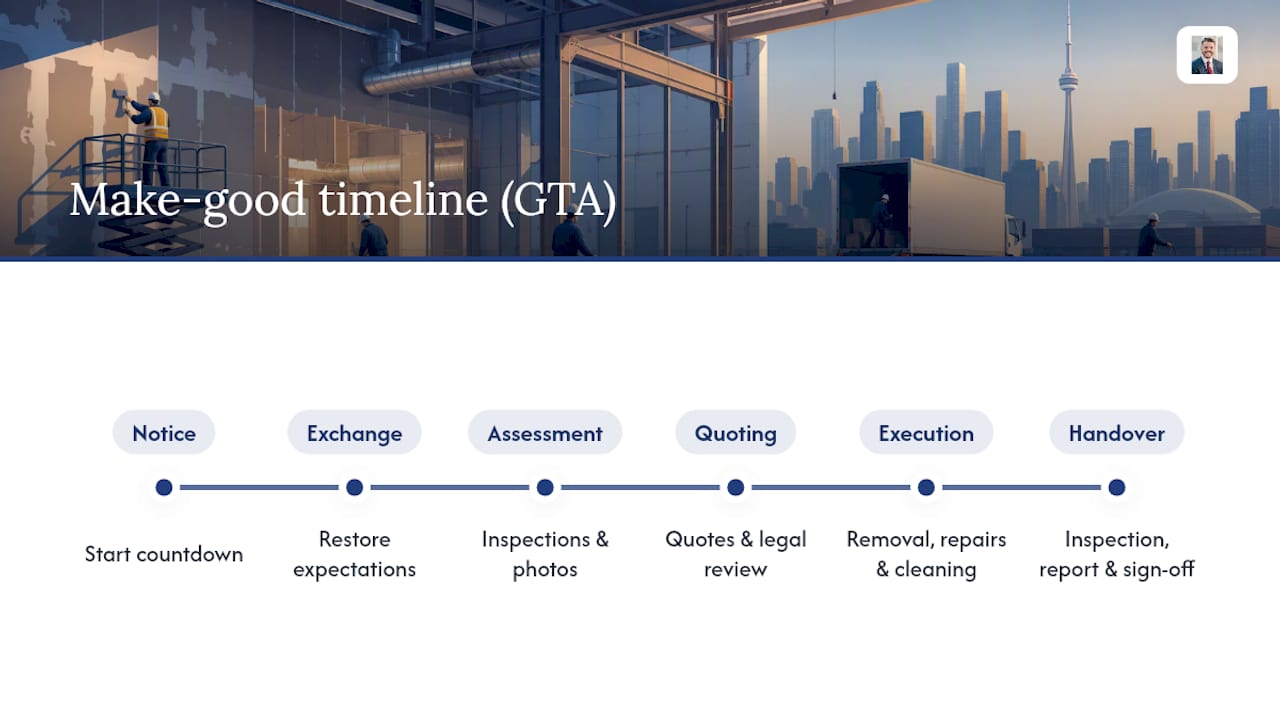
The process rarely runs on a single clean timeline, but a predictable sequence applies to most GTA industrial surrenders. It starts with the termination or non-renewal notice, which triggers the countdown clock. Within the following weeks, both parties typically exchange correspondence about restoration expectations, and this is where ambiguous lease language starts causing friction if it wasn’t clarified earlier.
Next comes the condition assessment phase: inspections, photo documentation, and contractor walkthroughs, usually spanning several weeks depending on facility size. Quoting follows, often running in parallel with legal review of the landlord’s specific demands. Work execution, fixture removal, patching, cleaning, and any mechanical servicing, is scheduled to finish before or right at the surrender date, since remaining on site past expiry can trigger overholding rent under some leases.
The final stage is the handover inspection and sign-off. This is the step tenants most often skip or rush, and it’s the one that protects you if the landlord later claims damage that existed before you vacated. A signed, dated condition report at handover closes the loop and starts the clock on any deposit release. For larger facilities, this entire sequence, from notice to signed handover, commonly spans four to nine months, which is why early planning matters more than late execution.
Ontario regulations and standards affecting make-good obligations
Make-good in Ontario is governed primarily by contract law and the wording of the Commercial Tenancies Act, rather than a prescriptive regulatory checklist. There is no government-mandated make-good standard the way there is for residential tenancies. That absence of a fixed standard is precisely why lease drafting carries so much weight, and why courts default to interpreting the parties’ own contractual language.
Where regulation does intersect with make-good, it’s usually environmental. If a tenant’s operations involved fuel storage, industrial chemicals, or activities regulated under Ontario’s environmental protection framework, remediation obligations can exist independent of the lease, layered on top of whatever the restoration clause says. A tenant who assumes a clean lease exit also means a clean environmental exit is making a risky assumption.

Building code and permit requirements can also surface during make-good, particularly when a tenant is removing structural elements like mezzanines or altering fire separations installed during their buildout. Removal work sometimes requires its own permit and inspection sign-off, which adds time most tenants don’t budget for. None of this is unique to industrial leases, but industrial buildouts tend to involve more structural and mechanical alteration than office space, so the exposure shows up more often.
Common disputes and litigation examples in Ontario industrial make-good
Disputes cluster around a small number of recurring fact patterns. The most common is a landlord attempting to recover the full cost of a capital replacement, a roof or rooftop HVAC system, when the equipment was already near the end of its useful life before the tenant ever occupied the space. Courts have pushed back on this repeatedly, refusing to let restoration clauses function as a vehicle for building-wide upgrades, as seen in the C. & M. Holdings Ltd. v Tiffany Gate Ltd. line of authority discussed by McMillan LLP.
A second common dispute involves ambiguous lease wording. When a lease is silent or vague on reinstatement, landlords sometimes assert a broad obligation that the tenant never actually agreed to, and litigation often turns on which party can produce better documentation of the original condition. This is precisely why a signed move-in inspection report is worth more than any argument made after the fact.
A third pattern involves overholding claims layered on top of restoration disputes. A tenant who stays on site past lease expiry to complete make-good work, without a clear written agreement on rent during that period, can face a deemed overholding rate that turns a manageable repair bill into a much larger one. Mondaq’s analysis flags this exact scenario as a recurring source of tenant financial exposure, and it’s avoidable with a written extension agreement negotiated before the expiry date, not after.
Typical cost ranges by facility size and type
Make-good costs scale with square footage, but not in a straight line, because fixed cost items like inspections and legal review don’t shrink proportionally for smaller spaces.
A small flex industrial unit under 15,000 square feet with a modest office buildout typically sees make-good costs concentrated in cleaning, patching, and partition removal, with mechanical exposure limited unless the tenant installed dedicated HVAC. A mid-size distribution facility between 50,000 and 150,000 square feet introduces racking removal, dock equipment, and a higher likelihood of rooftop unit involvement, which is where amortization negotiations start to matter financially. Large distribution or manufacturing facilities above 200,000 square feet carry the widest range, driven by specialized mechanical systems, potential environmental screening, and the sheer scale of concrete and flooring work.
Rather than quoting a single number that won’t apply to your building, the more useful exercise is comparing your facility against these three categories to identify which cost components apply to you, then pricing those specific items with a contractor quote. A tenant in a small flex unit who assumes distribution-centre-scale exposure will over-reserve unnecessarily; a large manufacturing tenant who assumes flex-unit-scale exposure will be badly under-budgeted.
Local market context and budgeting guidance for GTA occupiers
Make-good decisions don’t happen in isolation from the broader leasing negotiation, and GTA market conditions directly affect how much leverage you have to push costs back onto the landlord. Net rent plus additional rent, or TMI, remains the standard way to evaluate occupancy costs across Mississauga, Brampton, Vaughan, and the broader GTA industrial market, and understanding where your total occupancy cost sits relative to the market gives you a sense of how much negotiating room exists at renewal or expiry.
Tenant improvement allowances in the GTA industrial market currently range from $5 to $25 per square foot depending on term length and building condition, according to WarehouseIndex’s 2026 leasing guide. That range matters for make-good planning specifically because a generous TIA negotiated at lease signing can be structured to partially offset reinstatement costs down the road, rather than being spent entirely on day-one buildout.
Tenants renewing in place, rather than relocating, often have the strongest position to renegotiate restoration terms, since landlords generally prefer avoiding vacancy and re-leasing costs over enforcing a strict make-good clause against a tenant willing to sign another term. If you’re weighing renewal against relocation, that calculation should include your make-good exposure on both sides of the comparison, not just base rent.
Why the standard make-good advice sells GTA tenants short
Most guidance on this topic treats make-good as a checklist problem: document condition, get quotes, negotiate. That’s necessary but incomplete. The research is clear that courts interpret restoration obligations through the specific wording of the lease, which means the checklist only works if someone actually read the lease critically years before expiry, not months before.
The conventional advice underestimates how much leverage tenants give away by treating restoration as a move-out task rather than a renewal-negotiation task. By the time most occupiers start worrying about make-good, the clause is already fixed, the amortization language was never requested, and the only remaining lever is documentation and dispute defence. That’s a weaker position than negotiating the clause itself.
If there’s one priority for GTA industrial tenants, it’s this: read your restoration clause the same week you sign a renewal, not the year before it expires. Everything else, the inspections, the quotes, the contingency budgeting, matters, but it’s damage control compared to shaping the clause while you still have negotiating power.
— Michael Law
How Michael Law can help with lease-end and make-good planning
Reading a restoration clause correctly, and negotiating it before you sign, is worth more than any contractor quote gathered after the fact. Michael Law | Lennard Commercial provides tenant representation across the GTA specifically built around this kind of lease-end exposure: lease clause review, make-good cost budgeting, contractor coordination, and direct negotiation with landlords on amortization, carveouts, and settlement terms.

If you’re an occupier in Mississauga, Brampton, Vaughan, Markham, or anywhere across the GTA facing a lease expiry within the next 12 months, the earlier a broker reads your restoration language, the more room there is to negotiate rather than react. Michael Law | Lennard Commercial’s industrial tenant representation service covers exactly this work, from initial clause review through final handover inspection. Request a complimentary lease clause review to get a clear dollar estimate of your make-good exposure before you’re negotiating from a weaker position.
Sources
- The cost of leaving: restoring premises at the end of a commercial lease - Mondaq
- The complete Ontario warehouse leasing guide (2026) | WarehouseIndex
FAQ
What is a make-good clause in an Ontario industrial lease?
A make-good, or restoration, clause defines a tenant’s obligation to repair, clean, or reinstate premises at lease end, and its exact scope depends entirely on the specific wording each landlord and tenant negotiated.
Who pays for HVAC replacement at industrial lease end?
It depends on lease wording; landlords more easily recover cleaning costs, but capital replacements like HVAC typically require proof the tenant caused the damage or specific lease language assigning that cost to the tenant.
How much does industrial make-good typically cost?
Costs vary widely by facility size and condition, ranging from a few thousand dollars for cleaning and patching in a small flex unit to six figures for large facilities with mechanical replacement or environmental remediation needs.
Can a landlord make me pay for building upgrades through a restoration clause?
Ontario courts have refused to let restoration clauses function as a way for landlords to obtain upgrades beyond the premises’ original condition, as shown in case law discussed by McMillan LLP.
When should I start planning for make-good obligations?
Start 6 to 12 months before lease expiry for large industrial facilities, and ideally negotiate restoration terms at renewal rather than waiting until the final year.
Can Michael Law | Lennard Commercial review my lease before I budget for make-good?
Yes, Michael Law | Lennard Commercial offers a complimentary lease clause review for GTA industrial tenants to help quantify make-good exposure and identify negotiation opportunities before expiry.
Recommended

About Michael Law
Managing Partner and Industrial Real Estate Broker at Lennard Commercial Realty. Representing tenants and landlords across Toronto and the GTA for 15+ years. Michael specializes in GTA industrial real estate — connect with Toronto's leading industrial broker at mlawrealestate.com/industrial-broker-toronto.
Related Articles

More Toronto Industrial Real Estate Insights
Common Questions
What is a sale-leaseback in industrial real estate?
A sale-leaseback is a transaction in which an industrial property owner sells their building to an investor and simultaneously signs a long-term lease to remain in the property as a tenant. The seller unlocks the capital tied up in their real estate while retaining full operational use of the facility. The buyer acquires a tenanted investment property with immediate cash flow from a known occupant.
Read →What is a dock-to-grade ratio in industrial real estate?
Dock-to-grade ratio in industrial real estate refers to the number of dock-level loading doors relative to the building's floor area, typically expressed as one dock door per X,000 square feet. It is a key specification for distribution and warehousing tenants because it determines how many trucks can load and unload simultaneously and therefore the building's throughput capacity.
Read →What is clear height in a warehouse or distribution centre?
Clear height in a warehouse or distribution centre refers to the usable vertical space from the finished floor to the lowest overhead obstruction — typically the bottom of the roof structure, sprinkler heads, or HVAC equipment. It is the single most important building specification for warehouse tenants because it determines how many racking levels can be installed and therefore how much product can be stored per square foot of floor space.
Read →