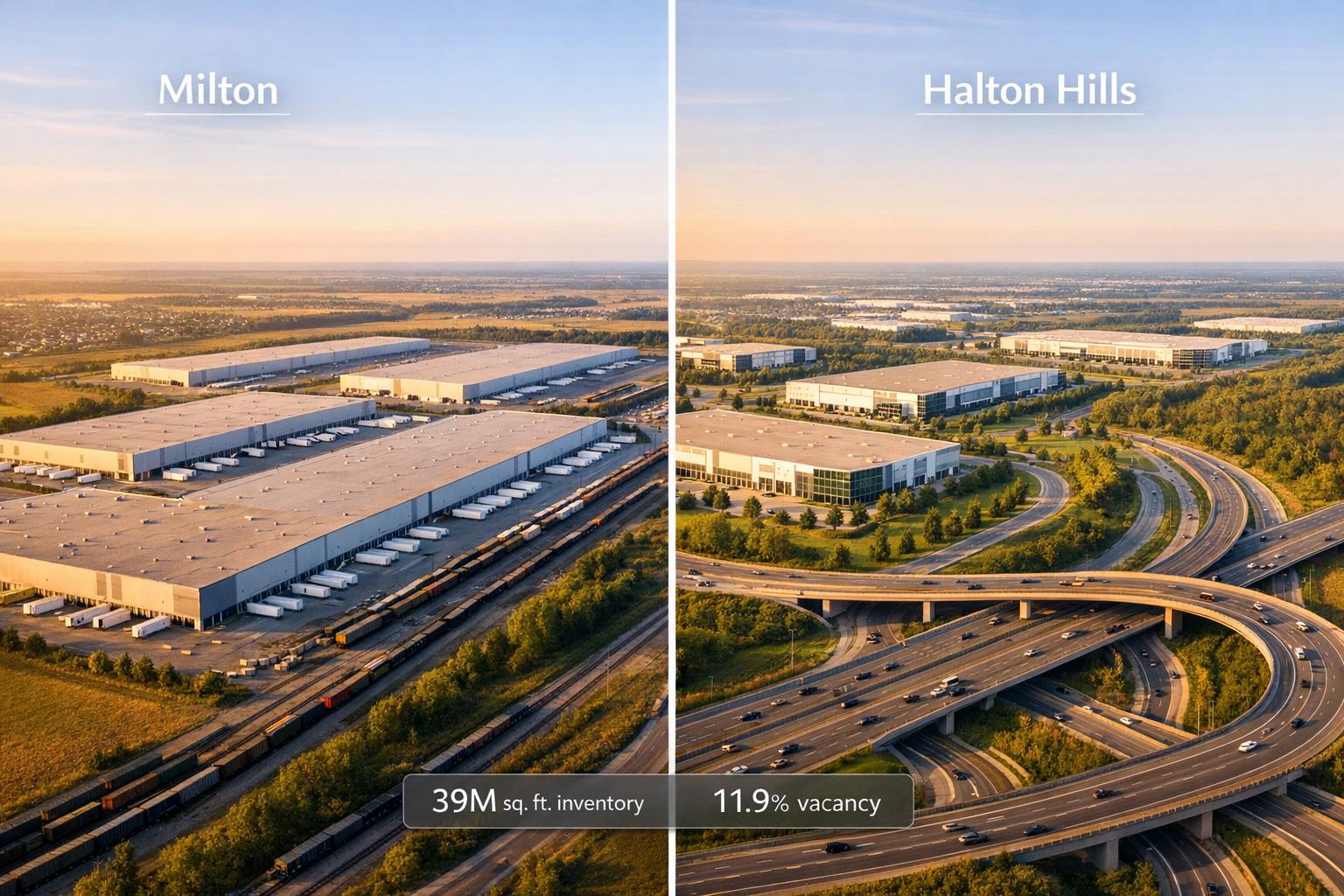
Milton vs Halton Hills Industrial
By Michael Law · Industrial Real Estate Broker, Lennard Commercial Realty
Compare Milton and Halton Hills industrial markets: 39M sq.ft., 11.9% vacancy—Milton for logistics/value, Halton Hills for prestige and highway access.

About Michael Law
Managing Partner and Industrial Real Estate Broker at Lennard Commercial Realty. Representing tenants and landlords across Toronto and the GTA for 15+ years. Michael specializes in GTA industrial real estate — connect with Toronto's leading industrial broker at mlawrealestate.com/industrial-broker-toronto.
Related Articles


More Milton Industrial Real Estate Insights
Common Questions
What is clear height in a warehouse or distribution centre?
Clear height in a warehouse or distribution centre refers to the usable vertical space from the finished floor to the lowest overhead obstruction — typically the bottom of the roof structure, sprinkler heads, or HVAC equipment. It is the single most important building specification for warehouse tenants because it determines how many racking levels can be installed and therefore how much product can be stored per square foot of floor space.
Read →What is a build-to-suit industrial lease?
A build-to-suit industrial lease is a transaction where a developer or landlord constructs a new industrial building specifically to a tenant's requirements — custom specifications, layout, clear height, dock configuration, and site features — in exchange for a long-term lease commitment from the tenant, typically 10 to 15 years. The tenant gets a purpose-built facility without the capital cost of ownership; the developer recovers their construction investment through the lease.
Read →What does triple net (NNN) mean in a commercial lease?
A triple net (NNN) lease means the tenant pays base rent plus three additional cost layers: property taxes, building insurance, and maintenance/operating costs. In GTA industrial real estate, virtually all leases are structured as triple net — the landlord collects a fixed net rent and passes all operating expenses through to the tenant, either as direct charges or as a proportionate share of the building's total operating costs. Understanding what is and is not included in the operating cost pool is one of the most important aspects of industrial lease negotiation.
Read →