
Stop Losing Allowances in the GTA: Offer to Lease vs Lease Agreement
By Michael Law · Industrial Real Estate Broker, Lennard Commercial Realty
An offer to lease can be legally binding in Canada, even though most tenants assume it’s just a starting point. If it lists the essential terms and shows both sides meant to be bound, courts will often treat it as an enforceable contract. Never sign one without legal and, for industrial space, broker review first.
TL;DR:
- An offer to lease becomes legally binding in Canada when it includes essential terms, shows clear intent, and parties act as if the deal is finalized, such as starting fit-out work or taking possession.
- Common pitfalls include loose merger clauses that erase negotiated promises and conducting costly activities before formal signing, which can unintentionally create enforceable agreements.
- Tenants should clearly specify in the offer if it is non-binding and include survival clauses for promises that must carry over into the final lease, especially in industrial deals.
- Provincial differences mainly affect procedural rules, with Quebec requiring explicit statements on whether the promise becomes the lease, while common law provinces follow similar legal tests focused on intent and essential terms.
- Early legal and broker review is crucial in tight markets, as landlords may insist on binding language and shorter conditional periods, and delays can weaken leverage significantly.
Table of Contents
- Offer to lease vs lease agreement: how they actually work in Canada
- What makes a lease agreement different
- The negotiator’s checklist: offer to lease vs lease agreement differences
- When does an offer to lease become legally binding in Canada?
- Drafting checklist: matching your paperwork to your intent
- Negotiation traps industrial tenants and landlords keep hitting
- After acceptance: drafting the lease and what happens if it stalls
- Do provinces enforce offers to lease differently?
- Michael Law’s quick take for GTA industrial tenants and landlords
- Sources
- FAQ
Offer to lease vs lease agreement: how they actually work in Canada
An offer to lease is the document that kicks off almost every commercial deal in Ontario. It’s a short form, usually a handful of pages, that pins down the deal points before anyone touches the full lease. Landlords like it because it moves fast, locks in a tenant, and lets both sides start planning fit-out or financing before lawyers draft anything longer.
A typical offer to lease covers:
- The parties, the premises, and a description of the space
- Term length, renewal options, and the proposed rent structure
- Basic covenants: use of premises, insurance expectations, repair responsibilities
- Conditions precedent: financing approval, zoning confirmation, landlord’s board sign off
You’ll see this document called an offer to lease, an agreement to lease, a promise to lease, or a letter of intent (LOI), depending on the firm and the province. In Ontario the terms “offer to lease” and “agreement to lease” get used almost interchangeably. In Quebec, provincial guidance treats the “promise to lease” as a distinct, formally recognized step, which matters if your portfolio crosses provinces.
What makes a lease agreement different
A lease agreement is the comprehensive contract that governs the tenancy once both parties execute it. It spells out insurance obligations, indemnities, default remedies, assignment and subletting rules, and dozens of clauses an offer never touches. Beyond the paperwork, a lease is also a legal interest in land, which is why some landlords register a notice of lease on title and why lenders often want to review or consent to it before advancing financing.
That legal status creates a real trap: a merger clause in the final lease can wipe out anything promised in the earlier offer unless you specifically preserve it. If your offer to lease included a landlord allowance or a free-rent period, make sure the lease repeats it.
The negotiator’s checklist: offer to lease vs lease agreement differences
Before you sign anything, run through these distinctions:
- Completeness. An offer usually covers only the essential terms; the lease fills in every operational and legal detail, from HVAC maintenance to holdover rent.
- Binding language. Courts look for explicit wording (“this offer is binding upon acceptance”) or conditional phrases (“subject to” a formal lease, “subject to” financing) that signal the opposite.
- Conduct after signing. Taking possession, starting build-out, or paying a deposit all point toward a binding deal, regardless of what the cover page says.
- Timing of key dates. Rent commencement, possession date, and the deadline to execute the formal lease should all be spelled out. Vague timing is where landlords lose leverage and tenants lose certainty.
- Exit points. Once you’ve accepted an offer with firm terms, renegotiating rent or term length becomes far harder than it was the day before you signed.
Common terms negotiated at the offer stage include the parties, term and renewal structure, base and additional rent under a net lease, repair obligations, security deposits, and personal guarantees, all of which carry forward into the final lease in expanded form.
When does an offer to lease become legally binding in Canada?
Canadian courts apply a fairly consistent test. An offer to lease can be enforceable when it contains the essential provisions, parties, premises, rent, commencement date, term, and material covenants, and when the parties objectively intended to be bound. “Objectively” is the key word: it’s not about what either side privately meant, it’s about what a reasonable reader would conclude from the wording and the behaviour that followed.
That’s why conduct matters as much as the contract language. Courts apply an objective test for intention to be bound, and tenant actions like starting fit-out work or taking possession strengthen the case that the offer was binding, even when the paperwork calls itself “subject to” a later lease. In cases like Northridge v Champion, courts have found binding agreements where essential elements were present and both sides acted as though the deal was done. If you take the keys and start demolition before the formal lease is signed, you’ve likely already agreed to something enforceable.

Drafting checklist: matching your paperwork to your intent
If you want an offer to stay non-binding, say so plainly. Add a clause stating the offer creates no obligation until a formal lease is executed, and avoid listing every material term, since a complete term set is itself evidence of intent to be bound according to commentary on offer to lease disputes.
If you want binding effect, or you need to preserve specific promises, build in:
- A survival clause naming which pre-lease commitments (tenant improvement allowances, completion dates, exclusivity terms) carry through to the final lease
- A firm deadline to negotiate and execute the formal lease, with a dispute mechanism if that deadline slips
- Deposit wording that states clearly whether it’s refundable and under what conditions
- Conditions precedent for title search, zoning confirmation, and environmental review, so the deal can unwind cleanly if something turns up
Quebec’s real estate regulator advises stating outright whether the offer becomes the lease or simply sets a timetable for one, which avoids a whole category of disputes before they start.
Negotiation traps industrial tenants and landlords keep hitting
Merger clauses cause more grief in industrial deals than almost anything else. If your offer promised a landlord allowance, a specific completion date for the shell, or exclusivity on outdoor storage, make sure the final lease repeats those terms word for word. A merger clause drafted loosely can quietly erase everything you negotiated at the offer stage.
The second trap is unintended binding commitments. Tenants sign what they think is a soft LOI, then start racking installation or hire contractors before the lease is signed. That conduct alone can convert a “non-binding” offer into an enforceable deal.
- Check every conditional clause before your team starts spending money on the space
- Confirm who signs off on zoning, environmental, and title matters, and by when
- Loop in a commercial lawyer and, for industrial space, a broker who negotiates GTA leases regularly before you accept anything with dollar figures attached
Pro Tip: Michael Law typically recommends adding a one-line survival clause to every offer to lease: “Sections X, Y, and Z shall survive execution of the formal lease and remain binding regardless of merger.” It costs nothing to include and it’s the single easiest way to stop a landlord allowance or completion date from vanishing once the final lease is signed.
After acceptance: drafting the lease and what happens if it stalls
Once an offer is accepted, the clock starts, and tenants should follow a clear commercial buildout guide outlining key phases to manage improvements and permits effectively. Expect a lease drafting window of a few weeks, a deadline to pull permits, a fit-out schedule, and a fixed possession date. FedDev Ontario’s guidance for occupiers recommends confirming zoning and permit requirements early, since delays here push every other date back.
If one side stalls on signing the formal lease, the other has options: negotiate an extension, pursue damages, or argue the offer itself is binding if it meets the essential elements test above. None of these are quick, which is exactly why a firm signing deadline in the original offer matters more than most tenants realize.
Do provinces enforce offers to lease differently?
The core legal test, essential terms plus objective intention to be bound, applies across common law Canada, so Ontario, Alberta, and British Columbia courts all ask roughly the same questions. What differs is procedural culture and regulatory framing, not the underlying contract law.
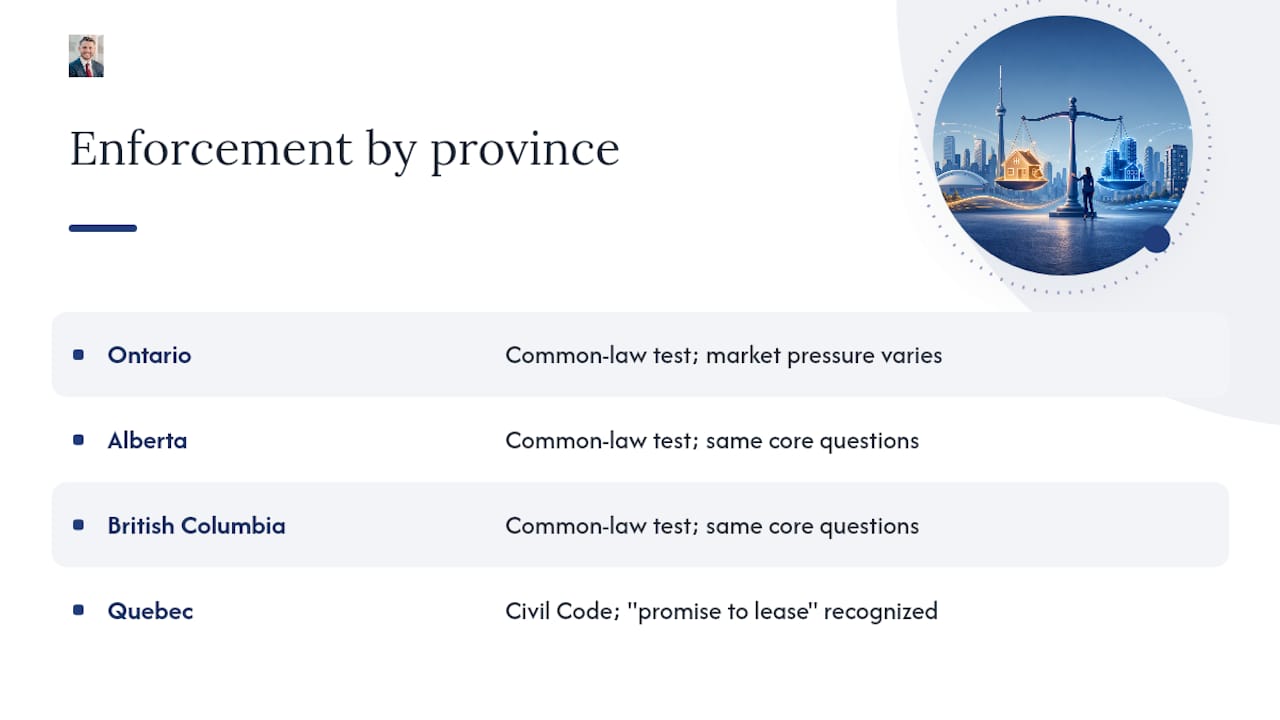
Quebec is the clearest outlier. It operates under the Civil Code rather than common law, and its real estate regulator formally recognizes the “promise to lease” as a distinct step with its own expectations. Quebec’s brokerage guidance pushes brokers to state explicitly whether the promise becomes the lease itself or simply sets a deadline to negotiate one. That’s a more prescriptive standard than most Ontario deals follow, where the same ambiguity gets left to case law and after-the-fact litigation.
Within Ontario, there’s no separate statute governing offers to lease differently by city. A deal in Brampton or Milton faces the identical legal test as one in North York. What changes practically is market pressure. In tight industrial submarkets like Vaughan or Milton, landlords receive multiple offers and can insist on binding language and shorter conditional periods, because they know another tenant is waiting. In softer suburban office markets, tenants sometimes negotiate longer conditional windows since landlords have less leverage.
The practical lesson for anyone leasing across provinces: never assume Ontario boilerplate works unmodified in Quebec, and never assume a lawyer who handles retail leases in Toronto has reviewed the specific case law your industrial deal in Barrie or Hamilton might trigger. Aird & Berlis’s commercial leasing guidance recommends starting title, zoning, and lender consent checks the moment the offer is signed, regardless of which province you’re in, since those issues rarely respect provincial boundaries once financing or registration gets involved.
Michael Law’s quick take for GTA industrial tenants and landlords
Call your lawyer before you sign the offer, not after, and bring your broker in at the same time if you’re touring industrial space in this market. Availability across Brampton, Milton, and Vaughan is tight enough that landlords can push binding language through fast, and tenants who wait to get advice often find they’ve already lost the leverage they needed. If you want a second opinion on a specific offer, Michael Law at Lennard Commercial reviews these deals regularly across the GTA industrial market.
Ready to negotiate your next industrial lease with the right terms in place from day one? Michael Law’s tenant representation team works exclusively for occupiers across Toronto, Mississauga, Brampton, and the wider GTA, and can review your offer to lease before you sign anything.
— Michael Law
Sources
FAQ
What is the difference between an offer to lease and a lease agreement?
An offer to lease is a short document setting out the essential deal terms, while a lease agreement is the full, comprehensive contract with detailed legal provisions that typically governs once both parties execute it.
What are the two main types of lease agreements?
Commercial leases are generally structured as gross leases, where the landlord covers most operating costs within a fixed rent, or net leases, where the tenant pays base rent plus a share of property taxes, insurance, and maintenance.
Is it better to own or lease industrial space?
It depends on capital availability, growth plans, and how long you expect to occupy the space; leasing preserves capital and flexibility, while ownership builds equity but ties up cash that could fund operations or expansion.
Is a lease offer legally binding?
It can be. An offer to lease is enforceable in Canada when it contains the essential terms and the parties objectively intended to be bound, regardless of whether a formal lease was ever signed afterward.
Recommended

About Michael Law
Managing Partner and Industrial Real Estate Broker at Lennard Commercial Realty. Representing tenants and landlords across Toronto and the GTA for 15+ years. Michael specializes in GTA industrial real estate — connect with Toronto's leading industrial broker at mlawrealestate.com/industrial-broker-toronto.
Related Articles

More Toronto Industrial Real Estate Insights
Common Questions
What is a sale-leaseback in industrial real estate?
A sale-leaseback is a transaction in which an industrial property owner sells their building to an investor and simultaneously signs a long-term lease to remain in the property as a tenant. The seller unlocks the capital tied up in their real estate while retaining full operational use of the facility. The buyer acquires a tenanted investment property with immediate cash flow from a known occupant.
Read →What is a dock-to-grade ratio in industrial real estate?
Dock-to-grade ratio in industrial real estate refers to the number of dock-level loading doors relative to the building's floor area, typically expressed as one dock door per X,000 square feet. It is a key specification for distribution and warehousing tenants because it determines how many trucks can load and unload simultaneously and therefore the building's throughput capacity.
Read →What is clear height in a warehouse or distribution centre?
Clear height in a warehouse or distribution centre refers to the usable vertical space from the finished floor to the lowest overhead obstruction — typically the bottom of the roof structure, sprinkler heads, or HVAC equipment. It is the single most important building specification for warehouse tenants because it determines how many racking levels can be installed and therefore how much product can be stored per square foot of floor space.
Read →