Act Now: Pickering Industrial Rents C$12 to C$18 PSF, Tenant Tactics
By Michael Law · Industrial Real Estate Broker, Lennard Commercial Realty
Pickering’s net industrial rents currently run $12 to $18 per square foot net, with newer logistics buildings pushing the top end. Availability is tightest under 50,000 square feet, so if your lease is up in the next 18 months, start your search or renewal conversation now rather than waiting for a renewal notice to force the timeline.
TL;DR:
- Availability for small bays under 50,000 square feet remains tight, leading to higher rents and less negotiating leverage for tenants renewing soon.
- Tenants should expect renewal rents to increase significantly compared to 2020-2021 levels, with slow market declines indicating a stabilized floor rather than further drops.
- Rent differences by bay size are substantial, with smaller spaces commanding higher rates due to scarce supply, especially near Highway 401 and major corridors.
- Additional costs such as taxes, insurance, and maintenance typically add $3 to $5 per square foot annually, making total occupancy costs around $18 per square foot in many cases.
- Starting renewal or relocation planning 9 to 18 months in advance is vital, with strong leverage for tenants who prepare market data and negotiate lease improvements early.
Table of Contents
- What are industrial lease rates in Pickering right now?
- Where can you find active industrial listings in Pickering?
- How do rents vary by bay size and building class in Pickering?
- What should you budget beyond the net rent?
- When should you start your renewal or relocation search?
- Michael Law’s practical perspective: tactical tips for Pickering tenants
- Where are Pickering rents headed next?
- What’s actually driving Pickering’s rent levels?
- How does Pickering compare to nearby GTA markets?
- Who pays for tenant improvements in Pickering leases?
- Editorial perspective
- How Michael Law | Lennard Commercial helps you secure the right space
- Sources
- FAQ
What are industrial lease rates in Pickering right now?
Net rents across Pickering’s industrial stock sit in the $12 to $18 per square foot range, with the spread driven almost entirely by building age, clear height, and how close a property sits to Highway 401. Older, lower-clearance buildings anchor the bottom of that band. Modern logistics-grade facilities with cross-dock configurations and taller clear heights push toward $18 and occasionally beyond, especially when they’re move-in ready.
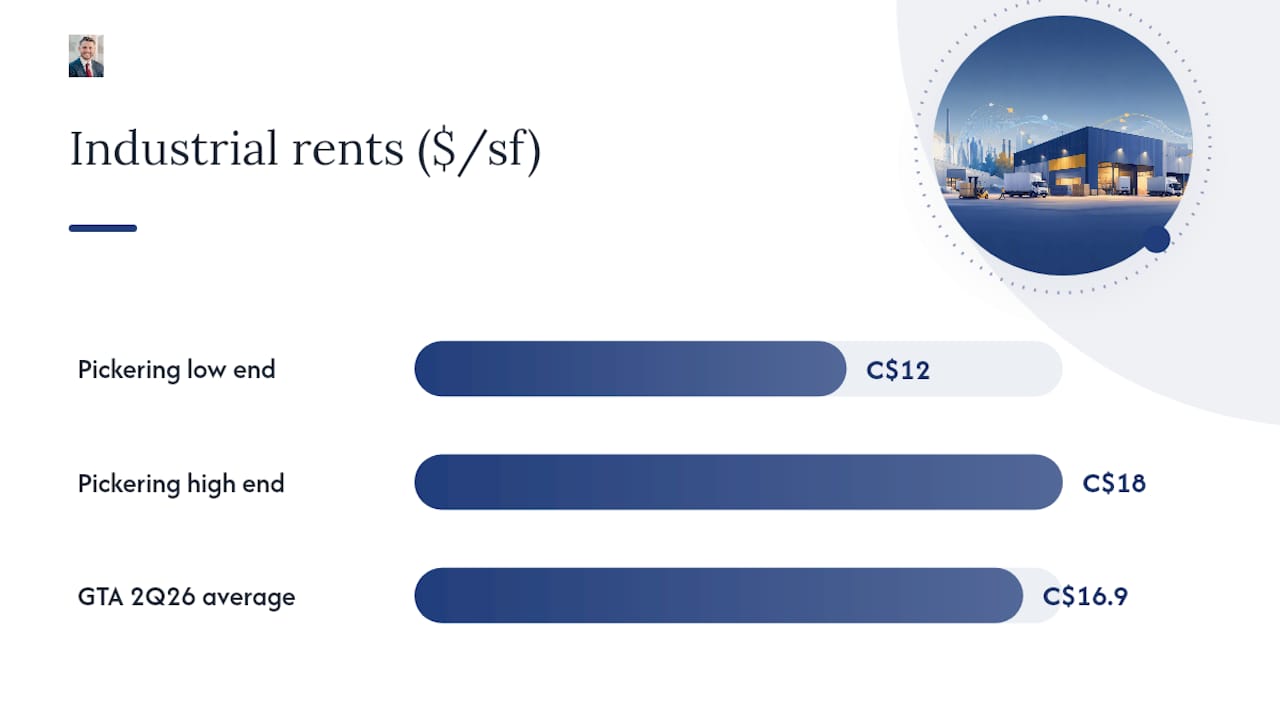
Durham Region’s broader vacancy and availability picture tightened through 2Q 2026, and asking rents have stabilized in the mid-teens per square foot after a stretch of softening. Regional context from Metro Toronto backs this up: GTA-wide asking rents landed around C$16.9 per square foot in 2Q26, with Durham showing early signs of stabilization and a construction pipeline running below its five-year average.
The clearest signal for tenants isn’t the headline rent. It’s where the squeeze actually sits:
- Small bays under 50,000 square feet are the most constrained segment in Durham Region, with limited options and landlords holding firmer on price.
- Renewals are resetting noticeably higher than the 2020 to 2021 cycle, so tenants comparing their current rent to a prior term should expect a real jump, not a modest bump.
- Rent declines have slowed rather than reversed. GTA data shows the market decelerating in its downward drift, which reads as a market finding a floor rather than one about to fall further.
None of this means rents are climbing sharply. It means the easy negotiating leverage tenants had during the peak vacancy years is fading, particularly for anyone chasing a smaller bay.
Where can you find active industrial listings in Pickering?
Start with a mix of sources, because no single channel shows everything. Listing portals give you breadth and let you scan pricing trends across dozens of properties quickly, but they lag on newly available space and rarely include off-market opportunities that a broker hears about first. Direct broker relationships fill that gap, often surfacing space before it’s publicly marketed.
Once you’ve got a shortlist, the real work is reading the listing correctly:
- Check whether the rent is net or gross. A “$14 gross” listing and a “$14 net” listing are not comparable, and confusing the two throws off your budget by thousands of dollars a month.
- Confirm bay size against your actual operational footprint. Listed square footage sometimes includes mezzanine or office space that doesn’t function as warehouse floor.
- Ask about clear height and loading configuration. A 24-foot clear building and a 32-foot clear building serve very different racking strategies, even at similar rents.
- Verify usable versus rentable area. Rentable area often includes a load factor for common spaces.
- Pin down the available date. “Immediate” listings that have sat for months are a red flag worth asking about directly.
Skip listings that omit clear height, yard depth, or loading door counts entirely. Those gaps usually mean the listing was thrown up quickly and hasn’t been vetted.
How do rents vary by bay size and building class in Pickering?
Rent bands shift meaningfully depending on how much space you need and what kind of building you’re looking at. Smaller users pay a premium per square foot because supply is scarcer and landlords know it. Larger footprints get some pricing relief, but they’re also harder to find on short notice.
Location adds its own premium layer on top of size. Buildings with direct access to Highway 401 or clustered along the Brock Road corridor tend to price at the higher end of their segment because trucking efficiency matters to tenants moving freight through the GTA daily. Special-purpose space carries its own surcharge regardless of size: cold storage and high-power manufacturing facilities routinely exceed standard net rent because the build-out cost to create that infrastructure gets baked into the asking rate. Modern logistics facilities with 32-foot clear heights and cross-dock configurations sit consistently near the top of whatever segment they fall into.
What should you budget beyond the net rent?
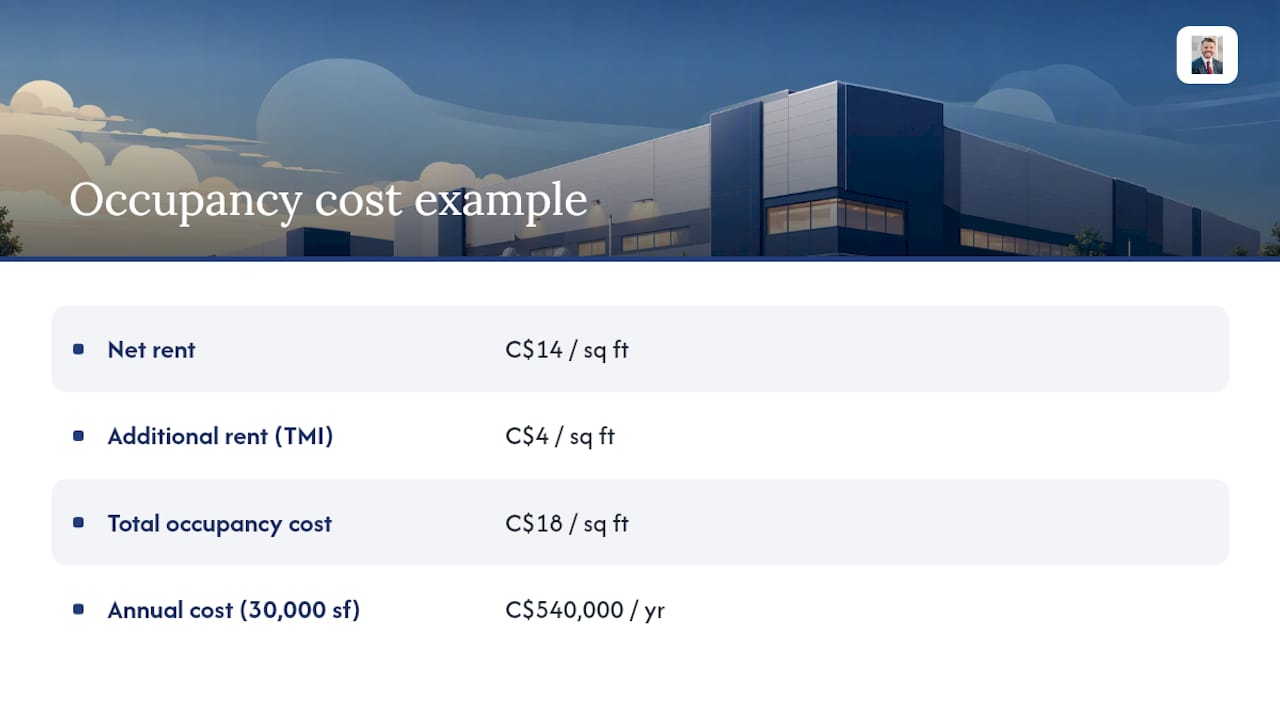
Net rent is only part of your monthly obligation. Additional rent, sometimes called TMI (taxes, maintenance, and insurance), covers property taxes, common area maintenance, and insurance, and it’s billed on top of net rent every month. In Pickering’s industrial market, additional rent typically runs $3 to $5 per square foot annually, depending on the building’s age and how much shared infrastructure it carries.
Run the math on a straightforward example: a 30,000 square foot bay at $14 net plus $4 additional rent works out to $18 per square foot in total occupancy cost, or $540,000 a year before utilities and your own operating expenses. That gap between the headline number and the real number is exactly why comparing listings on net rent alone leads to budget surprises.
Most industrial leases in this market run five to ten years with fixed annual escalations, commonly in the 2% to 3% range, built into the lease from day one rather than negotiated at renewal. Understanding how those step-ups compound over a term matters more than most tenants realize going in. Our rent escalation guide breaks down how to model that cost over a full five-year term before you sign anything.
When should you start your renewal or relocation search?
Give yourself 9 to 18 months of lead time, longer if you’re chasing a small bay under 50,000 square feet where inventory is thinnest. That window gives you room to tour realistic alternatives, which is also your strongest negotiating card with your current landlord. Early planning matters more in this cycle than it did during the looser vacancy years, because landlords now have less incentive to make concessions just to keep a tenant in place.
A few levers are worth raising directly with your landlord or broker before you sign anything:
- Expansion or contraction options, particularly if your business is scaling or you expect to right-size in the next few years.
- Tenant improvement allowances, which vary widely depending on term length and how much leverage you’re bringing to the table.
- Free rent or fixturing periods, especially on longer terms where landlords have more room to negotiate.
- Subdivision requests, since landlords with larger units are increasingly willing to split space to meet smaller-bay demand.
Before approaching a landlord or broker, pull together your current lease, three years of utility and operating cost history, a clear headcount or equipment forecast, and a hard number on your required clear height and loading configuration. Walking in with that ready signals you’re a serious tenant, not a browser.
Michael Law’s practical perspective: tactical tips for Pickering tenants
The tenants most exposed right now are small-bay users renewing without a market comparison in hand. They assume their last rent is a fair benchmark, and in this cycle it usually isn’t. Landlords know inventory under 50,000 square feet is scarce and they’re pricing accordingly.
My advice: get a real market scan before you renew, not after your landlord sends a number. Ask about subdividing larger units if your footprint has shrunk. And bring usage forecasts to the table. Landlords weight term certainty and creditworthy tenants as heavily as headline rent, so a clear growth or downsizing plan gives you real leverage.
Pro Tip: Request comparable lease data for your specific bay size, not the market average. A 15,000 square foot bay and a 100,000 square foot bay in the same building can carry a $3 to $4 per square foot spread.
Where are Pickering rents headed next?
Rents ran up sharply from 2021 through 2023 as e-commerce demand and supply chain reshuffling pulled vacancy down across the GTA. That peak has passed. Rents have since eased from those highs, but the retreat has slowed noticeably rather than continuing in a straight line down.
GTA data through 2Q26 shows the pace of decline decelerating, which reads less like a market in free fall and more like one settling toward a floor. Durham Region’s construction pipeline sitting below its five-year average reinforces that read. Fewer new buildings coming online means less new supply to absorb, which limits how much further rents can drop even if demand stays soft.
For tenants, the practical takeaway is this: don’t plan a renewal strategy around the assumption that rents will keep falling. That assumption drove a lot of renewal delays over the past two years, and many of those tenants are now negotiating from a weaker position because the market moved before they did. If your lease has 12 months or less remaining, the smarter play is treating current pricing as roughly where the market will sit rather than betting on a further pullback.
What’s actually driving Pickering’s rent levels?
Three forces shape what you’ll pay in Pickering, and none of them operate independently. Highway access sits at the top. Properties with direct routes to the 401 corridor let trucking operations move freight efficiently through the GTA, and tenants pay a premium for that positioning regardless of building age.
Supply and demand imbalance drives the rest. Small-bay inventory under 50,000 square feet has stayed scarce because most new construction in Durham Region targets larger footprints aimed at big-box logistics tenants, leaving smaller occupiers competing over a shrinking pool of older buildings. That mismatch alone explains most of the premium small users pay compared to large distribution tenants.
Building specifications add a third layer. Clear height, loading configuration, and power capacity all affect what a space can be used for, and specialized needs like cold storage or high-draw manufacturing narrow your options further, which pushes pricing up regardless of the broader market direction. A building that checks every box for a 3PL operator might be completely unsuitable for a food-grade tenant needing refrigeration infrastructure, and that specificity limits competition among landlords for those niche spaces.
Economic conditions across Ontario’s manufacturing and logistics sectors also feed into demand, though that influence moves more slowly than the supply-side factors above. A slowdown in manufacturing activity eases pressure on industrial space gradually, not overnight, which is part of why rents have stabilized rather than dropped sharply even as broader economic growth has cooled.
How does Pickering compare to nearby GTA markets?
Pickering sits in a reasonably competitive spot within the eastern GTA industrial landscape. Its net rent band of $12 to $18 per square foot tracks close to the regional GTA average of roughly C$16.9 per square foot, positioning it as neither a discount market nor a premium one.
Compared to Mississauga or Brampton, both of which sit closer to Pearson Airport and carry heavier logistics demand, Pickering typically prices lower for comparable building specifications. That gap exists because those western GTA markets serve a denser concentration of national distribution tenants competing for the same limited inventory, which pushes rents higher.
Against Ajax and Whitby, its closest neighbours within Durham Region, Pickering runs fairly comparable, with small variances driven more by individual building age and highway proximity than by any broader municipal difference. A tenant deciding between Pickering and Ajax for a 40,000 square foot bay will likely find similar pricing and should base the decision on building specifics rather than location alone.
The practical implication: Pickering offers a middle path. Tenants priced out of Mississauga’s tightest submarkets, or unwilling to pay that premium, often find comparable building quality in Pickering at a meaningfully lower rent, without sacrificing much on the Highway 401 access that makes eastern GTA logistics work.
Who pays for tenant improvements in Pickering leases?
Tenant improvement allowances in Pickering’s industrial market vary by lease term and tenant credit strength, but the general pattern holds across most deals: landlords contribute an allowance toward the buildout, and the tenant typically pays for anything beyond that allowance out of pocket.
Longer lease terms, generally seven years or more, tend to unlock larger allowances because landlords amortize that cost over a longer income stream. Shorter terms of three to five years usually come with smaller allowances or none at all, particularly in a market where landlords have regained some pricing leverage on small-bay space.
Standard improvements like office buildout, basic HVAC adjustments, and paint or flooring commonly fall within a negotiated allowance. Specialized work, such as installing refrigeration infrastructure for cold storage or upgrading electrical service for high-power manufacturing equipment, usually falls to the tenant unless that specific use case was part of the original lease negotiation. This is exactly the kind of detail worth raising early, since retrofitting a space for specialized power or climate control after signing is far more expensive than negotiating it into the original tenant improvement package.
Tenants with strong credit and longer-term commitments have real room to negotiate improvement allowances upward, particularly in a market where landlords value term certainty. Our guide on assessing GTA industrial rent walks through how to frame that ask during negotiations.
Editorial perspective
Pickering’s market has stopped falling but hasn’t turned aggressively landlord-friendly yet, which leaves a narrow window for tenants to act. Audit your current footprint against your real growth plans this quarter, then instruct a broker to run a market scan before your renewal date arrives, not after.
— Michael Law
How Michael Law | Lennard Commercial helps you secure the right space
Chasing listings across five different portals and cold-calling landlords eats weeks you don’t have, especially with small-bay inventory this tight. A commercial real estate brokerage offers tenants a faster path: direct market intelligence on off-market space, access to brokers familiar with landlords open to negotiation, and a shortlist tailored to specific bay size and clear height needs instead of a generic portal search.
An engagement typically starts with a market briefing that lays out current rent bands and available inventory for your size range, followed by a curated shortlist of properties worth touring, then hands-on negotiation support once you’ve found the right fit. Whether you need tenant representation for a lease renewal, a relocation, or a first-time site selection, the process is built around getting you accurate numbers before you commit to anything. If your lease is coming up for renewal or you’re evaluating whether to stay or move, reach out through the industrial tenant representation page to start your market scan now.
Sources
- Industrial Property Appraisal in Pickering | Aion Appraisals
- Durham Region commercial market update | DR Group
- 2Q26 Toronto Ontario industrial market report (NMRK)
FAQ
What is the average commercial rent per square foot in Pickering?
Net industrial rents in Pickering currently range from $12 to $18 per square foot, depending on building age, clear height, and proximity to Highway 401. Add typical additional rent of $3 to $5 per square foot for taxes, insurance, and maintenance to estimate your total occupancy cost.
Is it expensive to live in Pickering?
That question typically refers to residential costs, which sit separately from the commercial and industrial rents this guide covers. For industrial tenants, Pickering’s business costs price competitively against western GTA markets like Mississauga while offering solid Highway 401 access.
Are there commercial units for sale in Pickering, Ontario?
Yes, industrial and commercial properties come to market in Pickering regularly, alongside lease listings. A broker tracking off-market opportunities, such as through Michael Law | Lennard Commercial’s user sale and purchasing services, can surface options that never appear on public portals.
Where can I find industrial space for rent in Ajax?
Ajax sits within Durham Region alongside Pickering and shows comparable pricing and availability patterns, since both markets draw on similar Highway 401 access and tenant demand. Checking listing portals alongside a broker with direct landlord relationships covers both public and off-market inventory in Ajax and Pickering simultaneously.
How much should I budget above net rent for a Pickering industrial lease?
Plan for an additional $3 to $5 per square foot annually on top of net rent to cover taxes, insurance, and common area maintenance. On a 30,000 square foot bay at $14 net, that pushes total occupancy cost to roughly $18 per square foot, or $540,000 a year before utilities.
Recommended

About Michael Law
Managing Partner and Industrial Real Estate Broker at Lennard Commercial Realty. Representing tenants and landlords across Toronto and the GTA for 15+ years. Michael specializes in GTA industrial real estate — connect with Toronto's leading industrial broker at mlawrealestate.com/industrial-broker-toronto.