
30 Business Days Can Cost Your ROFR Lease in the GTA and Ontario
By Michael Law · Industrial Real Estate Broker, Lennard Commercial Realty
A right of first refusal lease clause gives the holder, usually a tenant, the first chance to buy the property on the exact terms a bona fide third party has already offered. It does not let the holder force a sale or dictate price. In Canada, whether that right actually protects the tenant against a determined landlord depends heavily on drafting, notice timing, and whether the right is registered against title in the relevant province.
TL;DR:
- Registering a ROFR against title depends on the province, with Ontario allowing caution registration and Alberta permitting caveats to protect the rights.
- A genuine third-party offer must be received and accepted by the landlord before the tenant’s response window begins, which is typically 10 to 30 business days.
- Courts require the delivery of a fully signed purchase and sale agreement within the exercise period, making early exercise based on a term sheet a common mistake.
- Renters should demand precise drafting clauses defining “offer” and “matching terms,” avoid vague deadlines, and seek legal advice immediately upon notice.
- In portfolio sales, the seller must allocate price fairly for the encumbered property and reissue notices if deal terms change to ensure enforceability.
Table of Contents
- What a right of first refusal actually is under Canadian law
- How a ROFR is triggered: notice, timing, and matching
- ROFR, option to purchase, and right of first offer: what’s the difference
- Registration and province differences: does a ROFR bind a new owner
- Drafting checklist: the clauses that prevent disputes later
- Tenant playbook: exercising a ROFR without losing it
- Landlord obligations and the limits of good faith
- Portfolio sales: how a ROFR survives a bundled transaction
- What Canadian courts have decided about enforcing ROFRs
- Practical tips from GTA industrial leasing
- Why I tell GTA tenants to fight for a ROFR
- Get help drafting or enforcing a ROFR in the GTA
- Sources
- FAQ
What a right of first refusal actually is under Canadian law
A ROFR is ordinarily a contractual promise, not an automatic interest in land. The landlord agrees that before selling to anyone else, it will first offer the tenant the chance to buy on the same terms it is willing to accept from a third party. On its own, that promise binds the original landlord and tenant, but a later purchaser who buys without notice of the ROFR may take the property free of it, according to Practical Law Canada’s summary of ROFR mechanics.
Whether the right survives a sale to a new owner depends on:
- Whether the ROFR is registered against title (province-specific rules apply)
- Whether the new purchaser had actual or constructive notice of the right
- Whether the clause was drafted to bind “successors and assigns”
Industrial tenants push hardest for ROFRs when they have made a large capital investment in a facility, such as racking, cold storage, or specialized manufacturing infrastructure, and cannot easily relocate without significant cost and downtime.
How a ROFR is triggered: notice, timing, and matching
The mechanics matter more than the concept. A ROFR only activates once the landlord receives an offer it is genuinely “prepared to accept,” meaning a real, arm’s length offer from a third party, not a placeholder or a sham designed to test the tenant’s appetite. Vague drafting on this point is where most disputes start.
A typical exercise sequence looks like this:
- The landlord receives a bona fide third-party offer it intends to accept.
- The landlord delivers written notice to the ROFR holder, including the material terms (ideally a copy of the signed offer or agreement of purchase and sale).
- The clock starts on the negotiated response window, commonly 10 to 30 business days depending on deal size.
- The tenant either matches the offer in full or lets the right lapse, and the landlord proceeds with the third party.
Courts scrutinize whether “matching” means price only or price plus every ancillary term (deposit size, closing date, financing conditions). Loose language here has produced real litigation in Canada.
Pro Tip: Push for a clause requiring delivery of the fully signed purchase and sale agreement, not just a term sheet. In the GTA industrial market, brokers frequently negotiate a 30 business day window tied to delivery of a signed PSA, and a missing signed PSA is the most common reason a tenant’s attempt to exercise later falls apart.
ROFR, option to purchase, and right of first offer: what’s the difference
These three instruments get confused constantly, and the differences carry real consequences for tenants weighing lease purchase agreements or renewal lease rights strategies.
- Right of first refusal: reactive. The holder only acts once the landlord has a third-party offer to match. No immediate equitable interest arises.
- Option to purchase: proactive. The holder can force a sale at a pre-agreed price or formula, at any time within the option period, whether or not the owner wants to sell.
- Right of first offer: the owner must offer the property to the holder first, before shopping it externally, but the holder sets the opening terms rather than matching someone else’s.
Options generally create a stronger, more immediately enforceable interest and are more likely to support registration. Tenants who want price certainty and control over timing should negotiate an option; tenants who mainly want to prevent a surprise sale to a stranger often find a ROFR sufficient and easier for a landlord to accept.
Registration and province differences: does a ROFR bind a new owner
Whether a right of first refusal lease clause survives a change of ownership turns on province-specific registration mechanics, and this is the part general lease templates get wrong most often.
- Ontario: a ROFR can be protected by registering a caution or notice under the Land Titles Act framework, putting future purchasers on notice.
- Alberta: under the Law of Property Act, a ROFR can be deemed an equitable interest, allowing the holder to register a caveat against title.
- Other provinces: registration regimes vary, and some jurisdictions offer no clean registration path at all, per commentary on right of first refusal treatment across Canada.
Practical due diligence steps for a buyer:
- Review the head lease and any amendments for ROFR or option language
- Search title for registered notices or caveats
- Ask the seller directly whether any tenant holds an unregistered ROFR
Failing to register leaves the right vulnerable if the property changes hands to a purchaser without notice.
Drafting checklist: the clauses that prevent disputes later
Most ROFR litigation traces back to sloppy definitions written years earlier, according to commentary on drafting and compliance in Canadian real estate transactions. A tighter clause needs to:
- Define “offer” and “accepted offer” precisely, ideally requiring a fully executed agreement, not a letter of intent.
- Set an exact notice deadline and specify how notice must be delivered.
- State plainly whether matching covers price alone or every material term.
- Include a reinstatement clause covering what happens if the matched deal later fails to close.
- Address how the right applies if the property is sold as part of a larger portfolio.
Pro Tip: Avoid the phrase “reasonable time” anywhere in a ROFR clause. Courts construe ambiguity against whoever drafted it, and a vague deadline almost always favours the tenant in a dispute.
Tenant playbook: exercising a ROFR without losing it
Once notice arrives, the clock is real. Move fast.
- Retain counsel immediately and request the fully executed purchase and sale agreement, not a summary.
- Confirm the exact deadline and every term you’re expected to match.
- Line up financing or negotiate a short extension if the window is tight.
- Deliver written notice of exercise before the deadline, with proof of delivery.
- If the landlord fails to give notice at all, or the offer looks staged, preserve every email and document immediately.
Pro Tip: A tenant who suspects a landlord is trying to sidestep a ROFR should document the timeline in writing as it unfolds, not reconstruct it later. Courts weigh contemporaneous records heavily in specific performance claims.
Landlord obligations and the limits of good faith
Canadian courts require honesty and reasonableness in how a landlord handles a ROFR, even while allowing the landlord to pursue its own commercial interests. Structuring a deal specifically to defeat a tenant’s right, through a sham offer or misleading terms, invites a legal challenge, according to commentary on good faith in Canadian commercial contracts.
Conduct that has undermined ROFRs in past disputes includes:
- Accepting a third-party offer without ever notifying the rights holder
- Bundling the property into a portfolio sale specifically to avoid triggering the clause
- Giving notice with incomplete or misleading terms
A practical landlord checklist: track every ROFR across a portfolio, issue notice the moment a genuine offer is accepted, and give the holder a real, documented opportunity to respond before moving forward.
Portfolio sales: how a ROFR survives a bundled transaction
Selling several properties together as one package is where ROFRs get tested hardest. Courts have required vendors to allocate purchase price fairly across individual assets or to prepare a standalone agreement for the encumbered property, so the rights holder gets a meaningful opportunity to exercise, per Bennett Jones’s analysis of portfolio ROFRs in Canadian commercial real estate.
- Prepare a substantially final, individually priced PSA for the encumbered property before triggering notice
- Re-issue notice if the head deal’s terms change materially after the first notice went out
- Sequence portfolio closings so the ROFR property isn’t forced to close on a bundled timeline it never agreed to
What Canadian courts have decided about enforcing ROFRs
- In 1440825 Ontario Inc. v. Lenco Investment Ltd., the Ontario Court of Appeal held that a landlord must notify the tenant of a third-party offer and give the contractual matching period before accepting it, and ordered specific performance in the tenant’s favour after the landlord skipped that step.
- Budget Car Rentals and the Adesa line of decisions show courts scrutinizing portfolio sales closely, sometimes invalidating notices that fail to properly allocate price.
- The remedy courts reach for most often is specific performance or a declaration that the sale to the third party is invalid, not just damages.
Practical tips from GTA industrial leasing
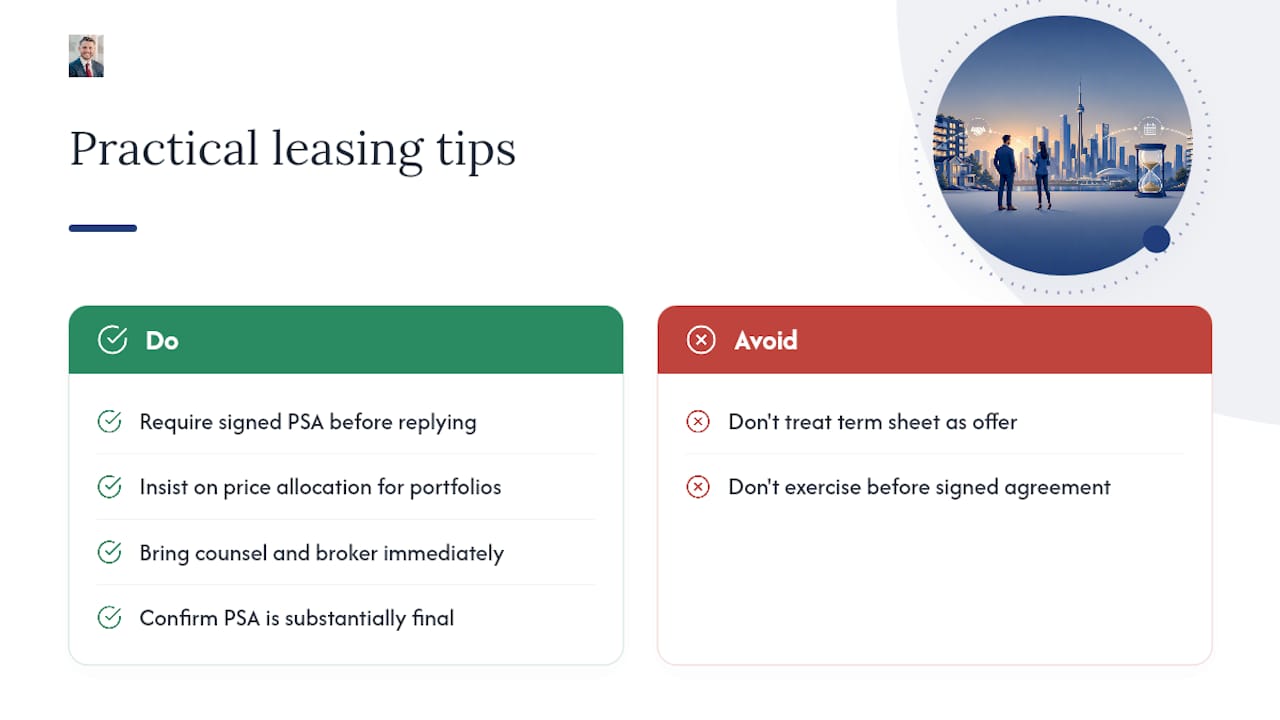
Require a substantially final, signed PSA before responding to any ROFR notice, and insist on price allocation whenever a portfolio sale is involved. The most common tenant mistake is treating a term sheet as a triggering offer and exercising too early, without the actual signed agreement in hand. Bring counsel and a broker in together the moment notice lands. For related tenant leverage, see negotiating GTA industrial leases with confidence.
Why I tell GTA tenants to fight for a ROFR
If your facility sits on a strategic site, near a 400 series highway interchange or a rail spur, and relocating would cost months of downtime, a ROFR is worth negotiating hard for. It won’t force a sale, but it buys you time and leverage the moment the landlord decides to exit. In the GTA’s tight industrial market, that leverage is often worth more than a lower base rent.
— Michael Law
Get help drafting or enforcing a ROFR in the GTA
Michael Law | Lennard Commercial is the practical alternative to going it alone on a lease negotiation. Where a generic template leaves “offer” and “matching terms” undefined, our tenant representation work builds the specific language that has actually held up in Ontario courts, and manages the notice and exercise process when a landlord puts a property on the market.

Before reaching out, gather your current lease, any draft ROFR language you’re negotiating, and a copy of the third-party purchase and sale agreement if you’ve already received notice. Our industrial tenant representation services in Toronto cover lease drafting, negotiation, and transaction management across Mississauga, Brampton, Vaughan, Milton, and the rest of the GTA. If your facility involves tenant improvements or build-out timing tied to a ROFR exercise, a commercial construction timeline guide can help you plan financing deadlines around closing. Contact Michael Law | Lennard Commercial to review your clause before you sign, or before you respond to a notice you’ve already received.
This article is general information, not a substitute for advice from a qualified lawyer. Consult a qualified legal professional about your own circumstances before acting on anything here.
Sources
- Rights of First Refusal in Canadian Commercial Real Estate: Navigating Portfolio ROFRs — Bennett Jones
- 1440825 Ontario Inc. v. Lenco Investment Ltd., 2014 ONCA 903 — MiniCounsel (CanLII excerpt)
FAQ
Is a right of first refusal a good idea for a tenant?
For tenants tied to a strategic or hard-to-replace facility, yes. A ROFR costs little to negotiate and provides a real safeguard against losing the site to an unexpected sale, though it works best when the notice and matching terms are drafted precisely.
What is the right of first refusal in Canada?
It’s a contractual promise, common in commercial and industrial leases, that requires the landlord to offer the tenant the first opportunity to buy on the same terms as any bona fide third-party offer it’s prepared to accept. It generally does not bind future owners unless registered against title under province-specific rules.
How do you get out of a right of first refusal?
Landlords typically exit a ROFR through mutual release, by the right expiring under its own terms, or by the tenant declining to match a properly delivered offer within the notice window. Attempting to sidestep it through a sham sale invites a good-faith challenge in court.
Can you explain a right of first refusal in simple terms?
If the landlord decides to sell and gets a real offer it likes, the ROFR holder gets first crack at buying on those same terms before the landlord can sell to anyone else.
Does a ROFR let a tenant force the landlord to sell?
No. The right only activates once the landlord chooses to accept a third-party offer; it does not compel a sale the landlord isn’t otherwise prepared to make.
Recommended

About Michael Law
Managing Partner and Industrial Real Estate Broker at Lennard Commercial Realty. Representing tenants and landlords across Toronto and the GTA for 15+ years. Michael specializes in GTA industrial real estate — connect with Toronto's leading industrial broker at mlawrealestate.com/industrial-broker-toronto.