
GTA Industrial Tenants: SNDA That Protects Your Lease and TI Credits
By Michael Law · Industrial Real Estate Broker, Lennard Commercial Realty
An SNDA agreement is a three-way contract between a tenant, a landlord and a lender that decides who wins if the property goes into foreclosure. The tenant agrees the lease sits behind the mortgage (subordination), the lender agrees not to evict a paying tenant (non-disturbance), and the tenant agrees to accept the lender or its buyer as the new landlord (attornment). For a GTA industrial tenant carrying a large tenant improvement investment, that trade is the difference between staying in a building and losing it overnight.
TL;DR:
- SNDAs primarily protect tenants’ rights to stay and receive credit for improvements or prepaid rent if a lender forecloses, but only if properly negotiated upfront.
- Recording the SNDA and obtaining an estoppel certificate at lease signing is essential for enforceability against future buyers or lenders who never reviewed the original lease.
- Without an SNDA, tenants risk eviction, loss of improvement credits, and delays or lower valuations during refinancing or sale transactions.
- Tenants should prioritize negotiating clauses that protect renewal, expansion, and prepaid rent rights explicitly within the SNDA before financing processes begin.
- Lenders usually request SNDAs during loan closing or refinancing, but tenants often have bargaining room only when negotiating lease terms before the lease is signed.
Table of Contents
- What is an SNDA agreement in commercial leasing?
- How does Ontario law treat SNDAs and attornment?
- When do landlords and lenders request an SNDA?
- What clauses should tenants negotiate into an SNDA?
- How do estoppel certificates and recording actually protect you?
- What happens if there’s no SNDA in place?
- Practitioner tactics for negotiating SNDAs on GTA industrial deals
- Do SNDAs affect lease renewal or expansion rights?
- Do office, retail and industrial leases need different SNDA terms?
- What do standard SNDA clauses actually say in practice?
- Negotiate SNDA protection before you sign, not after
- [Get lease terms reviewed before you sign](#get-lease-terms-reviewed-before-you-signhttpshauzedcomenblogswhat-to-look-for-in-a-rental-agreement)
- Sources
- FAQ
What is an SNDA agreement in commercial leasing?
Every SNDA rests on the same three moving parts, and each one does a different job.
Subordination ranks the lease below the mortgage in priority. Without it, a lender financing or refinancing the property can’t get comfortable that its security interest comes first.
Non-disturbance is the tenant’s payoff for subordinating. It’s the lender’s promise that if it forecloses, it won’t terminate the lease or evict a tenant who is paying rent and meeting lease obligations. Most lender forms condition this protection on the tenant staying in compliance with the lease up to the point of enforcement.
Attornment is the flip side. It requires the tenant to recognize the lender, or whoever buys the property at a foreclosure sale, as the new landlord and keep paying rent under the existing lease terms.
Each piece has direct dollar consequences:
- Subordination determines whether your lease survives a lender’s enforcement action at all.
- Non-disturbance protects your right to stay, assuming you’re not in default.
- Attornment is what makes non-disturbance enforceable, since it gives the successor owner a tenant obligated to perform.
- None of the three automatically protects tenant improvement credits, prepaid rent, or renewal options unless the document says so explicitly.
How does Ontario law treat SNDAs and attornment?
Ontario courts have drawn a hard line on one point: a lender can’t simply assume a tenant’s obligations transfer to it after taking possession. Case law from the Ontario Court of Appeal, referenced in commentary on the Goodyear line of authority, confirms that absent an actual attornment agreement, a lender or successor owner cannot compel a tenant to perform under a lease that was subordinate to the mortgage. That’s a meaningful limit on lender power, and it’s exactly why attornment clauses exist in the first place.
This matters differently depending on how the lender enforces. A power of sale, the standard route for Ontario mortgage default, transfers title through a straightforward sale process, and whatever SNDA terms exist typically follow the property to the buyer. A tenant’s insolvency, by contrast, triggers federal bankruptcy proceedings, which can override provincial lease protections entirely and put the tenant’s remaining rights in the hands of a trustee.
Recording the SNDA on title, and backing it with a signed estoppel certificate confirming the tenant’s compliance status, is what makes these protections stick against a future buyer or second mortgagee who never saw the original lease negotiation. Without that paper trail, enforceability against a stranger to the original agreement gets a lot murkier.
When do landlords and lenders request an SNDA?
SNDAs aren’t required by any Ontario statute. They’re a customary condition lenders attach to secured commercial loans, which means the request usually shows up at one of a few predictable moments.
- Loan closing on a new acquisition. A buyer financing a purchase needs existing tenants to subordinate before the lender will fund.
- Refinancing. A landlord replacing an existing mortgage often has to deliver fresh SNDAs from every tenant as a closing condition.
- A lease clause that mandates it. Many leases already obligate the tenant to sign an SNDA “upon request” at any point during the term.
- Portfolio sales or recapitalizations. New ownership structures frequently trigger a fresh round of lender due diligence, estoppel requests and SNDA execution.
Timing decides who holds the leverage. Tenants who negotiate SNDA language while the lease itself is still being drafted have real bargaining room, because landlord motivation to close the deal is highest at that stage. Wait until the landlord is mid-refinancing and asking for a signature under deadline pressure, and that leverage mostly evaporates. Missed estoppel deadlines or delayed registration at that late stage can also stall the landlord’s financing, which puts unwanted pressure on the tenant to sign whatever’s put in front of them.
What clauses should tenants negotiate into an SNDA?
The base lender form almost never protects a tenant’s financial interests beyond the bare minimum. These are the clauses worth pushing for.
- Successor landlord obligations. Require any successor owner to honour outstanding tenant improvement allowances, repair commitments and warranties that predate the foreclosure.
- Prepaid rent and deposit credit. Insist the SNDA explicitly obligates the successor to credit prepaid rent and security deposits, since a successor has no automatic duty to honour these absent contract language.
- Narrow lender approval rights. Push back on broad consent requirements over lease amendments, and propose a defined “materially adverse” standard rather than open-ended lender discretion.
- Deemed approval timeframes. A clause stating the lender’s consent is deemed granted if it doesn’t respond within a set number of days prevents administrative delay from stalling a legitimate business decision.
- Limited cure periods. Cap how long a lender gets to cure a landlord default before the tenant can exercise its own remedies, including rent offset.
- Right to record. Confirm the tenant can register the SNDA on title, which is what protects the deal against a future buyer who never reviewed the lease file.
Pro Tip: Ask your landlord to name a specific SNDA form and negotiated points as an exhibit to the lease itself, before financing is even discussed. Retrofitting these protections after a lender’s counsel has drafted their own version is a much harder fight.
How do estoppel certificates and recording actually protect you?
An estoppel certificate is the tenant’s sworn statement confirming lease terms, rent status and whether the landlord is in default, and lenders request them precisely because they can’t take the landlord’s word for it. It’s the document that lets a lender or buyer rely on the lease as written rather than guessing.
Recording the SNDA itself, ideally alongside or shortly after the estoppel is signed, is what makes the protections visible to any future purchaser or second lender who checks title before closing. The practical checklist is short: negotiate the clauses at lease signing, execute the SNDA when the lender requests it, deliver a matching estoppel certificate, and confirm registration before the financing closes. Building can review our guide to estoppel certificates for a closer look at what lenders expect in that document specifically.
What happens if there’s no SNDA in place?
Skip the SNDA, and each party is exposed in a different way. A tenant can face eviction in a foreclosure with no contractual claim against the successor for tenant improvement credits or prepaid rent already paid to the old landlord. A lender loses the predictable rental income stream it was counting on when it underwrote the loan, and can struggle to assign leases cleanly if it needs to sell the note. A landlord trying to refinance or sell without SNDAs in hand often faces closing delays, or a lower valuation, because the buyer’s lender won’t fund against uncertain tenancies.
Two quick scenarios illustrate the gap. A tenant with no SNDA gets served notice after the landlord’s lender forecloses, loses the space with no recourse, and eats the cost of relocating on short notice. A landlord mid-refinance who waits until closing week to chase down tenant signatures can watch the deal slip past its rate lock while tenants stall for their own negotiating leverage.
Practitioner tactics for negotiating SNDAs on GTA industrial deals
Tenants asking for SNDA protection in a GTA industrial lease typically want plain, specific language: a successor landlord must honour any unpaid tenant improvement allowances, credit prepaid rent, and respect renewal options already negotiated into the lease. That is a negotiation point, not boilerplate, and it belongs in the lease itself, not left to whatever form the lender’s counsel produces later.
On tight timelines, brokers often coordinate the exchange of estoppel certificates, SNDA execution and lender sign-off simultaneously to avoid a last-minute financing holdback that can derail an otherwise closed deal. Broker-led coordination handles the scheduling and document flow; legal counsel should still review the actual SNDA language before signature, particularly on lender approval rights and cure periods.
Do SNDAs affect lease renewal or expansion rights?
Renewal and expansion options are exactly the kind of tenant right that can quietly disappear in a successor landlord transition unless the SNDA addresses them directly. A standard lender-drafted SNDA focuses on subordination, non-disturbance and attornment. It rarely says anything about whether a new owner has to honour a renewal option, a right of first refusal on adjacent space, or an expansion right tied to a specific unit becoming vacant.
That silence is the risk. If the SNDA doesn’t explicitly bind the successor to the lease’s renewal and expansion provisions, a new owner could argue those rights were personal to the original landlord relationship and don’t automatically carry forward. For an industrial tenant that negotiated a five-year renewal option specifically because relocating a distribution operation is expensive and disruptive, losing that option in a foreclosure is a real operational problem, not a paperwork technicality.
The fix is straightforward: the SNDA should state, in plain terms, that the successor landlord takes the property subject to the entire lease, including renewal options, expansion rights and any rights of first offer, not just the base rent and term. Tenants negotiating a new industrial lease in Vaughan, Milton or Brampton, markets where taking on more space later is often part of the growth plan, should treat this as a non-negotiable line item rather than an afterthought. Landlords who resist adding this language are usually just trying to avoid limiting a future buyer’s flexibility, which is precisely the scenario the clause is meant to prevent.
Do office, retail and industrial leases need different SNDA terms?
The three components of an SNDA don’t change by property type, but the clauses worth fighting for shift depending on what’s actually at stake in each lease.
Office tenants tend to focus SNDA negotiation on tenant improvement allowances, since office build-outs (reception areas, private offices, cabling) are often substantial and hard to recover if a successor owner disclaims responsibility. Multi-tenant office buildings also raise questions about shared services and common area maintenance obligations surviving a change in ownership.
Retail tenants, particularly in shopping centres, care more about co-tenancy clauses and exclusivity provisions, protections tied to which other retailers occupy the centre, that have real revenue implications and don’t fit neatly into a generic lender SNDA form. A successor landlord who doesn’t maintain the same tenant mix can materially hurt foot traffic for the remaining tenants.
Industrial tenants, the group most relevant to GTA occupiers, usually prioritize different things entirely: large tenant improvement investments in racking, dock equipment and specialized power or refrigeration infrastructure, plus renewal options tied to long lead times for relocating logistics operations. Industrial leases also more commonly include expansion rights on adjacent space, which makes the renewal and expansion protection discussed above especially relevant to this property type.

The lender’s base SNDA form rarely distinguishes between these use cases, which is exactly why a generic template signed without review can leave sector-specific risks uncovered.
What do standard SNDA clauses actually say in practice?
A subordination clause typically states that the lease and all tenant rights are subject and subordinate to the mortgage, now and for any future amendments or refinancing, unless the lender agrees otherwise in writing. In practice, this means a tenant with a strong lease can still end up junior to a lender’s interest they never negotiated directly with.
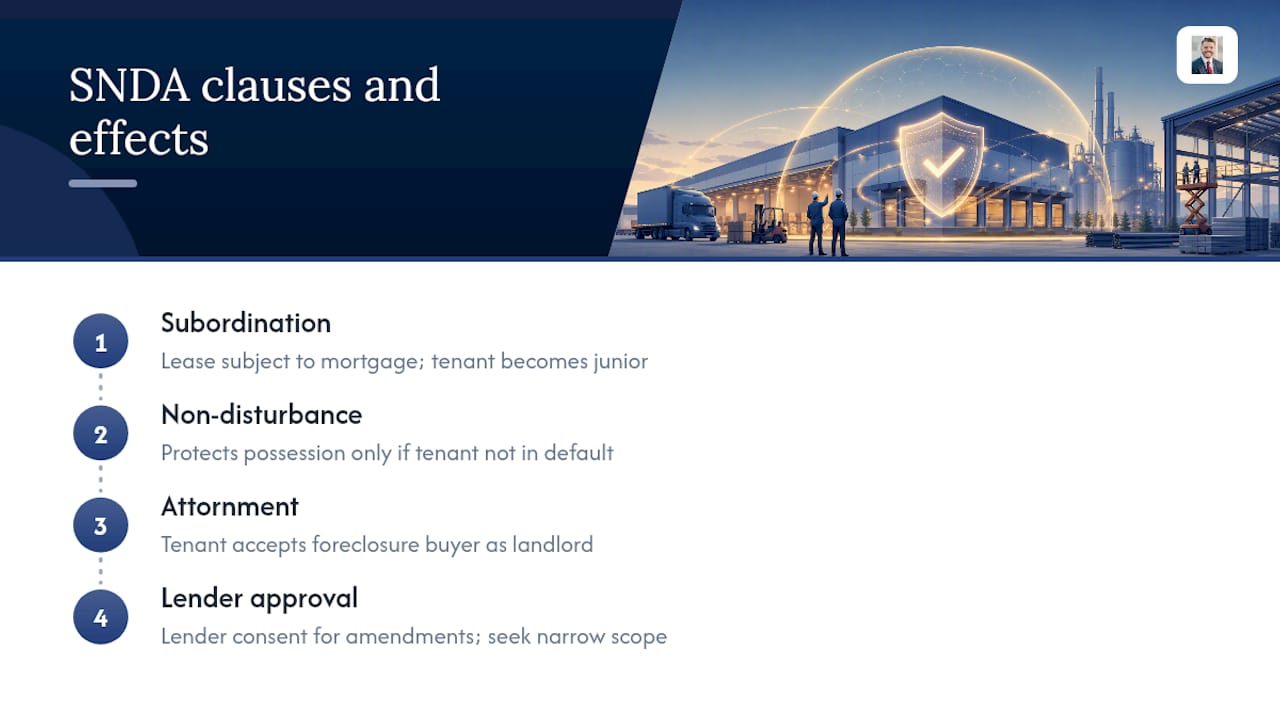
A non-disturbance clause states the lender won’t disturb the tenant’s possession following foreclosure, provided the tenant isn’t in default. The practical implication is that this protection is conditional, not automatic, which is exactly why building a clean compliance record and requesting an estoppel that documents good standing matters before any enforcement scenario arises.
An attornment clause requires the tenant to recognize the foreclosure purchaser as landlord and continue paying rent under the existing lease. This is the clause that gives non-disturbance any teeth, since it creates an enforceable landlord tenant relationship with whoever ends up owning the building.
A lender approval clause, often the most heavily negotiated provision, requires landlord to obtain lender consent before amending the lease, granting rent concessions, or agreeing to early termination. Tenants with negotiating leverage should push to narrow what counts as requiring approval and attach a deemed approval timeframe so a non-responsive lender can’t functionally veto a routine lease amendment by ignoring it.
Negotiate SNDA protection before you sign, not after
If there’s one thing to take away from all of this, it’s timing. Negotiate SNDA protections into the lease itself, before the landlord’s financing is on the table, because that’s the only point where a tenant has real leverage to shape the language rather than accept a lender’s standard form. Michael Law | Lennard Commercial works with industrial occupiers across the GTA on exactly this kind of lease structuring, and the site at Mlawrealestate covers the negotiation issues that come up most often in this market.
Two mistakes show up repeatedly in GTA industrial deals: tenants signing an SNDA at financing closing without review because they’re told it’s “just standard,” and tenants assuming renewal or expansion rights automatically survive a foreclosure without confirming the SNDA says so in writing. Both are avoidable with a proper lease review before signature.
— Michael Law
Get lease terms reviewed before you sign
Tenants should consider consulting with knowledgeable brokerage services that provide thorough reviews of SNDA clause-level details, tenant improvement credit language, renewal protections, and lender approval scope before signing under closing pressure.

Michael Law | Lennard Commercial provides tenant representation, lease negotiation, SNDA coordination and estoppel management for occupiers in industrial markets across the GTA, including Newmarket, Aurora, Kitchener and the broader Toronto region. If you’re mid-lease, approaching a renewal, or facing an SNDA request tied to your landlord’s refinancing, a lease review now is worth more than a signature under deadline pressure later. Reach out through Mlawrealestate to start a tenant representation conversation, or browse current available industrial properties if you’re weighing a move as part of that review.
Sources
- Attornment and non-disturbance agreements - GRLLP
- SNDAs from the tenant’s perspective: what to negotiate and why it matters - Holland & Knight
- SNDAs in real estate transactions: overview - Practical Law (Thomson Reuters)
- SNDA agreements in commercial real estate - LTAAG
FAQ
Can a commercial landlord terminate a lease in Ontario?
A landlord can terminate a commercial lease for tenant default, such as unpaid rent, under lease terms and Ontario’s Commercial Tenancies Act, but termination triggered by a lender’s foreclosure is governed separately by whatever SNDA, or lack of one, is in place.
Can an SNDA be negotiated, or is it a fixed lender form?
Yes. SNDA terms are negotiable, and tenants with leverage regularly narrow lender approval rights, add deemed approval timeframes and secure credit for prepaid rent and tenant improvements that standard forms don’t include.
How can a commercial tenant legally break a lease in Ontario?
Breaking a commercial lease early in Ontario generally requires either a termination clause already written into the lease, a negotiated surrender agreement with the landlord, or grounds like landlord default; there’s no general statutory right to walk away without one of these paths.
What rights do commercial tenants have in Ontario if the building is sold or refinanced?
A tenant’s rights on a sale or refinancing depend on the lease terms and any SNDA in place. Without an attornment agreement, an Ontario successor owner generally cannot compel a tenant to perform under a subordinated lease, which is exactly why negotiating SNDA terms in advance protects both occupancy and financial credits.
Who typically requests an SNDA, and when?
Lenders request SNDAs as a closing condition on commercial loans, most commonly at acquisition financing or refinancing, though many leases also include a clause requiring the tenant to sign one “upon request” at any point during the term.
Recommended

About Michael Law
Managing Partner and Industrial Real Estate Broker at Lennard Commercial Realty. Representing tenants and landlords across Toronto and the GTA for 15+ years. Michael specializes in GTA industrial real estate — connect with Toronto's leading industrial broker at mlawrealestate.com/industrial-broker-toronto.
Related Articles


More Toronto Industrial Real Estate Insights
Common Questions
What is a sale-leaseback in industrial real estate?
A sale-leaseback is a transaction in which an industrial property owner sells their building to an investor and simultaneously signs a long-term lease to remain in the property as a tenant. The seller unlocks the capital tied up in their real estate while retaining full operational use of the facility. The buyer acquires a tenanted investment property with immediate cash flow from a known occupant.
Read →What is a dock-to-grade ratio in industrial real estate?
Dock-to-grade ratio in industrial real estate refers to the number of dock-level loading doors relative to the building's floor area, typically expressed as one dock door per X,000 square feet. It is a key specification for distribution and warehousing tenants because it determines how many trucks can load and unload simultaneously and therefore the building's throughput capacity.
Read →What is clear height in a warehouse or distribution centre?
Clear height in a warehouse or distribution centre refers to the usable vertical space from the finished floor to the lowest overhead obstruction — typically the bottom of the roof structure, sprinkler heads, or HVAC equipment. It is the single most important building specification for warehouse tenants because it determines how many racking levels can be installed and therefore how much product can be stored per square foot of floor space.
Read →