Market InsightsApril 7, 2026
Top industrial property upgrades for value and efficiency
By Michael Law · Industrial Real Estate Broker, Lennard Commercial Realty
← Back to blog
Top industrial property upgrades for value and efficiency
April 7, 2026
On this page
Table of Contents
Key Takeaways
How to evaluate industrial property upgrades
LED lighting retrofits: quick ROI and tenant appeal
Building envelope upgrades: insulated cladding for long-term returns
Green roof installations: managing stormwater and unlocking rebates
Existing building commissioning (EBCx): operational savings without heavy capex
A practical approach to industrial upgrades in the GTA
Ready to maximise your GTA industrial asset?
Frequently asked questions
What industrial upgrade delivers the fastest ROI?
Are green roofs practical for all industrial properties in Toronto?
What incentives are available for building envelope or cladding upgrades in Ontario?
How disruptive are EBCx upgrades to ongoing operations?
Recommended
TL;DR:
Prioritize energy-efficient upgrades like LED lighting for quick ROI and tenant appeal.
Envelope and green roof upgrades enhance long-term asset value and meet regulatory standards.
Implement existing building commissioning first for cost-effective operational savings.
Choosing which upgrades to prioritise across a GTA industrial portfolio is rarely straightforward. Ageing facilities, rising energy costs, tighter compliance requirements, and increasingly selective tenants all compete for your capital budget at once. The good news is that certain upgrades consistently outperform others in the GTA market, delivering measurable returns on both operational efficiency and long-term asset value. This article breaks down four proven upgrade strategies, grounded in real case studies and Ontario-specific data, so you can make confident, evidence-backed decisions for your property.
Table of Contents
How to evaluate industrial property upgrades
LED lighting retrofits: quick ROI and tenant appeal
Building envelope upgrades: insulated cladding for long-term returns
Green roof installations: managing stormwater and unlocking rebates
Existing building commissioning (EBCx): operational savings without heavy capex
A practical approach to industrial upgrades in the GTA
Ready to maximise your GTA industrial asset?
Frequently asked questions
Key Takeaways
Point
Details
Quickest ROI upgrade
LED lighting retrofits pay back rapidly and qualify for major incentives in the GTA.
Long-term asset value
Building envelope and cladding upgrades provide 30+ years of energy savings and help properties comply with building codes.
Operational boost
Existing building commissioning uncovers savings and requires little capital or disruption.
Sustainable incentives
Green roofs can unlock development charge refunds while enhancing environmental performance.
How to evaluate industrial property upgrades
Before committing capital, you need a clear framework for ranking your options. Not every upgrade suits every building, and the GTA market has its own cost pressures, incentive programmes, and compliance landscape that shape what makes sense.
Start with these key criteria when assessing any upgrade:
Energy efficiency impact:
Will this meaningfully reduce utility costs at scale?
Incentive and rebate availability:
Does the project qualify for IESO, federal, or municipal programmes?
Regulatory compliance:
Does it bring the building in line with Ontario Building Code or local bylaws?
Asset lifespan extension:
Will this add years to the building's useful life?
Tenant attraction and retention:
Does it improve conditions that tenants actively seek?
Property age and type matter enormously here. A 1980s tilt-up concrete warehouse in Brampton has very different upgrade priorities than a newer flex-industrial unit in Markham. Understanding the
industrial property types
you own or are acquiring is the foundation for any sound upgrade strategy.
Building envelope upgrades
are a strong example of how compliance and value creation intersect. Envelope and lighting upgrades align with Ontario Building Code and often qualify for government incentives, making them doubly attractive for owners managing tight capex budgets.
Keeping pace with
property trends in 2026
also informs which upgrades are gaining traction with tenants and buyers, helping you stay ahead of the market rather than reacting to it.
Pro Tip: Pair a quick-payback upgrade like LED lighting with a longer-horizon project like envelope cladding. This approach generates near-term cash flow savings that can partially fund the larger investment, reducing the net capital outlay.
LED lighting retrofits: quick ROI and tenant appeal
If you are looking for the single fastest return on an industrial upgrade, LED lighting is consistently the answer. The technology is mature, the rebate programmes are well-established, and the operational impact is immediate.
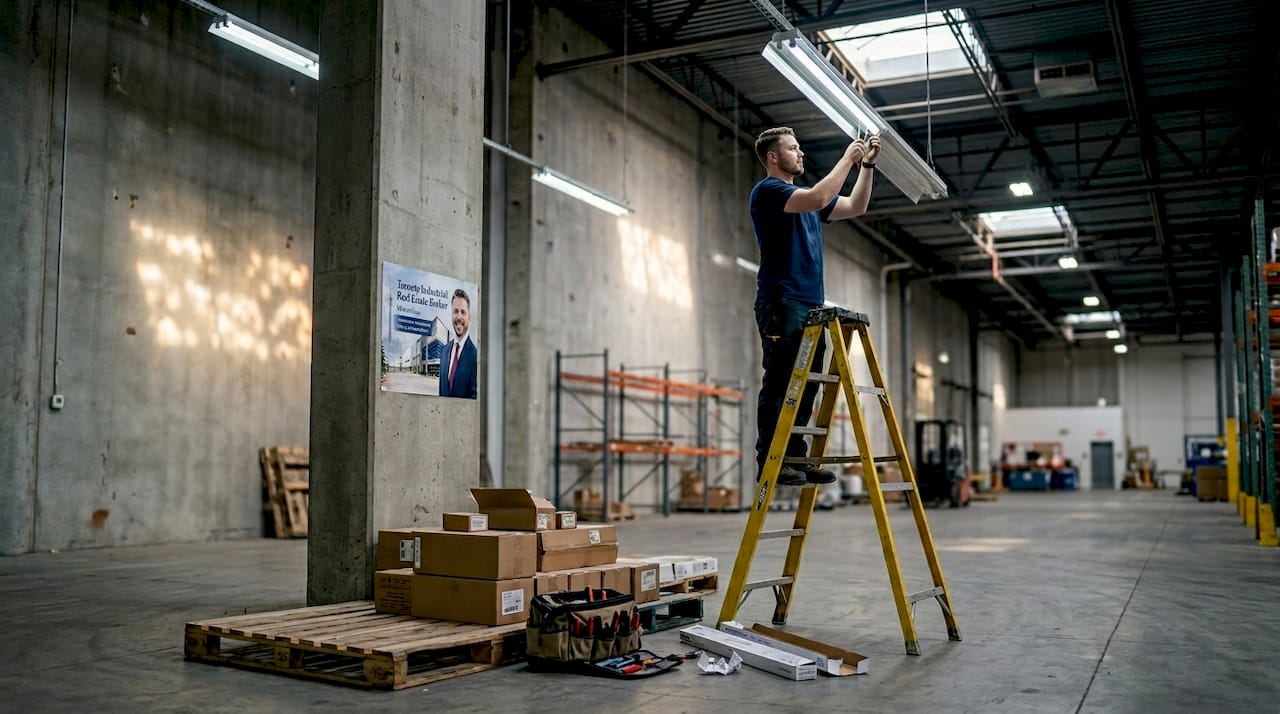
The 270 Spinnaker Way warehouse in Concord, Ontario, is a compelling example. This 216,377 square foot facility replaced its ageing fluorescent fixtures with a full LED system. The result was dramatic: foot-candle output jumped from a dim 8 to 10 range up to over 100, transforming the working environment. The project also secured a
$53,420 IESO rebate , significantly shortening the payback period.
For high-usage GTA industrial buildings, LED retrofits offer the quickest ROI at 12 to 24 months, factoring in rebates and ongoing energy savings. That is a remarkably short payback window for a capital improvement.
The benefits extend well beyond the utility bill:
Immediate operating cost reduction
from lower energy consumption
Improved safety and productivity
for tenants and their workers
Faster leasing cycles
as well-lit spaces are more attractive to prospective occupants
Reduced maintenance costs
given LED's longer lamp life versus fluorescent
Eligibility for IESO rebates
that can offset 20 to 40 percent of project costs
"High light levels in warehouse and logistics environments directly support worker productivity, reduce error rates, and improve safety outcomes. Tenants increasingly specify minimum lighting standards in lease requirements."
For
GTA industrial space examples
that illustrate how facility quality drives leasing velocity, the pattern is consistent: well-maintained, efficiently lit buildings lease faster and hold tenants longer.
Pro Tip: Submit your IESO rebate application before construction begins, not after. Pre-approval locks in your incentive amount and avoids the risk of programme funding running out mid-project.
Building envelope upgrades: insulated cladding for long-term returns
For maximising long-term asset value, exterior upgrades such as envelope and cladding play an outsized role. These are not glamorous improvements, but they are among the most financially durable investments an industrial property owner can make.
Envelope upgrades typically involve over-cladding: applying a new insulated panel system and rainscreen over the existing exterior wall. This approach avoids the cost and disruption of full demolition while dramatically improving thermal performance. Over-cladding delivers added insulation and a rainscreen, slashing energy loss and extending building lifespan by 30 or more years to meet Ontario Building Code requirements.
The benefits stack up over time:
30-plus year lifespan extension
on the building exterior
Significant heating and cooling savings
from improved thermal resistance
Enhanced compliance
with current and anticipated OBC energy standards
Modern aesthetic
that improves curb appeal and marketability
Reduced risk
of moisture infiltration and related structural damage
Eligible properties are typically those built before 2000 with single-skin metal or concrete panel exteriors. The upgrade is particularly well-suited to large-footprint warehouses and distribution centres, which have substantial wall area and high heating loads. Understanding which property types for investors benefit most from envelope work helps you prioritise across a mixed portfolio.
For further research on upgrade strategies and GTA marke...

About Michael Law
Managing Partner and Industrial Real Estate Broker at Lennard Commercial Realty. Representing tenants and landlords across Toronto and the GTA for 15+ years. Michael specializes in GTA industrial real estate — connect with Toronto's leading industrial broker at mlawrealestate.com/industrial-broker-toronto.