Warehouse renewal negotiation tactics: a tenant playbook
By Michael Law · Industrial Real Estate Broker, Lennard Commercial Realty
Start 9 to 18 months before your lease expires: verify your renewal notice window, gather market comparables, and invite competing written proposals from three to five landlords. Those three moves, run in parallel, are what separate tenants who land real concessions from tenants who accept whatever their landlord offers first.
Do this now:
- Pull your lease and confirm the exact renewal notice deadline and the fair market rent formula (or lack of one).
- Set a calendar reminder 60 days ahead of that deadline, then start your outreach immediately.
Three tracks run at once from here:
- Legal counsel reviews the renewal clause, notice mechanics, and any assignment or demolition rights.
- You launch a compressed outreach to three to five comparable landlords for written proposals.
- You model total cost of occupancy on every offer, not just the headline rent.
Pro Tip: Never let your landlord know you’re negotiating solo. A tenant with no visible alternative gets the landlord’s opening offer, not their best one.
Key Takeaways
Warehouse renewal negotiation tactics succeed when tenants create real competition among landlords and evaluate every offer by total cost of occupancy, not face rent alone.
| Point | Details |
|---|---|
| Start early | Begin 9 to 18 months before expiry and confirm your exact notice deadline in writing. |
| Build competition | Contact three to five landlords within a two to three week window for written proposals. |
| Target the right levers | Push TI allowance, free rent, and CAM caps before negotiating on face rent. |
| Compare true cost | Use effective annual rent, including amortized TI and free rent, to compare offers. |
| Get expert representation | Michael Law |
Table of Contents
- When to start and how to prepare for warehouse lease renewal negotiations
- How to benchmark rents and build credible relocation alternatives
- What are the primary negotiation levers at renewal?
- How do you compare renewal offers using total cost of occupancy?
- How do you run a competitive process to negotiate lease renewals?
- What benchmarks and red flags should tenants watch for?
- What due diligence and legal signoff steps protect you before signing?
- Quick checklist: questions to ask and red flags that need escalation
- Author perspective: why renewal is a market process, not a conversation
- How tenant representation changes your renewal outcome
- Sources
- FAQ
When to start and how to prepare for warehouse lease renewal negotiations
Nine to eighteen months out is the standard window recommended for commercial lease renewal negotiation in Ontario, and larger or specialized facilities (cold storage, heavy racking, custom power) need the longer end of that range because relocation, if it comes to that, takes time to execute.
Before anything else, pull the lease and check five things:
- The renewal option language and whether it’s a right or merely a right of first offer.
- The notice deadline mechanics: exact date, delivery method, and what happens if you miss it.
- How fair market rent gets defined and who decides if you disagree.
- Assignability and subletting rights, in case your space needs change mid term.
- Any landlord demolition or relocation clauses buried in the boilerplate.
Ontario commercial tenants have no automatic statutory right to renew. Renewal rights exist only because they were negotiated into the lease, and exercise windows, often six to twelve months, are strictly enforced.
Pro Tip: Bring in legal counsel first if your notice window is ambiguous or already close. Bring in a broker first if you’re confident on timing but unsure what the market will bear.
How to benchmark rents and build credible relocation alternatives
Landlords respect numbers, not complaints. You need submarket asking rents, current vacancy rates, and recent comparable transactions, pulled from local listings and broker networks, before you say a word about renewal terms.
A credible alternative isn’t a phone call to a competing landlord. It’s a written proposal, matched against your actual requirements (square footage, clear height, dock doors, power) on a like for like basis, with a timeline that lines up with your renewal decision date.
Gather these before you negotiate:
- Current submarket vacancy range for your building type and size class.
- Typical TI allowances being offered on comparable deals.
- Standard free rent periods in your submarket right now.
Contacting a minimum of three to five landlords at once, compressed into a two to three week window, is what turns a polite renewal conversation into genuine leverage.
What are the primary negotiation levers at renewal?
Face rent gets the attention, but it’s usually the hardest number to move. The levers that actually shift your total cost are tenant improvement (TI) allowance, free rent or abatement, the escalation structure (CPI-linked versus fixed steps), the CAM or operating expense cap, who owns repair and structural responsibility, and your restoration obligations at lease end.
Realistic targets, grounded in current practice:
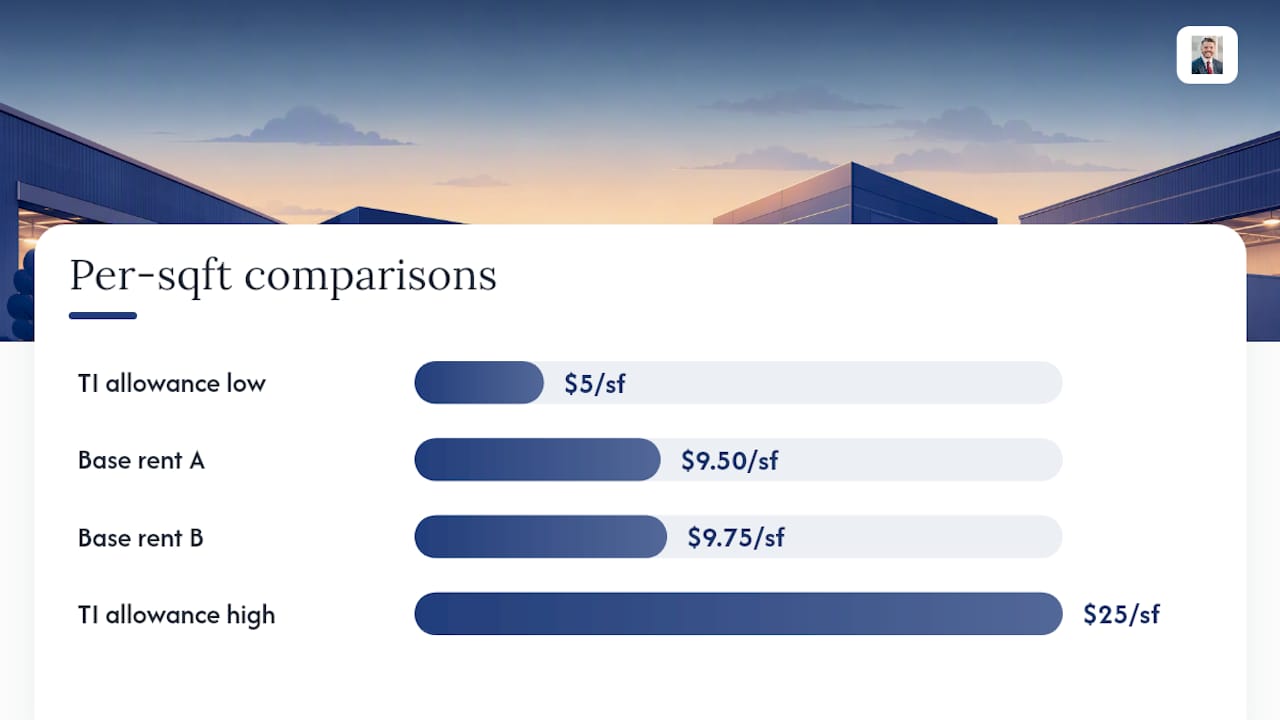
- TI allowance: roughly $5 to $25 per square foot depending on use, with heavier fit outs like automation or racking commanding the higher end.
- Free rent concessions are often negotiated as part of the lease term, with roughly a month per year being a common target.
- CAM cap: push for controllable expenses capped around 3 to 5% annual growth.
- Roof and structure: these stay landlord obligations, full stop, not shared maintenance items.
Landlords hand out TI, abatement, and expense caps more readily than a face-rate cut because those concessions don’t show up on the headline rent they report to their own investors or lenders. That’s exactly why they’re your best targets.
Pro Tip: Ask for the concessions landlords don’t have to disclose publicly before you push on the number everyone can see.
How do you compare renewal offers using total cost of occupancy?
Comparing two proposals by face rent alone is how tenants leave money on the table. The right unit of comparison is effective annual rent across the full term, including amortized TI and the cash effect of free rent.
Build a simple worksheet for each offer:
- Total base rent over the term, year by year.
- Subtract the value of free rent months.
- Add amortized TI cost (if the landlord funds it and recovers it through rent).
- Add projected CAM and operating expense exposure using the cap you negotiated.
- Divide by total square footage and term length for your effective annual rate.
| Offer Component | Landlord A | Landlord B |
|---|---|---|
| Base rent (year 1, per sq ft) | $9.50 | $9.75 |
| Free rent (months) | 4 | 6 |
| TI allowance (per sq ft) | $5 to $25 per square foot | $5 to $25 per square foot |
| CAM cap (annual) | 4% | Uncapped |
Pro Tip: Normalize hidden items like capital expenditure exposure, insurance obligations, and restoration liability before you compare final numbers. An uncapped CAM line can quietly erase a lower headline rent.
How do you run a competitive process to negotiate lease renewals?
A renewal negotiation without competition is just you accepting the landlord’s first number with extra steps. Running an actual process changes that dynamic in measurable ways, according to the same competitive leverage research cited above.
The playbook:
- Build a requirements matrix (size, clear height, power, dock doors, location radius).
- Identify three to five target landlords, including your current one.
- Launch simultaneous outreach within a two to three week window.
- Request standardized written proposals covering base rent, term, TI, free rent, CAM structure, and renewal terms.
- Evaluate all proposals using your total cost of occupancy worksheet.
- Call your top two for best and final.
Specificity matters when you request proposals. Vague requests get vague answers; a defined matrix gets comparable numbers back.
Pro Tip: Request best and final only after you’ve received every proposal. Moving too early tips your hand and kills the pressure you just built.

What benchmarks and red flags should tenants watch for?
Current market norms worth knowing before you sit down at the table: controllable CAM caps around 3 to 5%, TI ranges from $5 to $25 per square foot for industrial space, and free rent near one month per year of term. Escalations running meaningfully above these ranges usually signal a landlord testing what you’ll accept rather than reflecting genuine market conditions.
Watch for these red flags:
- A fair market rent clause with no defined method or comparable set.
- CAM pass-throughs with no cap at all.
- Landlord relocation or demolition rights with no compensation attached.
- Vague “maintenance” language covering roof or structural systems.
FMR is rarely objective. Define your comparables up front or agree to a capped formula with an independent appraiser or arbitrator to resolve disputes before they happen.
Tenant representation exists precisely to catch these clauses before signature. As Managing Partner at Lennard Commercial, Michael Law has spent over a decade advising industrial occupiers across the GTA on exactly this kind of clause-level risk, work detailed at Mlawrealestate.
What due diligence and legal signoff steps protect you before signing?
A signed renewal with an undiscovered roof problem is a lease you’ll regret within eighteen months. Order an independent inspection covering roof condition, dock equipment, HVAC, electrical infrastructure, and any deferred maintenance before you finalize terms; a structural feasibility review is worth commissioning on any building over ten years old.
On the contract side, verify:
- TI disbursement conditions and timing.
- Whether your renewal formula uses a fixed step, a cap, or open FMR, and what dispute resolution applies.
- Assignment and subletting rights.
- Surrender and restoration obligations at term end.
Roof replacement on a large industrial building can run into six figures. Never accept vague “maintenance” language. Name the system and allocate responsibility clearly in the document.
Bring legal counsel in for final review before signature, not after, and confirm every negotiated point appears verbatim in the executed lease or amendment. Verbal agreements and email confirmations don’t survive a dispute.
Quick checklist: questions to ask and red flags that need escalation
Ask your landlord directly: What triggers the notice deadline, and how must notice be delivered? Who pays for roof, HVAC, and structural repairs? What’s the TI disbursement process and timeline? How often is CAM reconciled, and against what documentation?
Three red flags mean stop and escalate immediately:
- A fair market rent clause with no defined method.
- CAM pass-throughs with no annual cap.
- Restoration language requiring full removal of racking, plant, or fixtures you installed.
Any of these three warrants a call to counsel or your broker before you sign anything.
Author perspective: why renewal is a market process, not a conversation
Too many tenants treat renewal as a negotiation with one landlord. It’s actually a market process, and your landlord’s real cost, the months of vacancy and lost income if you walk, is your leverage. Landlords who sense no competing option price accordingly. Landlords who see three written proposals on your desk behave differently.
Pro Tip: Document every competing proposal in writing, then ask your top two for best and final before you decide.
How tenant representation changes your renewal outcome
Running a genuine competitive process, matrix, outreach, comparison worksheet, best and final, takes real hours most operations teams don’t have spare during a renewal cycle. Michael Law | Lennard Commercial handles that process directly: sourcing comparable alternatives across the GTA, coordinating written proposals from multiple landlords, modelling total cost of occupancy on each one, and negotiating TI, CAM caps, and restoration language before your legal counsel ever sees a draft.

If your renewal notice window falls within the next 18 months, the time to start this process is now, not after you’ve already accepted the landlord’s first offer. Michael Law’s industrial tenant representation work across Toronto and the GTA covers exactly this kind of renewal negotiation, and current listings across the region are available at Mlawrealestate. Reach out through the firm’s location page to discuss your specific renewal timeline before your notice deadline puts you at a disadvantage.
Sources
- Renewal clauses in Ontario leases — how to negotiate fair terms · Hadri Law
- Creating competition: How to leverage other industrial spaces · Van Vlissingen and Co.
- How do I negotiate an industrial or warehouse lease? · Pulse RevOps
FAQ
What is the 70/30 rule in negotiation?
It’s a general negotiation principle suggesting you spend roughly 70% of the conversation listening and asking questions, and 30% speaking, so you gather more market and landlord-motivation intelligence than you give away.
What’s the most effective warehouse renewal negotiation tactic?
Running a genuine competitive process, soliciting written proposals from three to five landlords within a compressed window, consistently produces stronger concessions than negotiating one on one with your current landlord.
What are the four golden rules of negotiation?
Common versions emphasize preparation, listening more than talking, never revealing your walk-away point too early, and putting agreed terms in writing immediately, all of which apply directly to lease renewal talks.
What are some effective negotiation tactics for lease renewals?
Benchmark market rents before you talk numbers, request written proposals from competing landlords, prioritize TI and CAM caps over face-rate cuts, and never negotiate against a deadline the landlord controls.
When should I involve a broker or lawyer in a warehouse renewal?
Involve legal counsel as soon as your lease’s notice window or fair market rent clause looks ambiguous, and involve a broker like Michael Law | Lennard Commercial early enough to build genuine market alternatives before your notice deadline arrives.
Recommended

About Michael Law
Managing Partner and Industrial Real Estate Broker at Lennard Commercial Realty. Representing tenants and landlords across Toronto and the GTA for 15+ years. Michael specializes in GTA industrial real estate — connect with Toronto's leading industrial broker at mlawrealestate.com/industrial-broker-toronto.