14 ways to boost industrial ROI without buying more real estate
By Michael Law · Industrial Real Estate Broker, Lennard Commercial Realty
The fastest path to higher industrial ROI is a lease-first asset management strategy: tighten lease terms and escalations, then run the building on an ISO 55000 style Asset Management Plan (AMP) instead of reactive fixes. Together, these two moves lift net operating income (NOI) faster than most capital projects, and they cost far less to start.
The three highest-impact levers, in order:
- Restructure leases for stronger triple-net (NNN) recovery, longer terms and market escalations.
- Cut vacancy and rollover risk through tenant mix and lease-up execution.
- Move maintenance from reactive to planned, using a CMMS and AMP framework aligned with ISO 55000 principles and the funding logic behind Canadian programs like CNAM and FCM.
Michael Law | Lennard Commercial applies this exact sequence with GTA owners and occupiers, because it’s the order that produces measurable NOI movement within one lease cycle rather than years.
Key Takeaways
Industrial ROI improves fastest when lease restructuring and disciplined asset management happen before major capital spending.
| Point | Details |
|---|---|
| Start with leases | Escalations and NNN recovery language lift NOI in weeks, not years. |
| Build an AMP early | A documented plan protects asset value under ISO 55000 principles before capex decisions get made. |
| Rank capex by payback | Prioritize upgrades like LED retrofits and dock additions that pay back within one lease term. |
| Track NOI monthly | Small NOI gains compound into large valuation increases at typical cap rates. |
| Engage a specialist broker | Michael Law |
Table of Contents
- What are the fastest ways to boost industrial ROI?
- How do leasing terms improve net operating income?
- Does site selection and right-sizing actually move rent?
- How do you build strategic asset management into an industrial property?
- Which capital upgrades pay back fastest?
- What financing structures amplify industrial returns?
- How do you improve tenant mix without raising vacancy risk?
- Which technology tools cut costs and shorten vacancy?
- What’s a realistic timeline to implement these ROI tactics?
- How do you measure whether your ROI strategy is working?
- Where Michael Law | Lennard Commercial fits into your ROI plan
- A GTA broker’s take on what actually moves the needle
- Sources
- FAQ
What are the fastest ways to boost industrial ROI?
Rank tactics by how fast they move NOI against how much they cost to execute. Lease and operating fixes come first because they touch cash flow immediately; capital projects come later because they take longer to design, permit and lease into.
- Rent and escalation review — weeks to implement, low cost, high impact.
- Tenant mix and vacancy reduction — one to three months, low to medium cost.
- CMMS rollout and maintenance triage — three to six months, medium cost.
- AMP/SAMP development — six to twelve months, medium cost, high long-term impact.
- Value-add capex (docks, clear height, electrical) — twelve or more months, high cost.
| Priority tier | Time to impact | Cost bracket |
|---|---|---|
| Lease optimisation and escalations | Weeks to 3 months | Low |
| Tenant mix and lease-up execution | 1 to 3 months | Low to medium |
| CMMS and maintenance program | 3 to 6 months | Medium |
| Full AMP/SAMP rollout | 6 to 12 months | Medium |
| Value-add capital projects | 12+ months | High |
Owners chasing quick wins should work top to bottom. Occupiers evaluating a lease renewal usually only need the first two rows.
How do leasing terms improve net operating income?
Lease structure drives more of your NOI than almost any single capital decision. Industrial leases typically run longer than retail or office terms, longer lease terms typical in industrial properties. That length alone gives landlords leverage to negotiate triple-net (NNN) recovery language that shifts taxes, insurance and maintenance costs onto tenants.
Three moves tend to matter most:
- Push for CPI-linked or fixed step escalations rather than flat renewal rates.
- Tighten NNN recovery clauses so operating cost increases pass through automatically.
- Weigh tenant covenant strength and remaining lease term as heavily as face rent, since both directly affect financeability.
Negotiation levers worth using include step-rent structures, amortized tenant improvement allowances instead of upfront cash outlays, and carefully scoped release or sublease permissions that protect your downside if a tenant’s business changes.
Pro Tip: Free rent and TI packages look generous on a term sheet, but run the payback math first. A six-month concession on a ten-year lease with a creditworthy tenant is usually a better trade than a shorter lease with no concession and a weaker covenant.
For a deeper breakdown of escalation structures, see this industrial rent escalation guide, and for NNN mechanics specifically, review triple net lease strategies built for GTA owners and tenants.
Does site selection and right-sizing actually move rent?
Yes, and it moves rent more predictably than most owners expect, because tenants are increasingly specific about the physical spec they’ll pay for.
Location factors that matter most:
- Direct highway access and proximity to 400-series interchanges or major arterials.
- Last-mile delivery routes for logistics and e-commerce tenants.
- Local labour pool depth, especially for facilities running multiple shifts.
- Zoning that permits the tenant mix you’re targeting, not just what’s currently occupied.
Building specs tenants screen for:
- Clear height of 32 feet or higher for modern logistics users.
- Sufficient dock doors and a functional dock configuration for the trailer count.
- Adequate column spacing for racking efficiency.
- Electrical capacity that supports automation, refrigeration or EV fleet charging.
- Yard depth and trailer parking.
Right-sizing tactics like subdividing a large bay into smaller units, adding drive-in doors, or shrinking an oversized office footprint back to warehouse space can widen your tenant pool without a major redevelopment.
How do you build strategic asset management into an industrial property?
Reactive maintenance protects nothing. A documented Asset Management Plan protects value, because it forces lifecycle decisions to be made on data instead of on whichever system failed last. An Asset Management Plan built on ISO 55000 principles delivers the required service level at the lowest lifecycle cost, which is the entire point of the exercise.
A working AMP generally covers seven elements:
- Asset inventory and condition baseline.
- Defined levels of service (what “acceptable performance” means for each system).
- Condition and risk assessment across roofing, HVAC, electrical and structural systems.
- Lifecycle replacement strategies with realistic timelines.
- Financial forecasting tied to reserve planning.
- A prioritised improvement plan.
- Continuous monitoring and plan updates.
A CMMS is what makes the plan operational rather than theoretical. CMMS platforms map directly onto ISO 55000 through a centralised asset register, work order history, KPI dashboards and Facility Condition Index (FCI) forecasting that turns raw maintenance logs into capital planning inputs.
Municipalities across Canada now face legislated AMP deadlines under provincial infrastructure frameworks, and that shift matters for industrial owners too: as public asset management practice becomes the baseline expectation, lenders and buyers increasingly benchmark private industrial portfolios against the same standard when assessing capital risk.
Which capital upgrades pay back fastest?
Not every capex dollar returns the same. Some upgrades move achievable rent within one leasing cycle; others take longer but protect the asset against obsolescence.
| Upgrade | Cost tier | Time to complete | Primary return driver |
|---|---|---|---|
| LED and lighting efficiency retrofit | Low | Weeks | Lower tenant operating costs, faster lease-up |
| Additional dock doors | Medium | 2 to 4 months | Higher rent for logistics tenants |
| Electrical upgrade for cold storage or EV | Medium to high | 4 to 6 months | Access to premium tenant segments |
| Clear height increase | High | 8 to 12 months | Higher rent per square foot |
| Façade and site improvements | Low to medium | 1 to 3 months | Faster lease-up, marketability |
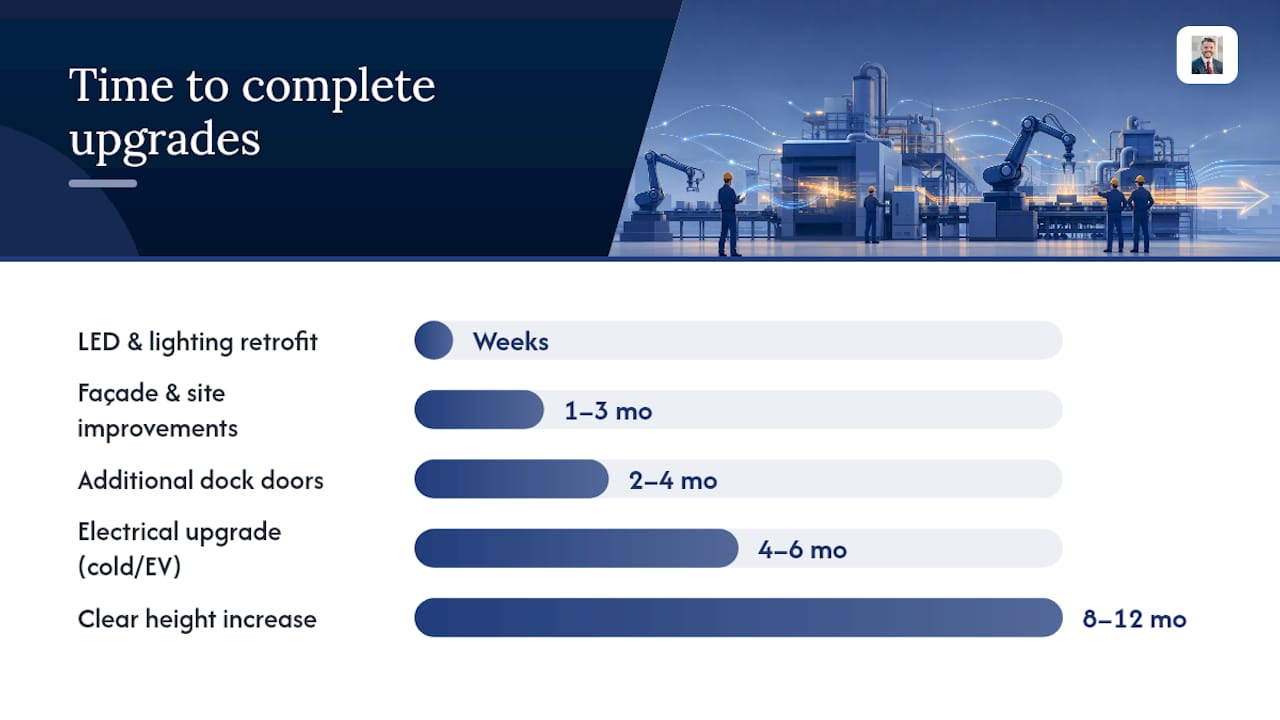
A simple pro forma: raising clear height on a 100,000 square foot bay might add $1.00 to $1.50 per square foot in achievable rent, but the construction cost and downtime often push payback past five years. An electrical upgrade for a cold storage tenant, by contrast, can be recovered inside a single lease term if it unlocks a specialized tenant willing to pay a premium.
Pro Tip: When the upgrade serves one tenant’s specific use, negotiate a tenant-funded TI or build-to-suit structure instead of paying for it as landlord capital. Save landlord-funded upgrades for improvements that widen your tenant pool broadly, like LED retrofits or dock additions offer relatively quick payback.
See practical cost references in this guide to industrial property upgrades and tenant improvement examples for GTA industrial spaces.
What financing structures amplify industrial returns?
Leverage cuts both ways, but used conservatively it’s one of the more reliable ROI multipliers available to industrial owners. A property generating a 6% unleveraged return can produce a meaningfully higher cash-on-cash return once financed at a rate below the property’s yield, provided debt service coverage ratio (DSCR) stays within lender comfort, typically 1.20x to 1.25x or higher for industrial assets.
- Pre-leasing before construction financing closes materially improves loan terms and reduces carry risk.
- Build-to-suit structures let occupiers lock in spec while landlords secure a long-term, creditworthy tenant from day one.
- Sale-leaseback arrangements free up capital for owner-occupiers without giving up operational control.
- CMHC multi-unit financing programs can support multi-tenant industrial deals under specific eligibility criteria.
Lenders underwrite the same fundamentals every time: tenant credit quality, remaining lease term, and whether escalations are strong enough to protect the loan through the term. Markets with low vacancy and strong absorption make all of this easier to finance, because stabilized assets with creditworthy tenants are exactly what underwriting teams want to see.
Pro Tip: Order your Phase 1 Environmental Site Assessment early in any acquisition or refinancing timeline. Lenders won’t move past it, and a late-discovered issue can stall a closing by weeks.
For a full walkthrough of acquisition financing considerations, see how to acquire industrial assets for successful investment.
How do you improve tenant mix without raising vacancy risk?
A multi-tenant park with staggered lease expiries and a mix of credit profiles is far more resilient than one anchored to a single tenant’s renewal decision.
- Stagger lease expirations across the property so no single year carries excessive rollover exposure.
- Blend larger, stable-credit tenants with smaller flexible-term users to widen your leasing funnel.
- Use targeted broker outreach, virtual property tours and staged incentives rather than blanket rent discounts.
- Standardize core lease clauses (escalation, recovery, assignment) to speed up approvals and reduce legal back-and-forth.
- Screen every prospective tenant’s credit before signing, since a defaulted lease costs far more than a slightly longer vacancy.
Which technology tools cut costs and shorten vacancy?
You don’t need an enterprise IT budget to get most of the benefit here.
- CMMS/EAM platforms centralize work orders, asset history and condition data, the foundation for any AMP.
- Lease administration software flags upcoming expiries, escalation dates and renewal options automatically.
- Market data tools benchmark your rent against comparable GTA industrial listings in real time.
- Virtual tour platforms shorten time-to-lease for out-of-market or international tenant prospects.
Predictive maintenance and condition monitoring let you intervene before a system fails rather than after, which avoids emergency labour costs and gives you leverage in lease renewal conversations, since a well-maintained building justifies a stronger ask.
What’s a realistic timeline to implement these ROI tactics?
Sequence matters. Trying to run capital projects before you’ve fixed leasing and vacancy usually wastes money.
- 0 to 90 days: lease audit, escalation review, marketing push on vacant space, quick low-cost capex like lighting.
- 3 to 12 months: AMP development, CMMS implementation, medium-cost upgrades like dock additions.
- 12+ months: major retrofits, clear height changes, build-to-suit projects.
| Phase | Who to engage | Typical cost bracket |
|---|---|---|
| 0 to 90 days | Leasing broker, marketing team | Low |
| 3 to 12 months | Asset manager, CMMS vendor, contractor | Medium |
| 12+ months | General contractor, environmental consultant, lender | High |
Build a contingency reserve of roughly 10% into any capex phase. Industrial construction and equipment costs have moved unpredictably in recent years, and a plan without a reserve line gets derailed by the first unexpected quote.
How do you measure whether your ROI strategy is working?
NOI is the number that matters most, because even a modest NOI increase compounds into a much larger valuation gain once capitalized at market cap rates. A $20,000 annual NOI improvement at a 6% cap rate adds roughly $333,000 in asset value, which is why lease and operating fixes deserve priority over slower capital projects.
| KPI | Definition | Typical benchmark |
|---|---|---|
| NOI | Rental income minus operating expenses | Track monthly, compare year over year |
| Occupancy rate | Leased square footage over total | high occupancy rates considered stabilized in most GTA submarkets |
| DSCR | NOI divided by annual debt service | 1.20x to 1.25x+ preferred by most lenders |
| Cash-on-cash return | Annual cash flow over equity invested | Varies by leverage and market |
| FCI | Deferred maintenance cost over replacement value | Lower is better; tracked annually |
- Report NOI and occupancy monthly.
- Update FCI and capital forecasts annually alongside your AMP review.
- Reconcile actual escalations against lease terms every renewal cycle.
Track a full breakdown of expense recovery and occupancy cost drivers in this industrial occupancy cost guide for GTA investors.
Where Michael Law | Lennard Commercial fits into your ROI plan
Most of what raises industrial ROI, lease restructuring, tenant credit screening, AMP development, requires local market knowledge that a spreadsheet alone can’t replicate. Michael Law | Lennard Commercial works directly with GTA owners, investors and occupiers on the exact sequence covered above: tenant representation, lease negotiation, site selection advisory and AMP or CMMS guidance for owners who want a structured maintenance program without building one from scratch internally.
If you’re weighing a lease renewal, evaluating a right-sizing move, or trying to figure out which capital project actually pays back, the fastest next step is a direct conversation rather than another spreadsheet exercise. Michael Law brings over a decade of GTA industrial leasing experience to that conversation, and Lennard Commercial’s platform supports it with market data across Mississauga, Brampton, Vaughan and the broader GTA industrial corridor. Start with a review of your current lease terms and building spec through industrial tenant representation services in Toronto, or browse current available industrial properties if you’re evaluating a move or expansion.
A GTA broker’s take on what actually moves the needle
Owners tend to overestimate what capital projects will do for their return and underestimate what a well-negotiated lease will do. I’ve watched a lease renewal with tightened escalations outperform a six-figure capital upgrade in year-one NOI impact more than once.
The GTA market rewards this sequencing specifically because industrial demand here remains strong, driven by e-commerce and supply chain realignment. That kind of demand gives landlords real leverage on escalations and NNN terms, leverage that gets left on the table when owners jump straight to capital planning. The other pattern I see constantly: value-add opportunities cluster around older buildings with inadequate clear height or dock capacity in submarkets like Brampton and Vaughan, where tenant demand for modern spec has outpaced available supply.
Learn more about Michael Law’s background and transaction history at Lennard Commercial.
Sources
- Asset Management Plan Template: 7-Step Guide (ISO 55000) | AssetLab
- Predictive maintenance and process automation | CTH Industrial Controls
- Industrial property demand Canada 2026 | Jeremy Kresky
FAQ
What is the fastest way to boost industrial ROI?
Restructuring lease terms, escalations and NNN recovery language typically delivers the fastest NOI gains, often within one leasing cycle, ahead of any capital project.
How does an Asset Management Plan improve ROI?
An AMP built on ISO 55000 principles documents lifecycle strategies that deliver required service levels at the lowest lifecycle cost, which protects property value and reduces unplanned capital spending.
Which capital upgrades pay back the fastest?
Lower-cost upgrades like LED retrofits, façade improvements and additional dock doors tend to pay back faster than clear height increases, which require larger investment and longer construction timelines.
What DSCR do lenders expect on industrial properties?
Most lenders require a debt service coverage ratio above one, typically around 1.20x or higher, alongside strong tenant credit and remaining lease term.
Should I hire a broker before starting a lease renewal?
Engaging a broker like Michael Law | Lennard Commercial before renewal negotiations begin typically improves leverage on escalations, NNN terms and tenant credit screening.
Recommended

About Michael Law
Managing Partner and Industrial Real Estate Broker at Lennard Commercial Realty. Representing tenants and landlords across Toronto and the GTA for 15+ years. Michael specializes in GTA industrial real estate — connect with Toronto's leading industrial broker at mlawrealestate.com/industrial-broker-toronto.