GTA industrial leasing process: a 2026 broker's guide
By Michael Law · Industrial Real Estate Broker, Lennard Commercial Realty
TL;DR:
- Tenants need to compare net rent plus TMI to understand total occupancy costs in GTA industrial leasing. Early engagement of a broker before the LOI stage is crucial to negotiate favorable terms and maximize leverage.
The GTA industrial leasing process is the stepwise sequence a tenant follows to identify, secure, fit out, and occupy industrial space — from defining your requirements through to lease execution, tenant improvement approvals, and ongoing lease administration. With Canada’s industrial vacancy rate currently moderate, the process demands more preparation than most tenants expect.
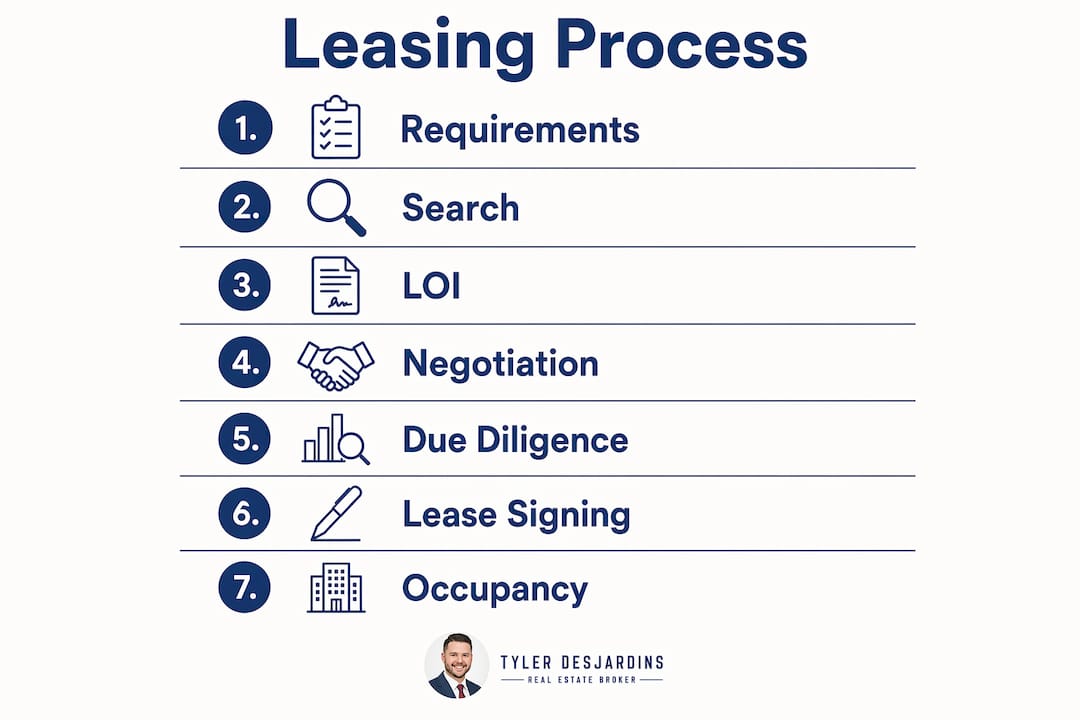
The seven core stages:
- Requirements definition — size, clear height, power, dock count, zoning use (2–4 weeks)
- Market search and site selection — shortlisting properties, touring, comparing total occupancy cost (4–8 weeks)
- Letter of Intent (LOI) — commercial terms, TI, free rent, renewal options (1–2 weeks)
- Due diligence — physical, zoning, environmental, and lease review (2–4 weeks)
- Lease negotiation and execution — legal drafting, clause negotiation, signing (2–6 weeks)
- TI approvals and fit-out — permits, construction, landlord sign-off (4–16 weeks depending on scope)
- Occupancy and lease administration — move-in, TMI reconciliations, renewal tracking (ongoing)
TL;DR — the one metric that matters: always compare net rent plus TMI as your total occupancy cost. A listing advertised at $18.00/sf net with $5.50 TMI equals $23.50/sf gross. GTA TMI typically runs $4.50–$6.50/sf in 2026. That spread is where deals are won or lost.
Table of Contents
How Michael Law | Lennard Commercial reduces your total occupancy cost
Most tenants engage a broker after they have already toured a building. That is too late. The leverage sits at the LOI stage, before commercial terms are set.
Michael Law | Lennard Commercial provides tenant representation across every stage: benchmarking net rents and TMI against comparable transactions, drafting LOI terms that protect you on TI allowances and renewal options, and negotiating caps on controllable operating costs so TMI escalations don’t erode your budget mid-lease. With new supply delivering across outer GTA submarkets in 2026, tenants on 7–10 year deals have real leverage to push for longer free-rent periods or higher TI — but only if they know the market well enough to ask.

Pro Tip: Convert every landlord concession (free rent, TI, building repairs) into a single net effective rent figure. Divide the total dollar value of concessions by the lease term in months, subtract from gross monthly rent, and compare properties on that number alone — not headline rates.
On GTA industrial lease negotiations, the practical wins include base-year tax protection, audit rights on TMI pass-throughs, and TI amortised as an explicit rent credit. Landlords on older stock are willing to negotiate all three right now. Reach out to Michael Law | Lennard Commercial to benchmark your next deal before you submit an LOI.
FAQ
What are the three types of industrial properties?
Industrial properties fall into three main categories: warehouse/distribution (high clear heights, dock-level doors, low office ratio), manufacturing (heavy power, reinforced floors, ventilation), and flex industrial (lower clear heights, higher office ratio, suited to light assembly or showroom uses).
What is the industrial vacancy rate in Canada right now?
Canada’s overall industrial vacancy rate stabilised at 5.5% in the first quarter of 2026. GTA submarkets vary — outer markets like Milton and Brampton tend to show higher availability than infill Toronto nodes.
What does a GTA industrial lease typically cost?
Most GTA industrial leases are triple-net structures, meaning tenants pay net rent plus TMI (taxes, maintenance, insurance). TMI typically runs $4.50–$6.50 per square foot annually in 2026; always add it to the advertised net rate to get your true occupancy cost.
When should you hire a tenant representative? Industry network resources like Brokers Connect can help tenants find experienced commercial brokers early in the process.
Before you tour your first building. A broker engaged at the requirements stage shapes the search criteria, prevents you from overpaying on TMI, and ensures the LOI protects renewal rights and TI commitments before a landlord locks in terms.
Key takeaways
The GTA industrial leasing process runs seven stages, and total occupancy cost (net rent plus TMI) is the single figure every tenant must calculate before signing anything.
| Point | Details |
|---|---|
| Seven-stage process | Requirements → search → LOI → due diligence → negotiation → fit-out → occupancy and administration. |
| TMI adds real cost | GTA TMI typically runs $4.50–$6.50 per square foot annually in 2026; a net listing advertised in this range can cost more when TMI is included. |
| Engage a broker early | Representation before the LOI stage is where TI, free rent, and cap negotiations are won. |
| 2026 tenant leverage | New outer-GTA supply gives tenants on 7–10 year deals room to push for higher TI and longer free rent. |
| Michael Law | Lennard Commercial |
Recommended

About Michael Law
Managing Partner and Industrial Real Estate Broker at Lennard Commercial Realty. Representing tenants and landlords across Toronto and the GTA for 15+ years. Michael specializes in GTA industrial real estate — connect with Toronto's leading industrial broker at mlawrealestate.com/industrial-broker-toronto.