Intensification impact on Toronto industrial real estate
By Michael Law · Industrial Real Estate Broker, Lennard Commercial Realty
TL;DR:
- Intensification in Toronto’s industrial market focuses on densifying existing employment lands through vertical development instead of converting land to housing. This shift creates a valuation premium for transit-adjacent and redevelopment-ready sites, while older assets face increased risks and softening in value. Limited supply, policy protections, and transit expansion are shaping higher rents, investment yields, and operational considerations across the GTA.
Intensification in Toronto’s industrial market means something specific: it is the shift toward vertical, multi-level, and operationally denser use of existing employment lands, not a wholesale conversion to housing. The City of Toronto’s Employment Areas policy explicitly conserves these lands for business and economic activity while pushing for more intensive physical development on a finite supply. For occupiers and investors, the immediate consequence is a two-speed market: transit-oriented and redevelopment-ready sites carry a growing valuation premium, while older single-storey assets in areas facing encroachment from sensitive uses are softening. Supply remains tight, with new construction starts slowing and the pipeline constrained by land scarcity and construction costs. Contact an industrial broker before committing to a lease, purchase, or redevelopment to get a current site assessment.
Key intensification impacts at a glance:
- Value split: Transit-adjacent and redevelopment-ready industrial land commands a premium; aging single-storey stock in mixed-use transition zones faces pressure.
- Policy protection: The Toronto Official Plan forecasts 1.98 million jobs by 2051 and treats Employment Areas as finite and irreplaceable.
- Supply crunch: GTA industrial vacancy sits near historic lows, and the construction pipeline is tightening, which pushes rents upward on well-located space.
- Operational risk: Sensitive uses near industrial zones can trigger noise and traffic complaints that constrain operating hours and permitting.
Supply context: Industry observers note the GTA construction pipeline has contracted sharply. With limited new supply expected to reach the market within the next several months, occupiers renewing leases or seeking new space face a narrowing window before rents move higher.
Table of Contents
- How does intensification affect sustainability in Toronto’s industrial zones?
- What are the zoning and legal hurdles for industrial intensification in Toronto?
- Recent intensification projects in Toronto: what actually happened
- How transit expansion is reshaping industrial site selection
- What should occupiers and investors actually do right now?
- How intensification is moving rents and investment yields
- Work with Michael Law | Lennard Commercial on your next GTA industrial decision
- FAQ
- Key takeaways
How does intensification affect sustainability in Toronto’s industrial zones?
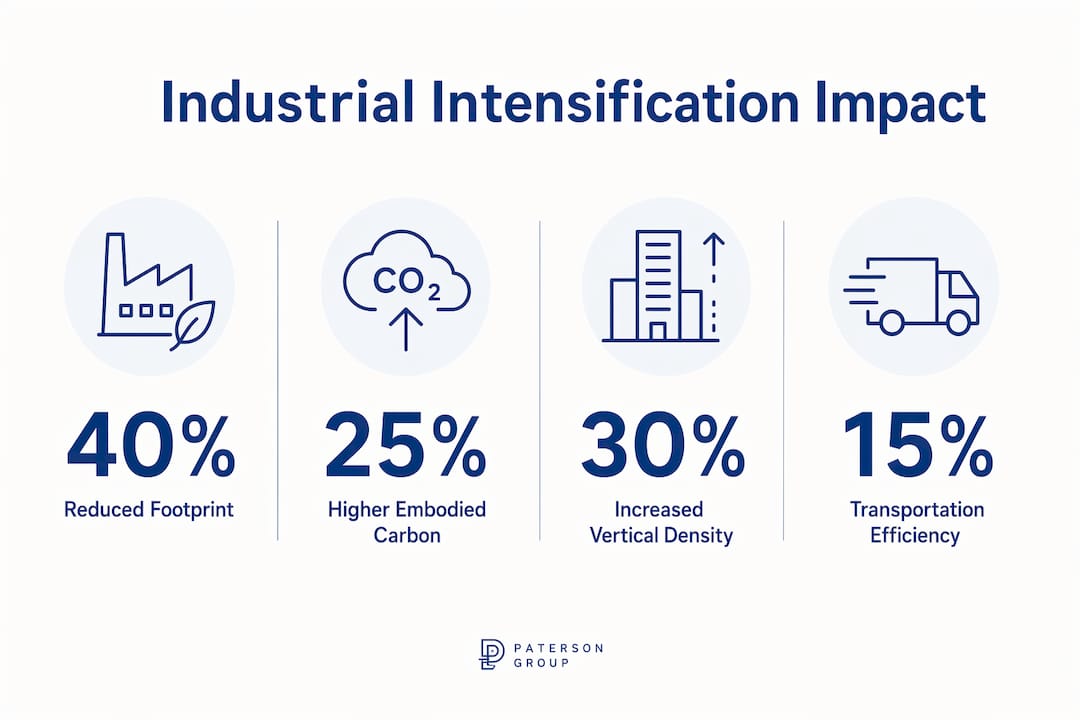
Vertical and multi-level industrial development changes the environmental calculus significantly. Stacking operations onto a smaller footprint reduces land consumption, which matters in a region where the Ontario Greenbelt permanently limits outward expansion. Denser sites also support active and transit-based commuting, cutting vehicle kilometres travelled per employee.
The tradeoff is real, though. Multi-level warehouses require more embodied carbon in construction: heavier structural systems, fire-suppression upgrades, and mechanical lift infrastructure all add material intensity. Green building standards such as LEED and BOMA BEST are increasingly expected on new GTA industrial projects, and some municipalities are beginning to require EV charging infrastructure and stormwater management as conditions of site plan approval. Occupiers evaluating modern facility features should factor these requirements into their operating cost models from day one.
What are the zoning and legal hurdles for industrial intensification in Toronto?
The path through Toronto’s planning system is not straightforward. OPA 591 explicitly prohibits residential uses on Core and General Employment Area lands, which protects industrial operators but also limits the mixed-use upside that some investors have priced in. Any conversion or re-designation requires a Municipal Comprehensive Review, a high bar that takes years and carries no guarantee of approval.
Industry stakeholders responding to OPA 804 have flagged that even partial re-designations can create disinvestment risk by signalling policy uncertainty. For intensification within Employment Areas, the typical process involves a Zoning By-law Amendment, a site plan application, and often a Compatibility/Mitigation Study to demonstrate that new development will not impair adjacent industrial operations. Timelines of two to four years from application to permit are common. Investors modelling redevelopment feasibility should treat approvals as uncertain, not assumed. A practical industrial zoning guide covers the municipal process in detail.
Recent intensification projects in Toronto: what actually happened
The Downsview lands and the East Harbour precinct are the most-cited examples of large-scale employment area intensification in Toronto. Both involve phased, multi-use redevelopment that retains employment floor area while adding density, and both required extensive precinct planning processes before any shovels moved.
At a smaller scale, last-mile logistics operators have been retrofitting older industrial buildings in Etobicoke and Scarborough with racking systems, increased clear heights, and upgraded dock capacity rather than relocating. This internal intensification, operating more efficiently within an existing footprint, is the most common form occupiers actually encounter. The Brampton logistics portfolio and Mississauga distribution centre advisory work by Michael Law | Lennard Commercial illustrates how these operational decisions play out in practice across the western GTA.

How transit expansion is reshaping industrial site selection
The Eglinton Crosstown LRT and the Finch West LRT are the two transit projects most directly affecting industrial corridors. Properties along the Eglinton corridor have seen land value uplift because transit access improves labour catchment for shift-based operations, a factor that matters as much to a food manufacturer as it does to a logistics operator. The 7 Appraisal analysis of commercial property value in Toronto confirms that transit proximity is now a distinct value driver, particularly along corridors targeted for intensification.
Road capacity is the other side of the coin. Intensified industrial nodes generate more truck movements per hectare than low-density warehousing, and several GTA municipalities are reviewing truck route designations as a result. Occupiers should confirm that a site’s truck access is protected under current zoning and that planned road changes will not restrict delivery windows.
What should occupiers and investors actually do right now?
For occupiers:
- Audit your current lease for demolition clauses, redevelopment rights, and notice periods. If your landlord holds land in a transit corridor or Employment Area under review, you may have less security than you think.
- Confirm the site’s Employment Area designation and check whether any OPA or re-designation application is active at the City.
- Model your space needs on a vertical footprint if your current site is under intensification pressure. Clear height, column spacing, and floor-load capacity determine whether a multi-level solution works for your operation.
- Review industrial relocation strategies before your lease expiry window closes.
For investors:
- Evaluate redevelopment feasibility using a full delivery-cost stack: vertical construction premium, lift and racking systems, fire-protection upgrades, and a conservative occupancy cash-flow model. Do not assume rezoning will happen on your timeline.
- Properties with strong cash-flow fundamentals and long-term industrial tenants in protected Employment Areas carry lower risk than speculative redevelopment plays.
- Prioritise sites within 800 metres of rapid transit stops, with highway access and confirmed truck routes.
Pro Tip: Ask your broker to pull the active OPA and Zoning By-law Amendment applications within 500 metres of any site you are evaluating. A nearby re-designation application can signal both opportunity and risk, depending on which side of the boundary your property sits.
How intensification is moving rents and investment yields
Rents on well-located, transit-adjacent GTA industrial space have risen sharply over the past several years, driven by the same supply constraints that intensification is meant to address. As of 2026, average industrial sale prices in the GTA exceed $350 per square foot, up roughly 8% year over year, reflecting the structural floor that Greenbelt policy places under land values.
Multi-level industrial buildings require higher rents to support their capital costs than single-storey warehouses, which narrows the tenant pool to operators who can justify the premium: high-value logistics, cold storage, and advanced manufacturing. Yields on older single-storey assets in mixed-use transition zones are compressing for a different reason: uncertainty about future use and right-to-operate risk reduces the income multiple buyers will pay. The spread between a well-located, transit-served asset and an aging suburban box is widening. For investors, that spread is where the GTA industrial investment strategy conversation starts.
Work with Michael Law | Lennard Commercial on your next GTA industrial decision

Intensification is reshaping which GTA industrial sites hold value, which leases carry hidden risk, and which redevelopment plays are actually feasible. Michael Law, Managing Partner at Lennard Commercial, has spent over a decade advising logistics operators, manufacturers, and investors through exactly these decisions across Toronto, Mississauga, Brampton, Vaughan, Markham, and the broader GTA.
The practical help on offer: tenant representation and lease negotiation with intensification clauses in scope, site selection with Employment Area designation checks built in, redevelopment feasibility scoping, and acquisition and disposition advisory for owners weighing their options. Whether you need a quick site viability check or a full industrial tenant representation engagement, the starting point is a broker-led market briefing tailored to your specific operation and timeline. Reach out through mlawrealestate.com to get that conversation started.
FAQ
What does intensification mean for industrial real estate in Toronto?
Intensification means developing existing employment lands more densely, through multi-level buildings, vertical logistics, or denser operations, rather than converting them to housing. The City of Toronto’s Employment Areas policy protects these lands while encouraging more intensive physical development.
Does intensification threaten my right to operate as an industrial tenant?
It can. Toronto’s by-laws require buffers or design measures when sensitive uses are introduced near industrial operations, but encroachment from nearby residential conversion can still generate complaints that constrain operating hours or trigger permit reviews.
How does intensification affect industrial rents and property values?
Transit-adjacent and redevelopment-ready sites carry a growing premium. Average GTA industrial sale prices exceed $350 per square foot as of 2026, and rents on well-located space continue to rise as new supply remains constrained.
Can industrial land in Toronto be converted to residential use?
Not easily. OPA 591 prohibits residential uses on Core and General Employment Area lands. Any conversion requires a Municipal Comprehensive Review, a multi-year process with no guaranteed outcome.
How can Michael Law | Lennard Commercial help with intensification decisions?
Michael Law | Lennard Commercial provides tenant representation, site selection, lease negotiation, and redevelopment feasibility advisory across the GTA, with Employment Area designation checks and intensification risk assessment built into every engagement.
Key takeaways
Intensification is already splitting the GTA industrial market into winners and laggards, with transit-served, policy-protected sites pulling ahead while older single-storey assets in transition zones face growing uncertainty.
| Point | Details |
|---|---|
| Policy protects Employment Areas | The City of Toronto prohibits residential uses on Core and General Employment Area lands, limiting conversion risk. |
| Transit proximity drives value | Sites within rapid transit corridors carry a measurable premium; average GTA industrial sale prices exceed $350 per square foot as of 2026. |
| Multi-level buildings cost more | Vertical industrial construction requires higher rents to cover capital costs, narrowing the viable tenant pool. |
| Right-to-operate is a real risk | Encroaching sensitive uses can trigger complaints and permit reviews that constrain industrial operations. |
| Michael Law | Lennard Commercial |
Recommended

About Michael Law
Managing Partner and Industrial Real Estate Broker at Lennard Commercial Realty. Representing tenants and landlords across Toronto and the GTA for 15+ years. Michael specializes in GTA industrial real estate — connect with Toronto's leading industrial broker at mlawrealestate.com/industrial-broker-toronto.