Toronto warehouse lease structure: a 2026 tenant guide
By Michael Law · Industrial Real Estate Broker, Lennard Commercial Realty
TL;DR:
- Most Toronto warehouse leases are triple-net agreements that pass operating costs to tenants, affecting total occupancy expenses.
- Understanding lease terms, including TMI, escalations, and negotiable clauses, helps tenants achieve predictable costs and protections.
A Toronto warehouse lease structure defines how base rent and operating costs are split between landlord and tenant for industrial space. Get this wrong and your monthly bill can run $3–$5 per square foot higher than the advertised rate. Get it right and you have a predictable occupancy cost, negotiated protections, and room to grow.
The core components every tenant needs to understand:
- Base rent (net rent): the landlord’s portion, quoted in dollars per square foot per year
- Additional rent (TMI): property taxes, maintenance, and insurance passed through at cost
- Lease term and renewal options: duration, escalation schedule, and exit rights
- Tenant responsibilities: utilities, HVAC, repairs, and build-out obligations
Most industrial leases in Ontario are triple-net (NNN), meaning you pay base rent plus TMI on top. Modified gross and full-service gross structures exist but are far less common in GTA warehouses. Understanding which structure you are signing shapes your total occupancy cost more than any single line item in the lease.
Table of Contents
- What lease structure types do Toronto warehouse tenants actually encounter?
- Key lease terms and space measurements you need to know
- Financial and operating cost considerations beyond base rent
- How to assess and negotiate a Toronto warehouse lease effectively
- Michael Law’s 2026 GTA industrial market insights
- Work with Michael Law | Lennard Commercial on your next GTA warehouse lease
- Key takeaways
- FAQ
What lease structure types do Toronto warehouse tenants actually encounter?
The GTA industrial market runs almost entirely on one structure, but knowing the alternatives helps you spot when a landlord is packaging costs differently.
Triple net (NNN) lease is the dominant form for GTA industrial properties. You pay base rent plus property taxes, building insurance, and common area maintenance (CAM) separately. Budget predictability is lower because TMI fluctuates with tax assessments and maintenance cycles, but you get full transparency on what you are paying and why.
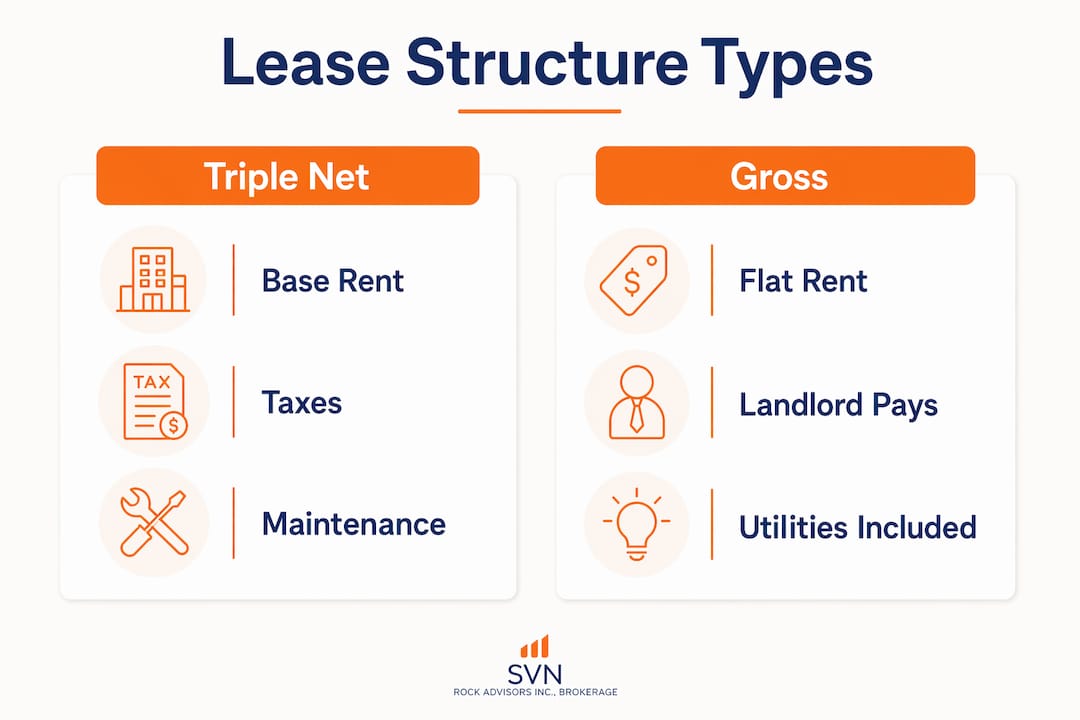
Modified gross lease sits between NNN and full-service. Operating costs are negotiated rather than standardized, often with tenants covering expenses above a base-year threshold. This structure is more common in multi-tenant industrial buildings where landlords want to share cost risk.
Full-service (gross) lease bundles everything into one flat rent. The landlord absorbs taxes, insurance, maintenance, and utilities. Gross leases are rare in GTA industrial and typically appear only in short-term subleases or small flex spaces under 5,000 square feet.
Industrial gross lease is a modified gross variant where you pay base rent plus utilities and janitorial costs. The landlord covers taxes, insurance, and structural maintenance. It offers more predictability than NNN while keeping direct-use costs like electricity in your control.
| Lease type | Tenant pays | Budget predictability | Common in GTA? |
|---|---|---|---|
| Triple net (NNN) | Base rent + taxes + insurance + CAM | Lower, expenses fluctuate | Yes, dominant |
| Modified gross | Base rent + negotiated expenses | Medium | Moderate |
| Full-service gross | Single all-inclusive rent | High | Rare |
| Industrial gross | Base rent + utilities + janitorial | Medium-high | Some flex/multi-tenant |
Key lease terms and space measurements you need to know
Lease documents use specific terminology that directly affects what you pay and what you can do with the space. These are the terms that matter most.
Base rent is quoted on a per-square-foot, per-year basis. A listing at $16.80/sf net means that figure goes to the landlord. Add TMI on top to get your true cost. Always compare properties on total occupancy cost, not just the advertised net rate.

Rentable square footage (RSF) is the area you pay rent on, which may include a proportionate share of common areas. Industrial gross square footage typically reflects the actual physical footprint of the unit. The gap between the two can be meaningful in multi-tenant buildings, so confirm which measurement the lease uses.
Clear height is the usable vertical space from floor to the lowest obstruction, usually a beam or sprinkler head. Modern GTA distribution facilities run 32–40 feet of clear height. Older urban stock often sits at 18–24 feet. If you run racking or mezzanine systems, clear height directly limits your storage capacity.
Lease term and renewal options shape both your cost and your negotiating position. Five-year terms offer flexibility; ten-year terms unlock larger tenant improvement allowances (TIAs) and often better base rates. Renewal options should specify the rent-setting mechanism, whether fixed, fair market value, or a capped escalation.
Security deposit in GTA industrial leases is typically two to six months of gross rent, held by the landlord. Negotiate a step-down provision so the deposit reduces after you have demonstrated a clean payment history.
Key clauses to review carefully:
- Exclusivity and use restrictions: limits on what business activities you can conduct, and whether the landlord can lease adjacent space to a direct competitor
- Subleasing and assignment rights: your ability to transfer the lease if your business changes, merges, or needs to exit
- Tenant improvement allowances (TIA): landlord-funded build-out dollars, typically amortised into the rent over the term
- Restoration obligations: whether you must remove improvements at lease end, which can carry significant cost
Pro Tip: Negotiate out restoration obligations at the time of signing, not at lease expiry. Once the landlord has approved the improvements, get written confirmation that removal will not be required.
Financial and operating cost considerations beyond base rent
TMI is where many tenants get surprised. Understanding what goes into it, and what should not, is one of the most valuable things you can do before signing.
GTA warehouse TMI in 2026 ranges from $4.50 to $6.50 per square foot per year, depending on building age, service levels, and location. A 20,000-square-foot unit at the high end of that range adds $130,000 per year to your occupancy cost on top of base rent. That is not a rounding error.
TMI typically covers property taxes, building insurance, common area maintenance, snow removal, landscaping, property management fees, exterior lighting, and parking lot upkeep. What it should not cover, and what experienced tenants push to exclude, are capital expenditures like roof replacement, structural repairs, and major building system overhauls. Those are landlord responsibilities.
Annual rent escalations in GTA industrial leases typically fall in the 3% to 5% range, though in a softening market, negotiating fixed annual bumps of 2.5%–3% and a longer rent-free period in year one is common. On a five-year lease at $16.80/sf, these escalations can significantly increase your net rent over the term.
The distinction between controllable and uncontrollable operating expenses matters here. Tenants can negotiate caps on controllable costs such as management fees and maintenance contracts while uncontrollable costs like property taxes and insurance premiums typically remain variable. Tenants who understand this split gain real leverage when pushing for expense caps.
Pro Tip: Always negotiate a cap on controllable operating expenses, typically 4%–5% annually, and secure audit rights on the landlord’s expense statements. Without audit rights, you have no way to verify what you are actually being charged.
How to assess and negotiate a Toronto warehouse lease effectively
Start with total occupancy cost, not the headline rate. Add base rent plus TMI plus utilities plus any costs the lease assigns to you. That number is what you are actually paying.
When evaluating a building, check the features that affect operational efficiency: clear height, number of dock doors, truck court depth, power supply, and sprinkler coverage. A lower rent in a building that cannot support your racking configuration or truck fleet is not a deal.
Negotiation levers worth pushing on:
- Rent escalations: push for fixed bumps of 2.5%–3% rather than CPI-linked increases
- TIA: ask for $10–$25 per square foot on five to ten-year terms, depending on the scope of work
- Rent-free period: one to three months is achievable in the current market, used to offset fit-up costs
- Exclusivity clause: if you operate in a competitive category, restrict the landlord from leasing to a direct competitor in the same complex
- Assignment rights: negotiate broad assignment rights so you can transfer the lease if your business is acquired or restructured
Lease language often looks rigid but most terms beyond base rent are negotiable, including subleasing, assignment, restoration obligations, and TIA amounts. The landlord’s first draft is a starting position, not a final offer.
Pro Tip: Bring current market data to every negotiation. Knowing that comparable space in the same submarket is available at a lower rate gives you a concrete anchor. A broker with active GTA deal flow can provide that data in real time.
Michael Law’s 2026 GTA industrial market insights
Toronto’s industrial market has shifted meaningfully from the 2023 cycle peak, when demand far outpaced supply and landlords held nearly all the leverage. The picture in 2026 is more balanced.
Toronto’s industrial vacancy sits at approximately 2.4% as of Q1 2026, with asking rents at approximately C$16.80/sf net. That is structurally tight by any historical measure, but GTA-wide vacancy across submarkets remains low but allows for some negotiation compared to the very tight vacancy seen in earlier years. Landlords have shifted toward stabilising pricing rather than pushing rents higher, which creates real room to negotiate on escalations, TIA, and free-rent periods.
Market snapshot: Toronto industrial vacancy at 2.4% in Q1 2026, with GTA-wide availability in the 2.2%–3.0% range. Asking net rents holding at approximately C$16.80/sf, with gross costs near C$22.00/sf once TMI is added.
Key pitfalls Michael Law sees tenants fall into repeatedly:
- Comparing properties on net rent alone without adding TMI and utilities
- Accepting CPI-linked escalations without understanding how quickly they compound
- Skipping operating expense audit rights, leaving no mechanism to challenge inflated TMI charges
- Ignoring subleasing restrictions that can trap a business in space it no longer needs
- Failing to negotiate capital expenditure exclusions from TMI, paying for roof and structural work that is legally the landlord’s responsibility
The lease negotiation best practices that consistently produce better outcomes share one trait: tenants who arrive prepared with market data and a clear understanding of their total cost position. That preparation is what separates a good lease from an expensive one.
Work with Michael Law | Lennard Commercial on your next GTA warehouse lease

Signing a warehouse lease in Toronto without a tenant-side broker is the most common way businesses overpay. Michael Law | Lennard Commercial represents tenants exclusively on GTA industrial leases, with no conflict of interest and no landlord relationships to protect.
Michael Law brings over a decade of active deal flow across Toronto, Mississauga, Brampton, Vaughan, Markham, and surrounding GTA submarkets. That means real-time comparable data, relationships with landlords before listings go public, and the negotiation experience to push on escalations, TIA, expense caps, and lease clauses that most tenants accept without question.
Whether you are leasing your first warehouse or renegotiating an existing term, the process starts with a straightforward conversation about your space requirements and budget. Reach out to Michael Law to get started.
Key takeaways
Toronto warehouse leases are almost always triple-net structures where total occupancy cost equals base rent plus TMI, and every term beyond the base rate is negotiable with the right preparation.
| Point | Details |
|---|---|
| NNN is the standard | Most GTA industrial leases are triple-net: base rent plus taxes, insurance, and CAM paid separately. |
| TMI adds real cost | GTA warehouse TMI runs in a range that depends on building age, service levels, and location; always calculate total occupancy cost, not just net rent. |
| Escalations compound | Annual rent escalations in GTA industrial leases are typically 3%–5%; in a softening market, negotiating fixed 2.5%–3% increases and flat rent in year one is common. |
| Most terms are negotiable | TIA, restoration obligations, assignment rights, and expense caps are all open to negotiation. |
| Michael Law | Lennard Commercial |
FAQ
What is a triple net (NNN) lease for a Toronto warehouse?
A triple net lease requires you to pay base rent plus property taxes, building insurance, and common area maintenance separately. It is the dominant structure for GTA industrial properties, and the advertised net rate is never your full cost.
What are the four main types of commercial leases?
The four types are triple net (NNN), modified gross, full-service gross, and industrial gross. In Toronto’s warehouse market, NNN dominates, with modified gross appearing in some multi-tenant buildings and full-service gross limited to short-term or small flex situations.
How much does it cost to lease warehouse space in Toronto?
Toronto industrial asking rents sit at approximately C$16.80/sf net in 2026, with gross costs near C$22.00/sf once TMI of roughly $4.50–$6.50/sf is added. Total occupancy cost also includes utilities, insurance obligations, and any tenant-specific build-out costs.
What is the most common commercial lease structure in Canada?
The triple net (NNN) lease is the most common structure for industrial and warehouse properties across Canada, including Ontario. It gives landlords predictable income and passes operating cost risk to tenants, which is why it dominates single-tenant and large-bay industrial buildings.
Can you negotiate a Toronto warehouse lease?
Yes. While base rent reflects market conditions, most other terms are negotiable, including rent escalations, tenant improvement allowances, free-rent periods, expense caps, and restoration obligations. Working with a tenant-side broker like Michael Law | Lennard Commercial gives you market data and negotiation experience to improve those terms.
Recommended

About Michael Law
Managing Partner and Industrial Real Estate Broker at Lennard Commercial Realty. Representing tenants and landlords across Toronto and the GTA for 15+ years. Michael specializes in GTA industrial real estate — connect with Toronto's leading industrial broker at mlawrealestate.com/industrial-broker-toronto.