Why Toronto industrial space is scarce: 2026 market guide
By Michael Law · Industrial Real Estate Broker, Lennard Commercial Realty
TL;DR:
- Toronto’s industrial space shortage is caused by a permanent Greenbelt restriction and land redesignations since 2019. Municipal approval delays and rising development costs further slow new supply, maintaining market tightness. E-commerce growth demands high-spec warehouses, but limited supply keeps vacancy low and rents high.
Toronto’s industrial space scarcity is defined by a structural supply-demand imbalance that no single policy change will quickly resolve. GTA industrial vacancy rose from sub-1% in 2022 to roughly 2.2%–4% by Q2 2026, yet the market remains deeply supply constrained. Three forces drive this: the Ontario Greenbelt permanently blocking outward expansion, over 1,200 acres of employment land redesignated to residential uses since 2019, and sustained logistics demand from e-commerce growth. For business owners, logistics managers, and commercial real estate investors, understanding why Toronto warehouse space is limited is the first step toward making better leasing and investment decisions.
Why is Toronto industrial space scarce?
Toronto’s industrial space shortage is structural, not cyclical. The GTA sits inside one of the most regulated land environments in North America, where geography, policy, and demand converge to keep supply permanently tight.

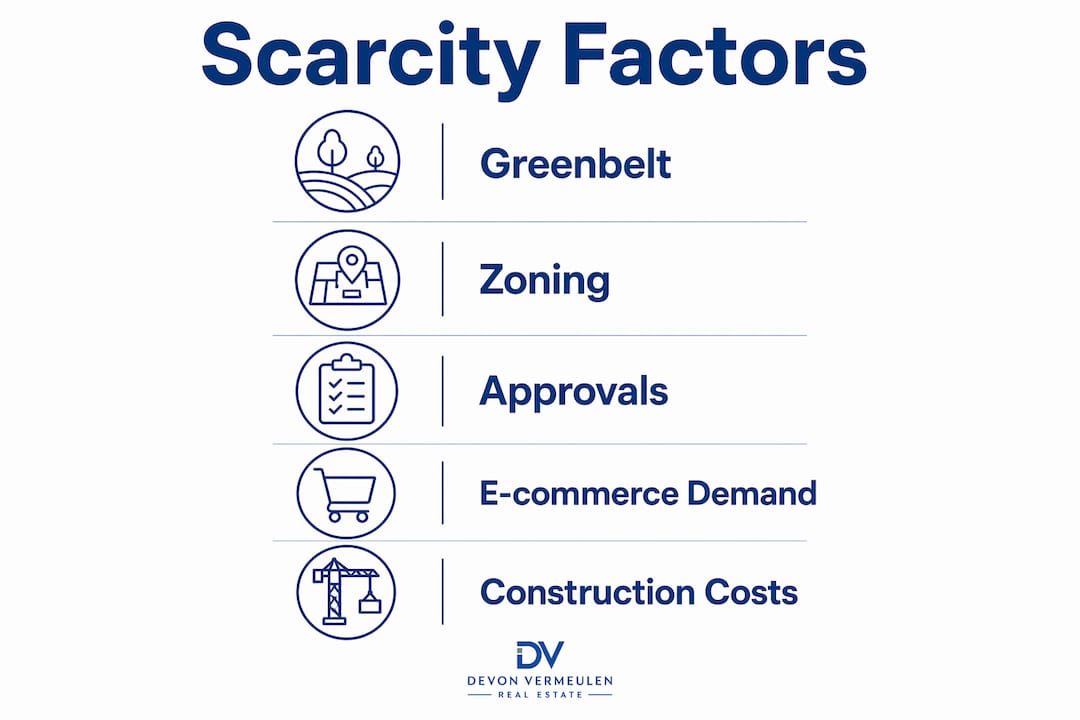
The Ontario Greenbelt permanently protects 810,000 hectares surrounding the GTA, preventing any new greenfield industrial park creation within its boundary. That protection is absolute. No amount of developer capital or municipal ambition changes it. The Greenbelt functions as a structural floor for land values and a hard ceiling on outward industrial expansion.
Inside the Greenbelt boundary, the situation is equally constrained. Over 1,200 acres of employment land have been redesignated from industrial to residential use since 2019. That land is gone from the industrial supply pool permanently. Each redesignation compresses the remaining industrial corridors and pushes rents higher.
The result is a market where industrial properties cluster in a shrinking set of corridors: the Highway 400 and 427 corridors in Vaughan and Brampton, the Highway 7 and 407 belt through Markham, and the Highway 401 spine through Mississauga and Pickering. Demand concentrates in these corridors because there is nowhere else to go. Industrial zoning classifications like E1 and M1 offer the most flexibility and attract the strongest tenant demand, while more restrictive E3 and M3 zones trade at higher risk premiums.
Pro Tip: When evaluating a site in a constrained submarket, check the zoning classification before anything else. An E1 or M1 designation gives you far more operational flexibility than a heavy industrial zone, and that flexibility directly affects your ability to sublease or assign the space later.
Infill sites within existing industrial areas face their own pressure. Residential and mixed-use developers compete aggressively for the same parcels, often outbidding industrial users because residential density generates higher land value per square metre. This dynamic pushes industrial users further from urban cores and raises the cost of last-mile logistics.
How do municipal approvals slow new industrial supply?
Municipal approval timelines are one of the most underestimated reasons for Toronto’s industrial space shortage. Industrial projects commonly require 24–36 months to navigate zoning, site plan approval, and environmental review processes. That timeline alone discourages speculative development.
The approval sequence for a new industrial facility typically follows this path:
- Pre-application consultation with the municipality to identify planning and zoning requirements, often taking 3–6 months before a formal submission.
- Zoning amendment or minor variance application, which triggers a public notice period and, frequently, community opposition hearings.
- Environmental assessment, required for brownfield sites and any development near sensitive land uses, adding cost and time before construction can begin.
- Site plan approval, which addresses grading, stormwater management, truck access, and landscaping, and can require multiple revision cycles.
- Building permit issuance, the final step before ground can break, often delayed by backlogged municipal review queues.
Community opposition adds unpredictable time to this sequence. Residents near proposed industrial sites regularly raise concerns about truck traffic volumes, noise during overnight operations, air quality, and stormwater runoff. These concerns trigger additional studies, revised site plans, and sometimes Ontario Land Tribunal hearings. A project that clears zoning in 12 months can spend another 12 months resolving community objections.
Brownfield remediation compounds the problem. Much of the available industrial land in the GTA sits on former manufacturing or fuel storage sites. Environmental remediation adds both cost and regulatory complexity. A site that looks attractive on paper can carry a remediation liability that makes the project financially unviable without government incentives.
Minor variance applications, used when a proposed building does not fully comply with existing zoning, add a minimum of 6 months to the approval timeline in most GTA municipalities. Stormwater management requirements reduce the buildable footprint of a site by 10%–15%, further shrinking the usable area after approval is granted.
Pro Tip: If you are evaluating a site that requires a minor variance, build at least 8 months of contingency into your project schedule. Municipal committees meet on fixed cycles, and a single deferral can push your hearing to the next quarter.
The combined effect of these delays means that even when a developer commits capital to a new industrial project today, the market will not see that supply for two to three years. Demand does not wait. Tenants searching for space now face a market shaped by decisions made in 2023 and earlier.
How has e-commerce growth driven demand for Toronto warehouse space?
E-commerce is the single largest demand driver behind the Toronto industrial real estate shortage. E-commerce accounted for 7.2% of total Canadian retail sales in Q4 2025. That share continues to grow, and every percentage point of e-commerce penetration translates directly into demand for warehouse and distribution space.
The specifications that e-commerce logistics require are not met by older GTA industrial stock. Modern fulfilment operations demand:
- 36-foot or greater clear heights to accommodate high-bay racking and automated picking systems
- Cross-dock configuration with truck doors on opposing walls to allow simultaneous inbound and outbound flow
- Last-mile proximity within 30 kilometres of dense urban populations to support same-day and next-day delivery commitments
- Ample trailer parking and staging area to handle peak volume surges during promotional periods
- ESFR sprinkler systems rated for high-pile storage, which older buildings rarely carry
The GTA delivered an estimated 25–30 million square feet of new industrial supply between 2024 and 2026. That volume sounds large. The reality is that most of it was pre-leased before construction completed, absorbed by third-party logistics providers (3PLs) and national retailers expanding their distribution networks. New supply has not meaningfully loosened the market because demand has grown in parallel.
Third-party logistics providers have consolidated their GTA footprints aggressively. A single 3PL contract win can require 200,000 to 500,000 square feet of new space on a compressed timeline. That scale of demand has no equivalent in the existing vacancy pool. The logistics trends shaping 2026 confirm that fulfilment speed and network density remain the primary competitive differentiators for e-commerce operators, which means demand for well-located GTA industrial space will not soften materially.
The vacancy rate normalization from sub-1% in 2022 to roughly 4% in 2026 reflects new supply delivery, not a demand retreat. Occupiers who interpret rising vacancy as a buyer’s market misread the data. The available space skews toward secondary locations, older buildings, and units that do not meet modern logistics specifications.
What economic and construction factors worsen the industrial space shortage?
Rising costs have made speculative industrial development financially difficult across the GTA. Construction material costs, labour rates, and financing expenses have all increased since 2021. The result is that many projects that pencilled out three years ago no longer meet investor return thresholds.
The cost-of-capital increase since 2021 has made many speculative industrial projects unfeasible. Developers now prioritise projects with pre-leased tenants because the risk profile of a vacant building at today’s financing rates is unacceptable to most institutional lenders. That shift from speculative to pre-leased development means the market adds supply only when a tenant has already committed. Tenants without the scale or credit to anchor a new development compete for whatever existing space remains.
“Industrial real estate represents 45% of Canadian commercial real estate investment volume, and GTA industrial cap rates compressed to 4.0%–4.5% by 2026. That compression reflects how much institutional capital is chasing a finite pool of assets. When cap rates fall, land values rise, and the economics of new development become harder to justify without premium rents.”
Brownfield remediation adds a further layer of financial risk. Environmental liability on a contaminated site can run into millions of dollars before a shovel breaks ground. Institutional investors apply a risk premium to these sites that often makes them uncompetitive against cleaner alternatives in secondary markets like Barrie or Hamilton. The GTA industrial investment guide details how investors are pricing these risks into acquisition models.
Stormwater management requirements reduce the buildable footprint of a site by 10%–15%. A 10-acre parcel that appears to support a 200,000-square-foot building may realistically accommodate only 170,000 square feet once detention ponds, bioswales, and setbacks are incorporated. Developers absorb this loss in yield, which further reduces project returns and discourages new supply.
The combination of high land cost, high construction cost, high financing cost, and regulatory complexity creates a development environment where only the largest and most experienced players can execute. Smaller developers exit the market. Supply growth slows. Tenants pay the price through higher rents and fewer options.
Key takeaways
Toronto’s industrial space scarcity is a structural condition driven by land policy, regulatory timelines, sustained e-commerce demand, and rising development costs that collectively prevent supply from keeping pace with occupier needs.
| Point | Details |
|---|---|
| Greenbelt restricts expansion | Ontario’s 810,000-hectare Greenbelt permanently blocks new greenfield industrial development around the GTA. |
| Employment land losses compound scarcity | Over 1,200 acres of industrial land have been redesignated to residential use since 2019, shrinking the supply pool. |
| Approvals take 24–36 months | Municipal zoning, environmental review, and community opposition add years before new supply reaches the market. |
| E-commerce sustains demand | E-commerce at 7.2% of Canadian retail drives ongoing demand for modern, high-spec warehouse space near urban centres. |
| Development economics deter new supply | High construction, financing, and remediation costs push developers toward pre-leased projects, limiting speculative supply. |
What I’ve learned from a decade in Toronto’s tightest industrial market
The question I hear most often from business owners and logistics managers is some version of: “Why can’t we find anything?” The honest answer is that the constraints are structural and they are not going away. The Greenbelt is not being removed. Employment land redesignations are not being reversed at any meaningful scale. Municipal approval timelines are not shortening. Anyone waiting for the market to “open up” is making a costly mistake.
What I have found actually works is starting the site search 18 to 24 months before a lease expiry. That timeline sounds excessive until you factor in the reality that the best available spaces in Brampton, Vaughan, and Markham are leased within weeks of hitting the market. Tenants who start early have options. Tenants who start at 12 months are negotiating from weakness.
Zoning is the detail most occupiers overlook until it costs them. A building that looks right on every physical dimension can be unusable if the zoning classification prohibits your specific operation. I have seen food processing tenants lose months discovering that a site’s zoning excluded their use class. Checking the zoning and location fit before touring a building saves significant time and money.
Stormwater and environmental requirements deserve the same scrutiny as clear height and dock doors. A site with a contamination flag or inadequate stormwater infrastructure will delay your occupancy by months, sometimes years. These are not details to discover during due diligence. They are screening criteria that belong at the front of the process.
The tenants who navigate this market well share one trait: they treat site selection as a project with a defined timeline, not a search that starts when the lease expires. The GTA industrial submarkets with the strongest fundamentals reward preparation. They punish delay.
— Michael Law
Working with Michael Law | Lennard Commercial in a constrained market
Navigating Toronto’s industrial space shortage requires more than a property search. It requires market knowledge, zoning expertise, and relationships built over years of active deal-making in the GTA.
Michael Law | Lennard Commercial provides industrial tenant representation for business owners, logistics operators, and investors across the GTA, including high-demand submarkets like Brampton, Vaughan, Markham, and Mississauga. With over a decade of experience in Ontario’s industrial sector, Michael Law brings direct knowledge of zoning classifications, municipal approval processes, and submarket dynamics that affect every leasing decision. The Brampton logistics portfolio case study illustrates how proactive representation delivers results in one of the GTA’s most competitive markets. Contact Michael Law | Lennard Commercial to start your site search with the lead time the market demands.
FAQ
What is the current industrial vacancy rate in the GTA?
GTA industrial vacancy rose from sub-1% in 2022 to approximately 2.2%–4% by Q2 2026. The market remains supply constrained despite this normalization, with most available space concentrated in secondary locations or older buildings.
Why is Toronto warehouse space so hard to find?
Toronto warehouse space is limited by the Ontario Greenbelt, which blocks greenfield development, combined with the redesignation of over 1,200 acres of employment land to residential use since 2019. Municipal approval timelines of 24–36 months further restrict new supply delivery.
How does e-commerce affect industrial space availability in Toronto?
E-commerce accounted for 7.2% of Canadian retail sales in Q4 2025 and drives sustained demand for large-format, high-spec distribution space near urban centres. Most new GTA industrial supply delivered between 2024 and 2026 was pre-leased before completion, preventing vacancy from rising meaningfully.
What zoning classifications matter most for GTA industrial tenants?
E1 and M1 zoning classifications offer the broadest operational flexibility and attract the strongest tenant demand in the GTA. More restrictive E3 and M3 zones carry higher risk premiums and limit the range of permitted uses.
How far in advance should a business start searching for industrial space in Toronto?
Starting 18–24 months before a lease expiry gives tenants the best chance of securing suitable space in the GTA’s tight market. Properties in high-demand corridors like Brampton and Vaughan lease within weeks of availability, leaving late-starting tenants with limited options.
Recommended

About Michael Law
Managing Partner and Industrial Real Estate Broker at Lennard Commercial Realty. Representing tenants and landlords across Toronto and the GTA for 15+ years. Michael specializes in GTA industrial real estate — connect with Toronto's leading industrial broker at mlawrealestate.com/industrial-broker-toronto.