
Why Toronto suits urban logistics tenants in 2026
By Michael Law · Industrial Real Estate Broker, Lennard Commercial Realty
TL;DR:
- Toronto’s strategic location makes it Canada’s leading logistics hub with unmatched regional reach and infrastructure.
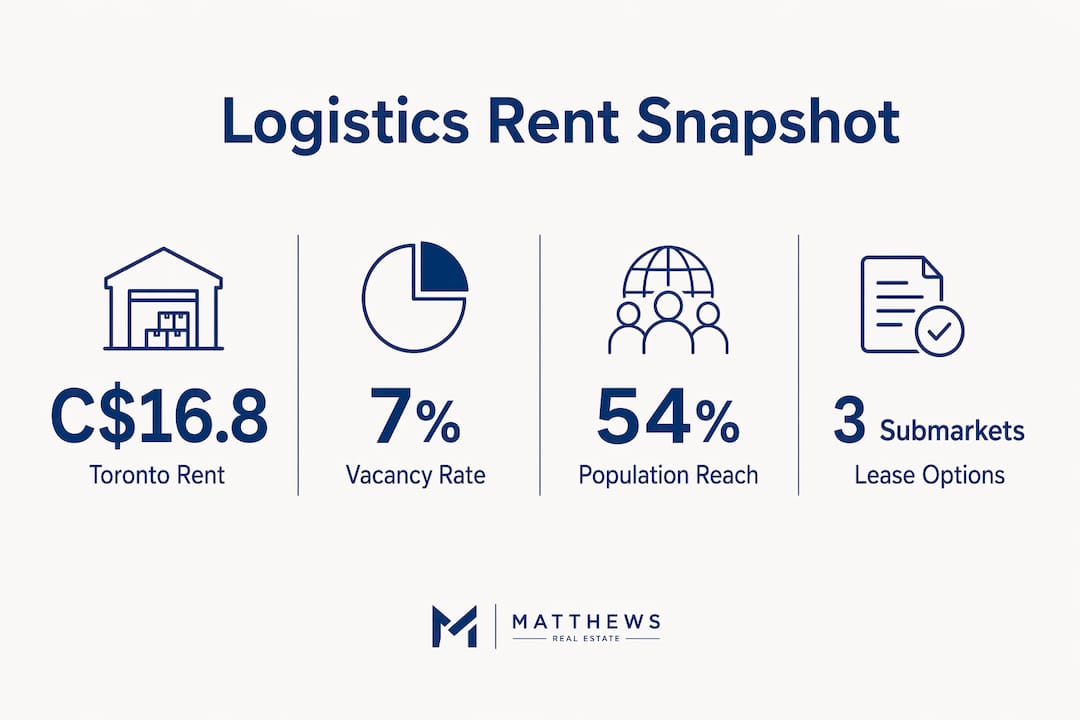
- In 2026, rents remain stable at around C$16.8 per square foot with tenants leveraging incentives in competitive submarkets.
Toronto is Canada’s primary logistics hub, and the case for it is structural, not circumstantial. The Golden Horseshoe holds over 54% of Ontario’s population and more than 20% of Canada’s total population. From a single distribution centre in the GTA, operators can reach most of Ontario, southern Quebec, and large portions of the U.S. Midwest and Northeast within a one-day trucking radius. That reach is unmatched anywhere else in the country.
Key reasons Toronto suits urban logistics tenants:
- Population density: Over 7 million GTA residents create natural last-mile efficiencies and high drop density.
- Transportation network: Seven intersecting 400-series highways, CN and CP intermodal rail yards, and Toronto Pearson International Airport, Canada’s busiest cargo facility.
- Market access: One-day trucking radius covers Ontario, southern Quebec, and U.S. border markets.
- Labour concentration: Peel Region accounts for roughly 40% of the Greater Toronto and Hamilton Area’s goods-movement workforce.
- Scalability: Modern Class A facilities with clear heights over 36 feet and high electrical capacity support automation and growth.
- Zoning stability: Municipal planning across Mississauga, Brampton, Vaughan, and Markham actively preserves industrial corridors.
- Tenant leverage: In 2026, tenants can negotiate free rent and tenant improvement allowances on Class A space.
How do Toronto’s rental rates compare to other logistics hubs?
Toronto industrial asking rents held at approximately C$16.8 per square foot gross in early 2026, with low vacancy in the Toronto submarket. That figure trails the peak rents seen in previous years by a noticeable margin, indicating a reset to a more sustainable level. Durham Region offers the GTA’s most competitive pricing, attracting value-oriented tenants serving east Toronto. Halton Region has somewhat lower rents, with higher vacancy providing negotiation opportunities.
The broader GTA picture matters for site selection decisions: total gross occupancy costs across the region run in the low-C$20s/sf range when additional rent is included. Compared to Vancouver, where industrial land scarcity has pushed costs sharply higher and constrained large-format development, the GTA offers meaningfully more choice at competitive all-in costs.
Pro Tip: Push for tenant improvement allowances and free rent periods in submarkets like Halton and Durham, where new supply has given tenants real leverage in 2026.
What sustainability initiatives affect urban logistics in Toronto?
Ontario’s provincial planning framework requires municipalities to minimise the environmental impact of goods movement, and Peel Region’s long-term goods movement plan explicitly targets a safe, sustainable, and integrated freight system. At the building level, demand for modern Class A distribution facilities reflects this shift: new product across Milton, north Brampton, and the Highway 400 corridor is built to ESFR sprinkler standards and designed for electric vehicle charging infrastructure. Last-mile operators in Toronto proper are increasingly deploying electric vans and cargo bikes to reduce emissions in dense urban zones. Ottawa’s 2026 federal Productivity Super-Deduction also accelerates write-offs for capital invested in modern manufacturing and processing real estate, making green upgrades more financially viable for owner-users and tenants alike.
What does Toronto’s regulatory environment mean for logistics operators?
Industrial zoning across the GTA is generally stable, with Mississauga, Brampton, Vaughan, and Markham maintaining protected employment lands that limit conversion pressure from residential development. Trucks account for an estimated 80% of goods movement in the GTA, and the Ontario Ministry of Transportation coordinates with regional municipalities to preserve freight corridors and reduce congestion on key arterials. Tenants should verify permitted uses, truck route designations, and noise bylaws at the site level before signing, as conditions vary across lower-tier municipalities.
Key takeaways
Toronto is Canada’s dominant urban logistics location because population density, multimodal infrastructure, and stable industrial zoning converge at a scale no other Canadian market can replicate.
| Point | Details |
|---|---|
| Population reach | Over 54% of Ontario’s population lives in the Golden Horseshoe, enabling unmatched last-mile density. |
| Rental context | Toronto submarket asking rents held at ~C$16.8/sf gross in Q1 2026, with low vacancy. |
| Infrastructure depth | Seven 400-series highways, CN and CP intermodal yards, and Pearson Airport anchor the freight network. |
| Tenant leverage | Free rent and tenant improvement allowances are negotiable in 2026, particularly in Halton and Durham. |
| Zoning protection | Employment land policies in Mississauga, Brampton, Vaughan, and Markham preserve industrial corridors long-term. |
FAQ
Why does Toronto outperform other Canadian cities for logistics?
The GTA combines Canada’s largest consumer market, the densest highway and intermodal network, and the highest concentration of third-party logistics providers in the country. No other Canadian city offers comparable reach, labour depth, and infrastructure in a single location.
What are typical industrial asking rents in the GTA in 2026?
Asking rents across the GTA held at approximately C$16.8 per square foot gross in early 2026, with Toronto proper at this level and Durham Region offering competitive pricing.

Which GTA submarkets suit last-mile logistics best?
Toronto proper and Mississauga lead for last-mile operations due to proximity to consumers and Pearson Airport. Vaughan and Markham serve northern GTA distribution, while Durham Region is emerging as a cost-effective eastern alternative.
How should tenants approach lease negotiations in 2026?
Tenants have more leverage in 2026. Prioritise free rent periods, tenant improvement allowances, and caps on controllable operating costs, especially in submarkets where new supply has pushed vacancy above the GTA average.
Michael Law | Lennard Commercial advises logistics operators and warehouse occupiers across the GTA on tenant representation and site selection. With over a decade in Ontario’s industrial market, Michael brings the submarket intelligence and negotiating experience that complex leasing decisions require.
Recommended

About Michael Law
Managing Partner and Industrial Real Estate Broker at Lennard Commercial Realty. Representing tenants and landlords across Toronto and the GTA for 15+ years. Michael specializes in GTA industrial real estate — connect with Toronto's leading industrial broker at mlawrealestate.com/industrial-broker-toronto.