C$16 to C$22 psf: Burlington Industrial Rents and Tenant Rep Tactics
By Michael Law · Industrial Real Estate Broker, Lennard Commercial Realty
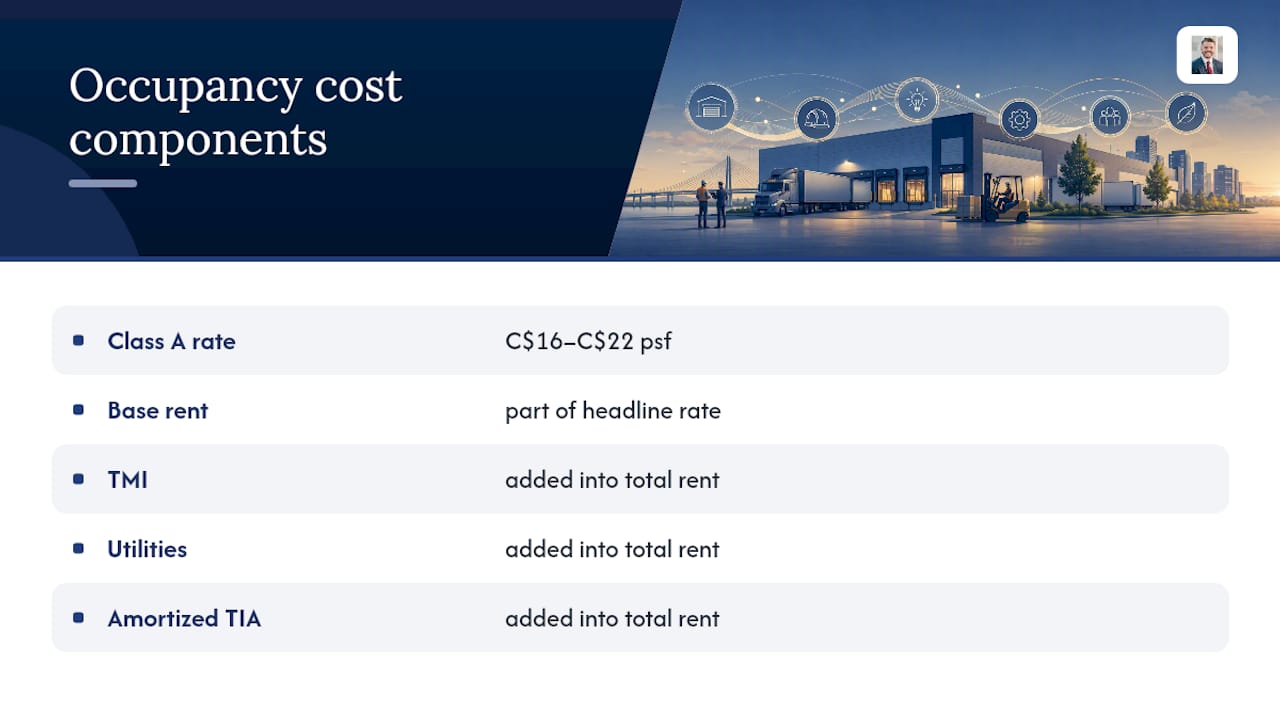
Burlington industrial net rents currently run C$16 to C$22 per square foot for Class A buildings and C$12 to C$16 per square foot for older Class B product. Before signing anything, compare total occupancy cost, which is net rent plus TMI plus utilities plus any amortized tenant improvement costs, not just the headline rate. The fastest path to an accurate number is contacting a broker or checking major listing portals directly.
TL;DR:
- Burlington’s Class A industrial net rents range from C$16 to C$22 per square foot, with premiums for properties near highways and with high clear heights.
- Total occupancy costs include net rent, TMI, utilities, and amortized tenant improvements, often elevating the actual price by C$7 to C$10 per square foot.
- Market constraints from land scarcity and physical borders keep rents high and limit new supply, especially for highway-adjacent properties.
- Strategic lease negotiation—focusing on TMI caps, restoration clauses, and tenant improvements—can significantly reduce long-term costs.
- Off-market listings and early broker insights are crucial in Burlington’s tight market for finding competitive space at better terms.
Table of Contents
- What Burlington industrial rents look like right now
- What drives the price of industrial space in Burlington
- How to calculate your true occupancy cost, not just the quoted rent
- Where to find Burlington industrial listings
- A prioritized checklist for evaluating and negotiating a Burlington lease
- What Ontario law actually says about your lease
- How a Burlington-focused broker approaches this market
- The gap between market reports and what tenants actually need
- How Michael Law | Lennard Commercial helps you secure the right Burlington space
- Sources
- FAQ
What Burlington industrial rents look like right now
Burlington’s Class A industrial space is asking C$16 to C$22 per square foot net, while Class B stock, often older and further from the QEW, trades closer to C$12 to C$16 per square foot. That spread reflects a market where new supply is scarce and landlords know it.
Regionally, 2Q26 estimated asking rents across the GTA sat near C$16.9 per square foot, with Halton Region benchmarks close behind at roughly C$16.3 per square foot. Add typical additional rent of about C$5.2 per square foot and gross occupancy costs land in the low to mid C$20s per square foot across the region.
| Market | Net asking rent (C$/sf/yr) |
|---|---|
| Burlington Class A | 16 to 22 |
| Burlington Class B | 12 to 16 |
| GTA average (2Q26) | ~16.9 |
| Halton Region average (2Q26) | ~16.3 |
Statistic callout: Burlington’s escarpment and Lake Ontario shoreline physically cap how much new industrial land can come to market, which is a big reason rents haven’t softened much even as leasing activity cools elsewhere in the GTA.
What drives the price of industrial space in Burlington
Rent isn’t set by size alone. A few features consistently separate a C$16 quote from a C$22 one:
- Highway access: buildings near the QEW, Highway 407, or the Harvester and Appleby corridors command a clear premium over sites requiring longer local hauls.
- Clear height: 32 to 40 feet supports modern racking and pushes rent higher than older 18 to 24 foot buildings.
- Dock configuration: more dock-level doors and deeper truck courts matter to 3PL and distribution tenants.
- Power and slab capacity: manufacturing tenants pay for heavier electrical service and reinforced floors.
- Yard and outdoor storage: fenced, secured outdoor space adds real value for trailer parking or equipment storage.
- Building age and conversion: older stock retrofitted for last-mile logistics often reprices closer to Class A rents even without a full rebuild.
- Unit size: smaller bays (under 10,000 square feet) often carry a per-square-foot premium versus large-bay distribution space.
How to calculate your true occupancy cost, not just the quoted rent
A quoted “net rent” is only part of the bill. Additional rent, commonly called TMI (taxes, maintenance, and insurance), gets layered on top, and any tenant improvement allowance amortized into the lease adds another line.
- Start with net rent: the base figure landlords quote, typically per square foot per year.
- Add TMI: GTA benchmarks run C$4.50 to C$6.50 per square foot depending on the building and municipality.
- Add utilities: usually metered separately and not included in TMI.
- Factor in TIA amortization: if a landlord provides tenant improvement money, it’s often clawed back through a rent bump over the term.
A worked example: C$18/sf net plus C$5.50/sf TMI equals roughly C$23.50/sf gross before utilities. Statistic callout: tenant improvement allowances in 2026 commonly range from C$5 to C$25 per square foot depending on scope and lease term, so two buildings quoting the same net rent can carry very different real costs once TIA and TMI are factored in. For a deeper breakdown of how these categories interact, see this guide on understanding occupancy costs in GTA industrial leases.
Where to find Burlington industrial listings
Public portals list plenty of Burlington inventory, but they don’t tell the whole story:
- Public listing sites (Realtor.ca, Spacelist, and similar commercial marketplaces) show available space but often lag behind what brokers know is coming to market.
- Brokerage-sourced listings frequently include space not yet publicly marketed, particularly in a submarket as land-constrained as Burlington.
- Filters that disqualify space early: minimum clear height, number of dock doors, and yard availability are the first specs that eliminate a building from consideration, so set those thresholds before you start searching.
- Lead times: expect several weeks between first inquiry and a shortlist of viable options, longer for specialized needs like cold storage or heavy power.
Brokers working the Halton market regularly hear about upcoming vacancies before they’re posted publicly, which matters when industrial lease prices Burlington tenants face are this tight.
A prioritized checklist for evaluating and negotiating a Burlington lease
Work through physical inspection first, then lease terms, then budget verification:
- Inspect the building: confirm clear height, dock count and configuration, truck circulation, power capacity, and slab thickness against your operational needs.
- Request environmental reports: especially for older industrial buildings or sites with a manufacturing history.
- Review lease structure: term length, rent escalations, and renewal option terms all affect long-term cost.
- Negotiate the tenant improvement allowance: this is often the most movable number in the deal.
- Clarify restoration obligations: many tenants underestimate what “restore to base building” actually costs at lease end, and negotiating to a broom-clean standard can save tens of thousands.
- Confirm assignment and sublease rights: important if your space needs might change before the term ends.
- Request historical operating costs: ask for the landlord’s last two to three years of TMI statements before you sign, not after.
Pro Tip: Ask for a cap on controllable TMI expenses in the lease itself. It’s one of the highest-value protections a tenant can negotiate, and most landlords will agree to some version of it if you ask early.
Walk away if a landlord won’t share TMI history, won’t put verbal promises about improvements into the lease, or insists on full-building restoration with no negotiation room. For tactical language on these points, see this piece on how to negotiate GTA industrial leases with confidence.
What Ontario law actually says about your lease
Ontario’s Commercial Tenancies Act sets a legal baseline for landlord and tenant relations, but it isn’t the document that governs your day-to-day rights. A signed commercial lease overrides most of what the Act provides, and that includes rent increases.
Unlike residential tenancies, commercial leases in Ontario carry no statutory rent control. Whatever escalation clause you sign is what applies for the full term, whether that’s a fixed annual bump, a percentage tied to an index, or a flat renewal rate set years in advance. That’s why the lease document matters more than the Act itself.
Have both the offer to lease and the final lease reviewed by a lawyer and your broker before signing. Catching a poorly worded restoration clause or an uncapped TMI provision before signature is far cheaper than fighting it in year three of a five-year term.
How a Burlington-focused broker approaches this market
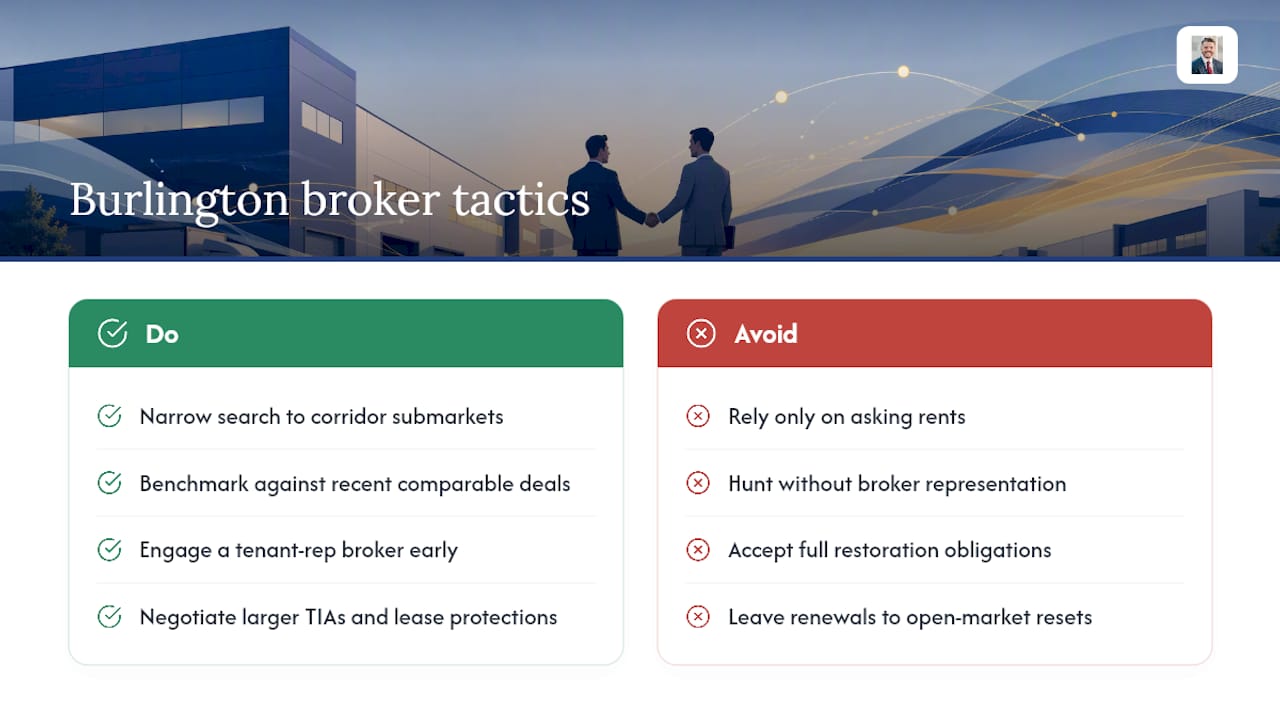
Site selection in Burlington starts with narrowing the corridor: QEW-adjacent product near Appleby and Harvester behaves differently than space further from the highway, and pricing reflects that split immediately. Benchmarking against recent comparable deals, not just asking rents, is what keeps a tenant from overpaying in a market this tight.
Broker representation frequently uncovers earlier or off-market Burlington options and negotiates stronger TIA packages and lease protections than tenants typically secure on their own. Tactical wins on past Burlington-area deals have included larger tenant improvement allowances, restoration obligations limited to broom-clean condition, and renewal options with pre-negotiated rate caps rather than open market resets.
If you’re actively evaluating space, a tenant representation agreement is the starting point for getting a broker working on your behalf rather than the landlord’s.
The gap between market reports and what tenants actually need
Most rent reports stop at the headline number, and that’s where the advice usually falls short. A Class A rate of C$16 to C$22 per square foot tells you almost nothing about what you’ll actually pay once TMI, utilities, and an amortized improvement allowance get added in. The tenants who negotiate well are the ones who ask for the TMI history before they ask about the base rent.
The conventional wisdom, that Burlington’s tight supply means tenants have no leverage, is only half true. Landlords do have pricing power on rent. They have far less power on restoration terms, TIA structure, and renewal caps, because those clauses cost them nothing to negotiate on paper and everything if a tenant walks. That’s where the real savings sit.
Prioritize the lease mechanics before the square footage. A building with a slightly higher net rent but a capped TMI and a fair restoration clause will almost always beat a cheaper quote with open-ended obligations. Read the lease like you’re going to be the one paying to fix it in five years, because you probably will be.
— Michael Law
How Michael Law | Lennard Commercial helps you secure the right Burlington space
Finding a Burlington building on a portal is the easy part. Getting the net rent, the TMI cap, and the restoration clause all working in your favour is where most tenants lose ground, usually because nobody’s negotiating specifically for them.

Experienced tenant representation brokers provide services across the Halton and GTA industrial markets, including lease negotiation, site selection, and market benchmarking built around tenant-specific requirements. This can include surfacing off-market Burlington opportunities before they appear on public portals and negotiating tenant improvement allowance and restoration terms that benefit tenants over the lease term. Brokerage services may also include landlord representation, investment sale advisory, and specialized industrial space types such as cold storage and high-power manufacturing.
If you’re evaluating industrial space in Burlington or anywhere in the GTA, visit the services page to start a conversation about tenant representation for your next lease.
Sources
- Renting commercial property in Ontario
- 2Q26 Toronto Ontario industrial market report
- Industrial property appraisal — Burlington (Aion Appraisals)
- The complete Ontario warehouse leasing guide (2026) | WarehouseIndex
FAQ
Where can I find industrial space for lease in Burlington, ON?
Public portals like Realtor.ca and Spacelist list available Burlington industrial space, but brokerage networks often surface options before they’re publicly posted. A local page like industrial real estate in Burlington is a good starting point for current availability and market context.
What are the most expensive areas in Burlington, Ontario?
Industrial space near the QEW and the Appleby and Harvester corridors commands the highest rents in Burlington, largely due to highway access and limited nearby land supply. Class A buildings in these corridors ask C$16 to C$22 per square foot net, toward the top of the local range.
What is the average commercial rent in Toronto?
GTA-wide industrial asking rents averaged around C$16.9 per square foot in 2Q26, with Halton Region, which includes Burlington, close behind at roughly C$16.3 per square foot. Gross occupancy costs, once TMI is added, typically land in the low to mid C$20s per square foot.
Is Burlington expensive to live in?
Burlington’s cost of living reflects its position as a desirable Lake Ontario community with limited land for new development, which pushes up both residential and industrial real estate costs. On the industrial side, that same land constraint is a key reason net rents have held firm even as broader GTA leasing activity has slowed.
How long does it take to secure an industrial lease in Burlington?
Expect several weeks from initial search to a shortlist of viable buildings, and longer if you need specialized features like cold storage or heavy power capacity. Working with a broker who tracks off-market Burlington inventory, such as through tenant representation services, can shorten that timeline meaningfully.
Recommended

About Michael Law
Managing Partner and Industrial Real Estate Broker at Lennard Commercial Realty. Representing tenants and landlords across Toronto and the GTA for 15+ years. Michael specializes in GTA industrial real estate — connect with Toronto's leading industrial broker at mlawrealestate.com/industrial-broker-toronto.
Related Articles



More Burlington Industrial Real Estate Insights
Articles & Analysis
Industrial Properties for Sale in Toronto
Read →Best GTA Industrial Submarkets for Your Next Move
Read →Best GTA Warehouse Locations for Industrial Users
Read →What a Commercial Leasing Representative Does
Read →Market Insights
Market intelligence: GTA real estate strategies for investors
Learn how GTA industrial investors and tenants use market intelligence to negotiate better leases, identify smart acquisitions, and stay ahead in one of Canada's most competitive industrial markets.
Read →