
Commercial real estate managers: GTA industrial guide
By Michael Law · Industrial Real Estate Broker, Lennard Commercial Realty
TL;DR:
- Effective industrial property management in the GTA can improve net operating income by 18% within a year through proactive lease administration, vendor management, and real-time financial transparency. Top-tier managers treat assets with ownership responsibility, integrating asset management practices and leveraging local market knowledge to optimize tenant retention and operational performance. Selecting a management firm with strong local relationships, advanced technology platforms, and a focus on transparency ensures maximized value and better decision-making.
Commercial real estate managers are professionals who oversee the day-to-day operations, financial health, and tenant relations of industrial properties to maximise value and returns for owners. In the Greater Toronto Area, where industrial vacancy rates remain among the tightest in North America, the difference between a well-managed asset and a poorly managed one shows up directly on the income statement. Property managers in this sector carry responsibilities that extend well beyond collecting rent. They coordinate vendors, administer leases, manage CAM reconciliations, and report financials in real time. This guide covers the best practices, market-specific strategies, and selection criteria that define high-performing management in the GTA industrial sector.
How do commercial real estate managers improve industrial property performance?
Professional property management can yield an average 18% improvement in Net Operating Income within the first 12 months. That figure reflects the compounded effect of tighter vendor contracts, fewer maintenance delays, and more accurate lease billing. For an industrial asset generating $1.5 million in annual NOI, an 18% lift means $270,000 in additional income without a single dollar of capital investment.

Vendor and maintenance management
Industrial properties carry significant mechanical and structural maintenance obligations. Roof systems, dock levellers, HVAC units, and sprinkler systems all require scheduled servicing. Top-tier commercial property managers maintain pre-approved vendor rosters with negotiated rates, which eliminates the costly cycle of emergency call-outs at premium pricing. They also track work orders through digital platforms, giving owners a live view of every open and completed maintenance item.
Proactive lease administration
Strategic lease administration is the single most effective tool for preventing revenue gaps in industrial properties. Critical dates including rent escalations, option exercise windows, and lease expiry notices must be tracked with precision. Missing a rent escalation trigger by even one month costs real money. A 10,000 square foot tenant paying $14.00 per square foot with a 3% annual escalation represents $4,200 in annual revenue that disappears if the escalation is not applied on time.
Pro Tip: Build a lease abstract database that flags critical dates 90, 60, and 30 days in advance. Most property management software platforms, including Yardi and MRI Software, include automated date-tracking modules that remove human error from this process entirely.
Technology platforms and financial transparency
Real-time financial access and vendor oversight are among the most valued capabilities property owners cite when evaluating management firms. Full-service commercial management firms provide owners with digital portals that display monthly financial statements, rent rolls, CAM reconciliation reports, and work order summaries. This transparency removes the information asymmetry that historically created friction between owners and managers. When an owner can log in at midnight and see exactly what was spent on snow removal in Brampton last week, trust is built structurally rather than through relationship alone.
Key performance areas where technology creates measurable impact:
- CAM reconciliation accuracy: Automated tracking of recoverable expenses reduces billing disputes with tenants.
- Rent roll visibility: Live rent rolls flag arrears immediately, allowing faster collections action.
- Budget variance reporting: Monthly comparisons of actual versus budgeted expenses catch cost overruns before they compound.
- Work order history: Documented maintenance records support capital planning and protect owners in lease-end disputes.
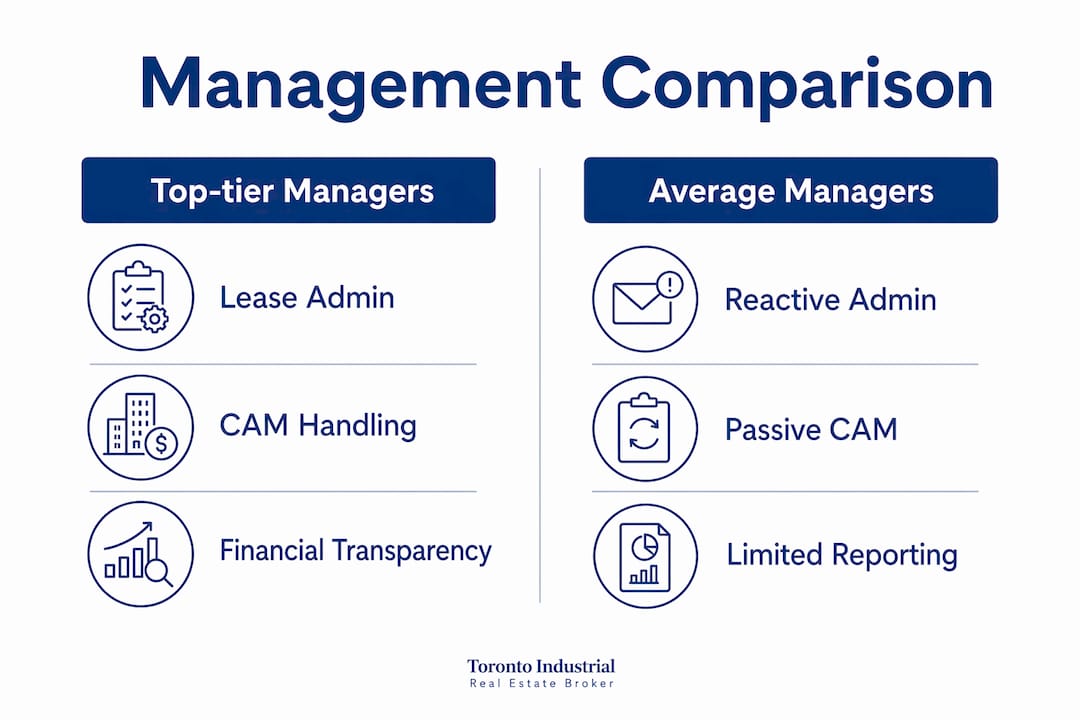
What differentiates top-tier commercial property managers from average ones?
The defining characteristic of a top-tier manager is the ownership mindset. This means treating the asset’s performance as a direct reflection of personal accountability, not as a service contract to be fulfilled at minimum effort. Managers who operate this way make decisions that a passive administrator would defer. They call a tenant before a lease expires rather than waiting for the tenant to initiate. They flag a roof inspection before the rainy season rather than after the first leak.
Integrated asset management
Top-tier firms integrate asset management with property management to coordinate accounting, operations, and leasing under one coherent strategy. This integration prevents the most common and costly management failures: CAM reconciliation mismatches, deferred maintenance backlogs, and lease renewal gaps. When the accounting team, leasing team, and operations team share the same data and communicate regularly, errors that fall between departments simply do not occur.
The table below compares the operational practices of top-tier versus average commercial real estate management firms:
| Practice area | Top-tier managers | Average managers |
|---|---|---|
| Lease administration | Proactive date tracking with automated alerts | Reactive, calendar-based reminders |
| CAM reconciliation | Monthly variance reviews, tenant-facing transparency | Annual reconciliation, frequent disputes |
| Vendor management | Pre-negotiated rosters, performance benchmarks | Ad hoc vendor selection, variable pricing |
| Financial reporting | Real-time owner portal with live rent rolls | Monthly PDF statements emailed on request |
| Tenant communication | Scheduled touchpoints, proactive renewal outreach | Responsive only, no structured engagement |
| Maintenance planning | Preventive schedules tied to capital budgets | Reactive repairs after tenant complaints |
Pro Tip: When evaluating a management firm, ask specifically how they handle CAM reconciliation disputes. A firm that has a documented dispute resolution process and can show you examples of resolved cases is operating at a professional level. A firm that cannot answer this question clearly is not.
High-performing managers also treat CAM recoveries and lease escalations as active revenue levers rather than passive bookkeeping tasks. This distinction matters enormously. A manager who audits recoverable expenses quarterly and applies escalations on schedule generates materially more income than one who processes these items annually as an afterthought.
What market challenges and opportunities exist in the GTA industrial sector?
The GTA industrial market features growing demand with variable vacancy rates, where strategic location, tenant quality, and lease management are key to maintaining profitability. The corridors most active in 2026 include Toronto West near the Airport, the Mississauga and Brampton nodes along Highway 410 and 427, and the North GTA markets of Vaughan and Markham. East GTA, covering Pickering, Ajax, Whitby, and Oshawa, continues to attract logistics users priced out of the western corridors.
Vacancy rates and rental pricing
Industrial vacancy in the GTA has been historically low by global standards, though 2025 and 2026 brought modest increases as new supply entered specific submarkets. This creates a nuanced environment for property managers. In tight submarkets like Mississauga Airport and Vaughan, managers can hold firm on rental rates and push escalations aggressively. In markets with newer supply, such as parts of Hamilton and Milton, managers must compete more actively on lease terms, tenant improvement allowances, and flexibility provisions.
The table below outlines key GTA industrial submarkets and their management priorities:
| Submarket | Demand driver | Management priority |
|---|---|---|
| Mississauga Airport | Air freight, e-commerce fulfilment | Rent escalation enforcement, dock management |
| Brampton / Highway 410 | Last-mile logistics, 3PL operators | Tenant retention, lease renewal timing |
| Vaughan / Woodbridge | Manufacturing, food processing | Preventive maintenance, power infrastructure |
| Markham / Richmond Hill | Tech distribution, light industrial | Tenant quality screening, lease flexibility |
| Durham Region (Ajax, Whitby, Oshawa) | Logistics overflow, owner-users | Occupancy stabilisation, competitive lease terms |
| Hamilton / Burlington | Heavy industrial, port-adjacent users | Capital planning, environmental compliance |
Tenant quality and retention strategies
Tenant retention strategies such as lease renewal focus and landlord responsiveness significantly impact occupancy rates in GTA industrial properties. Replacing an industrial tenant is expensive. Downtime between leases, tenant improvement costs, and leasing commissions can collectively represent 12–18 months of gross rent. A manager who retains a quality tenant through proactive renewal engagement protects far more value than one who simply re-leases a vacant unit at a marginally higher rate.
Local market intelligence empowers managers to make strategic decisions that align with owner goals and current conditions. Knowing that a competing building two kilometres away just dropped its asking net rent by $1.50 per square foot changes how you approach a renewal negotiation. Managers without access to current market data negotiate blind.
How to choose the right property management firm for GTA industrial assets?
Selecting the right management partner is one of the highest-leverage decisions an industrial property owner makes. The wrong firm costs you money through missed escalations, poor vendor pricing, and tenant attrition. The right firm operates as an extension of your ownership strategy. Owner satisfaction correlates directly with transparency and local knowledge, which means the evaluation process should focus on those two dimensions above all others.
Here is a structured approach to evaluating prospective management firms:
-
Assess local market expertise. Ask the firm to walk you through current vacancy rates, net rental ranges, and absorption trends in your specific submarket. A firm with genuine local knowledge answers this without hesitation. A firm that generalises is not close enough to the market to serve you well.
-
Review their technology platform. Request a live demonstration of their owner portal. Confirm that you will have real-time access to rent rolls, financial statements, CAM reconciliation reports, and work order histories. Firms still operating on monthly PDF emails are not equipped for the pace of today’s GTA market.
-
Examine their vendor network. Ask for a list of their primary vendors for roofing, HVAC, dock equipment, and landscaping. Confirm that these vendors are pre-qualified and operating under negotiated rate agreements. Spot-check one or two vendor relationships by asking about response time standards.
-
Clarify the fee structure. Full-service commercial management fees typically range from 3–6% of collected gross revenue for industrial assets, depending on property size and complexity. Confirm what is included and what triggers additional charges. Hidden fees for lease renewals, tenant coordination, or capital project oversight are red flags.
-
Test their communication responsiveness. Send an email inquiry before signing any agreement and measure the response time. A firm that takes three days to respond to a prospective client will take longer to respond to your tenants.
Pro Tip: Ask every prospective management firm for two references from industrial property owners in your specific submarket. Generic references from office or retail clients do not tell you how a firm performs in an industrial context. Industrial properties have distinct operational requirements, and experience in the asset class matters.
The importance of location in commercial property decisions extends directly to management. A firm headquartered in downtown Toronto managing a warehouse in Oshawa without local staff or vendor relationships will consistently underperform a firm with genuine presence in Durham Region. Proximity drives response times, vendor accountability, and market awareness.
Expert capital advisors and management firms that coordinate financial strategy with day-to-day operations deliver outcomes that neither discipline achieves alone. When the person managing your lease renewals understands your asset’s financing structure and exit timeline, every decision they make is calibrated to your actual goals rather than to a generic management checklist.
Key takeaways
Effective industrial property management in the GTA requires integrating proactive lease administration, real-time financial reporting, and an ownership mindset to consistently improve NOI and protect asset value.
| Point | Details |
|---|---|
| NOI improvement is measurable | Professional management delivers an average 18% NOI gain within the first 12 months. |
| Lease administration drives revenue | Active tracking of escalations and renewal dates prevents direct revenue loss on every lease. |
| Ownership mindset separates top firms | Managers who treat assets as their own capital make proactive decisions that passive administrators defer. |
| GTA submarket knowledge is non-negotiable | Vacancy rates and rental trends vary significantly across Mississauga, Vaughan, Durham, and Hamilton. |
| Technology and transparency build trust | Real-time owner portals with live rent rolls and CAM reports reduce disputes and improve decision-making. |
What I have learned managing industrial assets in the GTA
I have spent years working across the GTA industrial corridors, from the Airport submarket in Mississauga to the logistics nodes in Ajax and Whitby, and one pattern holds across every asset class and ownership structure: the gap between a well-managed property and a poorly managed one is almost never about the building. It is about the manager’s relationship with information.
The owners who get the best outcomes are the ones who demand real-time data and hold their managers accountable to it. They are not micromanaging. They are creating the conditions where problems surface early rather than late. A missed rent escalation discovered in month three costs one month of revenue. The same miss discovered at year-end costs twelve.
The ownership mindset concept is real, and I have seen it play out in concrete terms. A manager who genuinely treats your asset as their own capital will call you when a tenant’s business looks shaky, before the rent stops. They will flag a roof that needs attention before the spring melt, not after the first ceiling stain. That level of engagement cannot be written into a management agreement. It comes from hiring the right firm and then maintaining a relationship where accountability flows in both directions.
For GTA industrial owners specifically, I would add one piece of advice that most articles skip: your management firm’s vendor network is worth more than their management fee structure. A firm with strong relationships with local mechanical contractors, dock equipment specialists, and roofing companies in Brampton or Vaughan will save you more money annually than a firm offering a lower percentage fee but sourcing vendors on the open market. Negotiate on service quality first and fee percentage second.
The broker advantages in commercial leasing extend into management when the same firm handles both functions. Continuity of market knowledge between the leasing and management teams means your renewal strategy is always calibrated to current market conditions rather than to what the market looked like when the lease was signed.
— Michael
Work with a GTA industrial real estate specialist

Mlawrealestate delivers industrial real estate advisory services across every major GTA corridor, from Mississauga and Brampton to Vaughan, Markham, and Durham Region. Whether you are managing an existing portfolio, evaluating a lease renewal, or acquiring a new industrial asset, the depth of local market intelligence at Mlawrealestate translates directly into better decisions and measurable outcomes. Michael Law operates through Lennard Commercial Realty, one of Canada’s most respected commercial brokerage platforms, bringing institutional-grade analysis to every engagement. Explore available GTA industrial properties or connect directly to discuss your management and leasing strategy.
FAQ
What do commercial real estate managers actually do?
Commercial real estate managers oversee the operations, financial reporting, lease administration, and tenant relations of income-producing properties. In the industrial sector, this includes vendor management, CAM reconciliation, rent escalation tracking, and preventive maintenance coordination.
How much does commercial property management cost in the GTA?
Full-service industrial property management fees typically range from 3–6% of collected gross revenue, depending on property size and complexity. Confirm what services are included in the base fee before signing any management agreement.
What is CAM reconciliation and why does it matter?
CAM reconciliation is the annual or periodic process of comparing actual common area maintenance costs to the estimated amounts tenants paid throughout the year. Errors in CAM reconciliation are a leading cause of tenant disputes and revenue leakage in industrial properties.
How do I know if my property manager is performing well?
Benchmark your manager against three indicators: NOI trend year over year, tenant retention rate, and time to resolve maintenance work orders. A well-managed industrial asset should show improving NOI, occupancy above 95%, and work orders closed within agreed service timelines.
Why does local market expertise matter for industrial property management?
GTA industrial submarkets like Mississauga Airport, Vaughan, and Durham Region each have distinct vacancy rates, rental ranges, and tenant demand profiles. A manager without current local data cannot negotiate lease renewals or position your asset competitively against nearby alternatives.
Recommended

About Michael Law
Managing Partner and Industrial Real Estate Broker at Lennard Commercial Realty. Representing tenants and landlords across Toronto and the GTA for 15+ years. Michael specializes in GTA industrial real estate — connect with Toronto's leading industrial broker at mlawrealestate.com/industrial-broker-toronto.
Related Articles


More Toronto Industrial Real Estate Insights
Common Questions
What is a sale-leaseback in industrial real estate?
A sale-leaseback is a transaction in which an industrial property owner sells their building to an investor and simultaneously signs a long-term lease to remain in the property as a tenant. The seller unlocks the capital tied up in their real estate while retaining full operational use of the facility. The buyer acquires a tenanted investment property with immediate cash flow from a known occupant.
Read →What is a dock-to-grade ratio in industrial real estate?
Dock-to-grade ratio in industrial real estate refers to the number of dock-level loading doors relative to the building's floor area, typically expressed as one dock door per X,000 square feet. It is a key specification for distribution and warehousing tenants because it determines how many trucks can load and unload simultaneously and therefore the building's throughput capacity.
Read →What is clear height in a warehouse or distribution centre?
Clear height in a warehouse or distribution centre refers to the usable vertical space from the finished floor to the lowest overhead obstruction — typically the bottom of the roof structure, sprinkler heads, or HVAC equipment. It is the single most important building specification for warehouse tenants because it determines how many racking levels can be installed and therefore how much product can be stored per square foot of floor space.
Read →