
Tenant representation services: GTA industrial guide 2026
By Michael Law · Industrial Real Estate Broker, Lennard Commercial Realty
TL;DR:
- Tenant representation services in the GTA help industrial tenants secure favorable leases and reduce occupancy costs by 10%–25%. Engaging a dedicated, independent tenant advisor early in the process provides market data, negotiates concessions, and aligns lease terms with operational needs. Early involvement ensures maximum leverage and streamlines lease negotiations, ultimately saving tenants significant expenses over the long term.
Tenant representation services are specialised commercial real estate services where licensed brokers work exclusively for tenants to secure optimal industrial lease agreements and long-term occupancy strategies. In the Greater Toronto Area, where industrial vacancy rates have tightened significantly across Mississauga, Brampton, Vaughan, and the Durham Region, the stakes of signing the wrong lease are higher than ever. A skilled leasing representative does more than find available space. They reduce total occupancy costs by 10%–25% over a typical five-year industrial lease, which on a 5,000 sq ft facility can represent over $100,000 in savings. For logistics operators, manufacturers, and e-commerce businesses competing for limited GTA industrial supply, that difference is material.
How do tenant representation services lower occupancy costs?
The financial case for tenant advisory services is direct and measurable. Tenant reps bring current market data to every negotiation, which means they know exactly what comparable tenants in Brampton or Pickering paid last quarter. Landlords know this too, which is why having a knowledgeable representative at the table changes the dynamic immediately.
Benchmarking rent against real market data
A tenant negotiating alone relies on whatever the landlord’s broker shares. A tenant rep uses independent submarket data to benchmark base rent against actual comparable transactions. This prevents tenants from accepting above-market rates presented as standard.
Securing concessions beyond base rent
Tenant reps secure protections like rent-free periods, tenant improvement (TI) allowances, and expense caps that unrepresented tenants routinely miss. A free-rent period of two to four months on a 10-year lease is a significant cash-flow benefit. TI allowances fund fit-out costs that would otherwise come directly from your capital budget.
Key financial protections a tenant rep negotiates on your behalf include:
- Rent abatement periods: Free rent at lease commencement to offset fit-out downtime
- TI allowances: Landlord-funded contributions toward leasehold improvements
- CAM and tax caps: Annual limits on common area maintenance and property tax escalations
- Gross-up clause controls: Protections against inflated operating cost calculations
- Renewal and termination rights: Options that preserve flexibility as your business scales
Total occupancy cost modelling is where most unrepresented tenants lose money. Base rent is only one line item. Operating costs, property taxes, utilities, and escalation clauses compound over a five-year term. A tenant rep models all of these before you sign, not after.
Pro Tip: Ask your tenant rep to produce a total occupancy cost comparison across at least three shortlisted properties before entering final negotiations. The property with the lowest base rent is rarely the lowest total cost.
What does the tenant representation process look like?
Tenants typically negotiate a lease every three to five years, while landlords negotiate constantly. That experience gap is the core reason professional tenant advisory services exist. A structured process closes that gap at every stage.
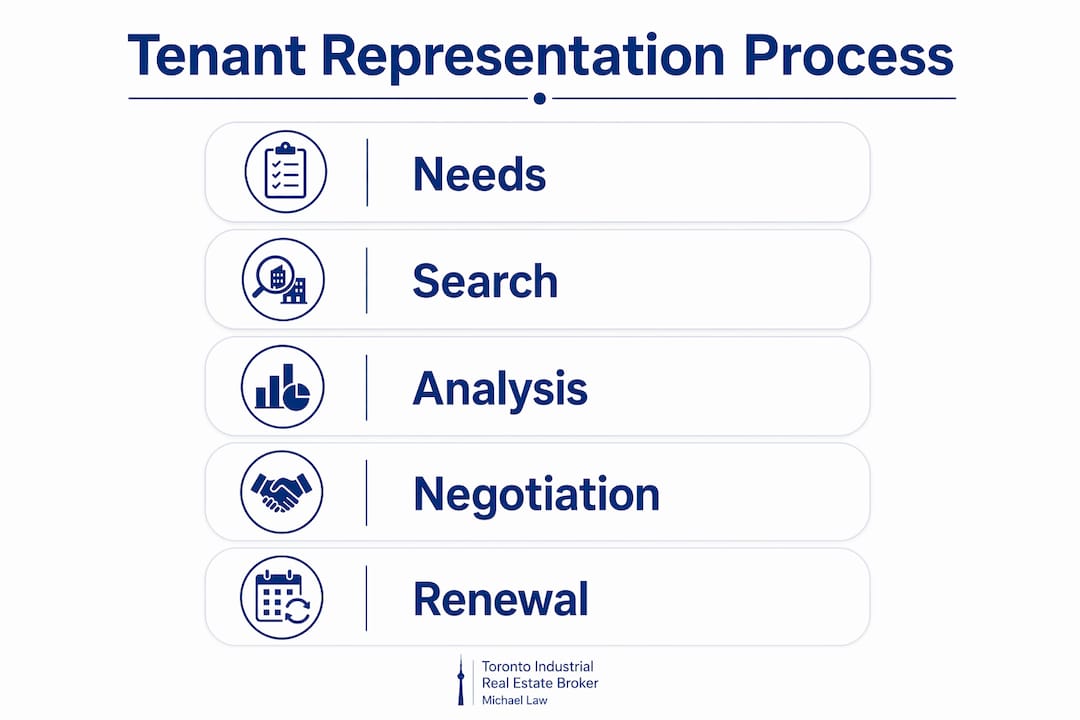
The full process for GTA industrial leasing follows these stages:
-
Needs assessment. The rep documents your operational requirements in detail: clear ceiling height (typically 28–40 ft for modern GTA logistics facilities), power supply (amps and voltage), dock doors, drive-in access, yard depth, and proximity to Highway 400, 401, 410, or 427. Detailed space assessments improve operational efficiency and reduce post-occupancy costs.
-
Market research. The rep surveys available inventory across relevant GTA submarkets, including off-market opportunities that never appear on public listing platforms. In tight markets like Vaughan or Mississauga Airport Corridor, off-market access is often the only way to find suitable space.
-
Property shortlisting and tours. A curated shortlist is presented with comparative analysis, not just addresses and photos. Each property is evaluated against your operational criteria.
-
Financial modelling. The rep builds a total occupancy cost model for each shortlisted property, accounting for base rent, operating costs, escalations, and any capital expenditures required to make the space functional.
-
Lease negotiation. This is where expert negotiation delivers the most value. The rep negotiates commercial terms, legal protections, and landlord concessions simultaneously, using competing offers as leverage where possible.
-
Post-occupancy support. A strong tenant rep relationship does not end at lease signing. Ongoing support includes lease audits to verify operating cost reconciliations, renewal strategy planning, and expansion advisory as your business grows.
Commercial lease documents often span 50–200 pages and contain clauses that, if unreviewed, can lead to tenants overpaying by 20% or more over the lease term. Key clauses include CAM caps, audit rights, and personal guarantees. A tenant rep reviews every one of these before you commit.
Pro Tip: Do not wait until you have found a space to engage a tenant rep. The needs assessment stage shapes which properties make the shortlist. Skipping it means you may tour the wrong buildings entirely.

Tenant rep vs. landlord broker: what is the real difference?
The distinction between a tenant representative and a landlord broker is not just procedural. It determines whose financial interests are protected at the negotiating table.
| Factor | Tenant Representative | Landlord Broker |
|---|---|---|
| Who they represent | Tenant exclusively | Property owner exclusively |
| Primary goal | Minimise tenant occupancy costs | Maximise landlord rental income |
| Market data access | Independent, cross-market data | Focused on their own listings |
| Conflict of interest | None with respect to tenant | Inherent conflict with tenant goals |
| Lease term flexibility | Advocates for tenant-friendly clauses | Advocates for landlord-protective clauses |
| Incentive alignment | Aligned with tenant business outcomes | Aligned with landlord financial returns |
Tenant representatives work exclusively for tenants, avoiding the conflicts of interest that are inherent in landlord representation. This independence is the foundation of the service. When a landlord’s broker shows you a property, their obligation is to their client, the landlord. When your tenant rep shows you a property, their obligation is to you.
The conflict becomes most visible during lease negotiation. A landlord broker will present the landlord’s standard lease form as normal and reasonable. Many clauses in that form are neither. Unlimited CAM charges, personal guarantee requirements, and restrictive assignment clauses are common examples. An independent tenant advisor identifies these clauses and negotiates their removal or modification.
The primary value of tenant representatives lies in their complete independence and sole allegiance to the tenant’s business outcomes. This is not a subtle distinction. It is the reason that GTA businesses with complex operational requirements, tight capital budgets, or multi-location portfolios consistently engage dedicated tenant advocacy rather than relying on the landlord’s team.
A practical test: if the broker showing you a property also represents the landlord of that property, you are receiving dual-agency representation at best and undisclosed landlord representation at worst. Neither serves your interests fully.
When and how should you engage a tenant rep in the GTA?
Timing is the most underestimated factor in commercial tenant services. Most businesses engage a tenant rep too late, which eliminates the negotiating leverage that makes the service valuable.
The right timing benchmarks for GTA industrial tenants are:
- Lease renewals: Engage a tenant rep 9–18 months before lease expiry to allow full market evaluation and negotiation
- Relocations: Begin the process 12–24 months before your required occupancy date to account for GTA supply constraints
- Expansions: Start 12 months ahead minimum, as purpose-built or large-format industrial space in Brampton, Vaughan, or Ajax requires significant lead time
- Lease renewals at tight-market properties: Earlier is always better; lease renewals represent the moment of highest leverage for tenants, but only when approached with alternatives in hand
Failing to engage tenant representation early often leads to missed negotiation opportunities, resulting in higher rent and less favourable lease terms due to last-minute pressure and lack of alternatives. This is the single most common and costly mistake GTA industrial tenants make.
When selecting a tenant rep, prioritise these criteria:
- GTA industrial specialisation. A generalist commercial broker does not carry the submarket knowledge required for industrial leasing in Mississauga, Markham, or Hamilton. Specialisation matters.
- Transaction track record. Ask for specific examples of comparable industrial leases negotiated in the past 24 months, including the concessions secured.
- No landlord conflicts. Confirm that your rep does not simultaneously represent landlords in the submarkets where you are searching.
- Post-signing capability. A rep who disappears after lease execution is not a strategic partner. Confirm they provide lease audit and renewal support.
Pro Tip: Request a written conflict-of-interest disclosure from any tenant rep before signing a representation agreement. In the GTA industrial market, where a small number of large landlords control significant inventory, undisclosed conflicts are a real risk.
Key takeaways
Tenant representation services deliver measurable financial and strategic value to GTA industrial tenants by providing independent expertise, market data, and skilled negotiation at every stage of the leasing process.
| Point | Details |
|---|---|
| Cost savings are quantifiable | Professional tenant reps reduce total occupancy costs by 10%–25%, often exceeding $100,000 on a 5,000 sq ft lease. |
| Independence is the core advantage | Tenant reps owe their duty solely to the tenant, eliminating the conflicts inherent in landlord broker representation. |
| Engage early for maximum leverage | Start the process 9–18 months before lease expiry or 12–24 months before relocation to preserve negotiating options. |
| Total cost beats base rent | Model all occupancy costs including CAM, taxes, and escalations before comparing properties or entering negotiations. |
| Post-signing support matters | Lease audits, renewal strategy, and expansion advisory extend the value of tenant representation beyond the signing date. |
What i have seen working in GTA industrial real estate
The businesses that get the best lease outcomes in the GTA are not always the largest or the most sophisticated. They are the ones that engage early and treat their tenant rep as a strategic partner rather than a transaction facilitator.
I have seen tenants save more in a single lease negotiation than they spent on operations in a full year. I have also seen businesses sign leases they deeply regret, not because they were careless, but because they did not know what they did not know. Commercial lease documents are complex instruments. The clauses that cost tenants the most money are rarely the obvious ones. They are the operating cost reconciliation provisions, the demolition clauses, and the personal guarantee requirements buried deep in the document.
The GTA industrial market in 2026 remains competitive. Vacancy has loosened slightly from its historic lows, but quality space in Mississauga’s Airport Corridor, Vaughan’s Highway 400 node, and Brampton’s Highway 410 corridor still moves quickly. That means tenants who wait too long to engage representation lose access to the best options before negotiations even begin.
My strongest advice is this: treat your lease as a financial instrument, not an administrative task. The terms you negotiate today will affect your occupancy costs, operational flexibility, and balance sheet for five to ten years. That outcome is worth professional advocacy.
You can review my transaction background and approach at Lennard Commercial Realty, where I have built my GTA industrial practice.
— Michael
How Mlawrealestate supports GTA industrial tenants
Mlawrealestate provides dedicated tenant representation for industrial occupiers across the full GTA, from Caledon and Brampton in the west to Ajax, Whitby, and Oshawa in the east. The service covers site selection, lease negotiation, renewal strategy, and occupancy cost analysis, all focused exclusively on industrial tenants in logistics, warehousing, and manufacturing.

Representation is structured so that tenants bear no direct cost. The landlord pays the commission, which means you access institutional-grade advisory without an out-of-pocket fee. If you are leasing, renewing, or considering a relocation in the GTA, explore Mlawrealestate’s industrial leasing services in Caledon and across the broader GTA market at mlawrealestate.com.
FAQ
What are tenant representation services in commercial real estate?
Tenant representation services are specialised advisory services where a licensed broker works exclusively for the tenant to negotiate industrial or commercial leases, secure favourable terms, and protect the tenant’s business interests throughout the leasing process.
How much do tenant representation services cost?
Tenant representatives receive their compensation via commission splits paid by the landlord, so tenants typically bear no direct cost. Confirm this arrangement in writing with your representative before signing any agreement.
When should a GTA business engage a tenant rep?
Engage a tenant rep 9–18 months before lease expiry for renewals, or 12–24 months before a planned relocation. Earlier engagement preserves negotiating leverage and access to the full range of available GTA industrial inventory.
What is the difference between a tenant rep and a landlord broker?
A tenant rep owes their duty solely to the tenant and negotiates to minimise occupancy costs and improve lease flexibility. A landlord broker represents the property owner and works to maximise rental income and protect landlord interests.
Can a tenant rep help with lease renewals, not just new leases?
Lease renewals are where knowledgeable tenant representatives can significantly reduce costs and improve terms, making renewal negotiations one of the highest-value applications of tenant representation services.
Recommended

About Michael Law
Managing Partner and Industrial Real Estate Broker at Lennard Commercial Realty. Representing tenants and landlords across Toronto and the GTA for 15+ years. Michael specializes in GTA industrial real estate — connect with Toronto's leading industrial broker at mlawrealestate.com/industrial-broker-toronto.
Related Articles

More Toronto Industrial Real Estate Insights
Common Questions
What is a sale-leaseback in industrial real estate?
A sale-leaseback is a transaction in which an industrial property owner sells their building to an investor and simultaneously signs a long-term lease to remain in the property as a tenant. The seller unlocks the capital tied up in their real estate while retaining full operational use of the facility. The buyer acquires a tenanted investment property with immediate cash flow from a known occupant.
Read →What is a dock-to-grade ratio in industrial real estate?
Dock-to-grade ratio in industrial real estate refers to the number of dock-level loading doors relative to the building's floor area, typically expressed as one dock door per X,000 square feet. It is a key specification for distribution and warehousing tenants because it determines how many trucks can load and unload simultaneously and therefore the building's throughput capacity.
Read →What is clear height in a warehouse or distribution centre?
Clear height in a warehouse or distribution centre refers to the usable vertical space from the finished floor to the lowest overhead obstruction — typically the bottom of the roof structure, sprinkler heads, or HVAC equipment. It is the single most important building specification for warehouse tenants because it determines how many racking levels can be installed and therefore how much product can be stored per square foot of floor space.
Read →