How to qualify industrial tenants: a GTA landlord's guide
By Michael Law · Industrial Real Estate Broker, Lennard Commercial Realty
TL;DR:
- Qualifying industrial tenants involves verifying operational fit, financial stability, and regulatory compliance before lease signing. This process uses a capability matrix based on building specifications, detailed financial documents, and environmental due diligence to mitigate risks. Consistent application of these criteria ensures effective tenant screening aligned with legal requirements and property needs.
Qualifying industrial tenants means verifying that a prospective occupant’s business operations, financial strength, and regulatory obligations align precisely with your property’s physical specifications and lease requirements. This process, formally known as industrial tenant due diligence, is the single most effective way to prevent costly defaults, compliance failures, and operational disputes. For GTA landlords managing assets in Mississauga, Brampton, Vaughan, or the Durham Region, a structured qualification framework covers three pillars: operational fit, financial stability, and regulatory compliance. Skipping any one of them exposes you to risks that no rent premium can offset.
How to qualify industrial tenants: start with your building specs
The qualification process begins before you speak to a single prospect. Documenting building constraints such as ceiling height, floor load rating, power capacity, loading dock count, truck court dimensions, and zoning classification is the foundation of every credible screening programme. These specifications define which tenant operations are physically possible in your building and which are not.
A capability matrix is the practical tool that translates those specifications into a screening filter. You list each building attribute in one column and the minimum tenant requirement in the next. A logistics operator needing 36-foot clear heights will immediately fail the matrix for a building with 24-foot ceilings. That single filter eliminates weeks of wasted negotiation.
| Building attribute | Minimum threshold example | Tenant type affected |
|---|---|---|
| Clear ceiling height | 28 ft minimum | Racking-intensive warehousing |
| Floor load rating | 5,000 lbs/sq ft | Heavy manufacturing |
| Power capacity | 600V, 3-phase | Food processing, auto parts |
| Truck court depth | 130 ft minimum | 53-foot trailer operations |
| Zoning classification | M2 or E2 (Ontario) | Outdoor storage, heavy industrial |
Zoning classification deserves particular attention in the GTA. Ontario’s industrial zoning categories, ranging from prestige employment to heavy industrial, determine permitted uses at law. A tenant planning to store hazardous materials outdoors in a prestige employment zone will face municipal enforcement regardless of what the lease says. Reviewing industrial zoning in the GTA before marketing a property saves both parties from a compliance problem that surfaces only after possession.
Mismatched specifications create financial risk that compounds over time. A tenant whose trucks cannot manoeuvre a shallow truck court will demand expensive modifications, delay operations, or default on rent while disputing responsibility. Catching the mismatch at the capability matrix stage costs nothing.
Pro Tip: Build your capability matrix as a one-page PDF and attach it to your initial listing brief. Brokers and tenants who self-screen against it save you two to three rounds of site visits with unqualified prospects.
How to assess the financial stability of potential tenants
Financial qualification is the most documented part of industrial tenant screening, yet it is also where landlords most commonly cut corners under leasing pressure. The standard practice requires 2 to 3 years of financial statements covering income, balance sheet, and cash flow, combined with a formal credit report and bankruptcy search. Together, these documents reveal whether a tenant can sustain rent obligations across a five or ten-year lease term, not just at signing.

Credit reports for commercial tenants in Canada are available through Equifax Business, Dun and Bradstreet, and similar bureaus. A credit score alone is insufficient. You need to examine payment history with trade creditors, outstanding liens, and any prior insolvency proceedings. A company with a moderate credit score but clean payment history and growing revenue is a stronger candidate than one with a high score masking recent restructuring.
The financial review process should include:
- Income statements for the past two to three years, reviewed for revenue trend, gross margin stability, and EBITDA relative to proposed rent obligations
- Balance sheets confirming net asset position and debt-to-equity ratio, with particular attention to current liabilities that could strain cash flow
- Cash flow statements showing operating cash generation, since profitable companies can still default if cash is tied up in receivables or inventory
- Credit bureau report from Equifax Business or Dun and Bradstreet, including trade payment history and any registered judgements
- Bankruptcy and PPSA searches through the Ontario Personal Property Security Registry to identify prior insolvencies or secured creditors with claims on assets
When financial statements reveal borderline results, personal guarantees from principals are the standard remedy in GTA industrial leasing. A personal guarantee does not eliminate risk, but it aligns the tenant’s principals with the lease obligation and deters strategic defaults. For newer companies without a multi-year track record, a security deposit equal to three to six months of gross rent is a reasonable requirement.
Industrial tenant searches commonly take six to twelve months in competitive GTA submarkets. Lowering financial qualification standards to accelerate lease-up creates a far more expensive problem. An underqualified tenant who defaults after eighteen months leaves you with vacancy, legal costs, and potential property damage that far exceed the rent collected.
Pro Tip: Ask for management-prepared financials if the tenant is a private company without audited statements. Then cross-reference their reported revenue against HST remittance history, which you can request as a condition of the application. Discrepancies between the two are a reliable early warning signal.
What operational and regulatory checks ensure tenant compliance?
Financial strength is necessary but not sufficient. Operational risk often lies in the details of what a tenant actually does inside the building: the equipment they run, the waste they generate, the utility loads they draw, and how their logistics flows interact with your site layout. A well-capitalised tenant running an incompatible operation creates disputes that no security deposit resolves cleanly.
The operational review should confirm:
- Intended use statement: A written description of all activities the tenant plans to conduct, including storage of any chemicals, flammable materials, or regulated substances
- Equipment list and utility requirements: Specific machinery, HVAC demands, compressed air, floor drainage, and electrical loads that must be matched against building infrastructure
- Waste handling procedures: How the tenant manages solid waste, liquid waste, and any hazardous materials, including disposal contracts and regulatory permits
- Insurance coverage: Confirmation of commercial general liability, property damage, and any pollution liability coverage required by the lease
- Repair and restoration obligations: Written acknowledgement of the tenant’s responsibility to restore the premises to base building condition at lease end
Environmental due diligence is a distinct and critical step for industrial properties. Phase I Environmental Site Assessments identify existing contamination risks and establish a baseline condition of the property before a new tenant takes possession. This baseline protects the landlord from liability if the tenant’s operations introduce new contamination. For tenants handling chemicals, solvents, fuels, or other regulated substances, a Phase I ESA is not optional. It is the minimum standard of care.
| Compliance check | Purpose | Who is responsible |
|---|---|---|
| Zoning and permitted use review | Confirms tenant operations are lawful at the address | Landlord and tenant jointly |
| Phase I Environmental Site Assessment | Establishes pre-tenancy baseline and identifies existing risk | Landlord (with tenant cooperation) |
| Insurance certificate review | Confirms adequate coverage before possession | Tenant provides, landlord verifies |
| Hazardous materials disclosure | Identifies regulated substances on site | Tenant discloses, landlord reviews |
| TSSA and municipal permits | Confirms tenant holds required operating licences | Tenant provides copies |
Ontario industrial due diligence practice ties tenant qualification directly to lease risk allocation. The qualifications you collect during screening should mirror the obligations written into the lease. If the lease requires the tenant to maintain environmental insurance, your qualification checklist must confirm they can obtain it before you execute the agreement.
What is the step-by-step workflow for tenant qualification?
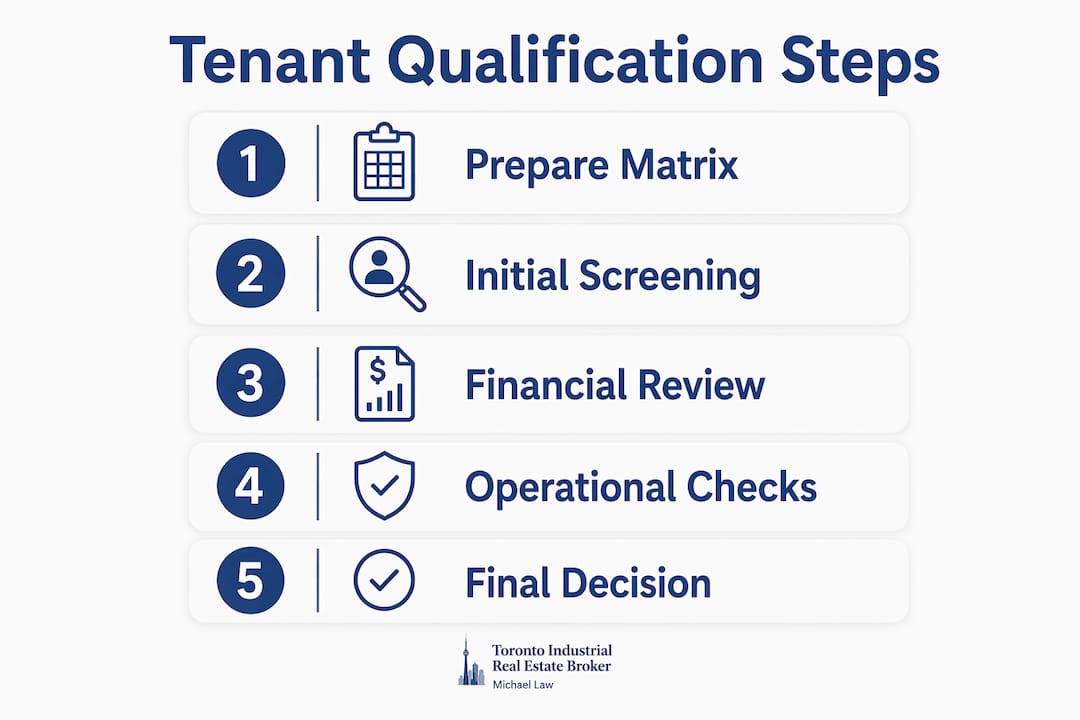
A structured workflow prevents the most common qualification failure: collecting information in the wrong order and discovering a disqualifying issue after significant time and legal costs have been invested. The sequence below integrates property specs, financial vetting, and compliance checks into a single linear process.
- Distribute the capability matrix to all prospective tenants and brokers before scheduling site tours. Tenants who cannot meet the physical specifications self-select out.
- Conduct a preliminary site tour with tenants who pass the capability matrix. Use this visit to assess operational fit in person, including truck court access, dock configuration, and power infrastructure.
- Issue a formal lease application requiring the tenant’s legal entity name, principal contact, intended use statement, and authorisation to conduct credit and background checks. Structured lease applications that collect verified legal entity and financial information are the foundation of continuous risk management.
- Run credit and background checks using the tenant’s written consent. In Canada, consent requirements under PIPEDA govern commercial tenant screening. In cross-border transactions involving U.S. entities, FCRA-compliant consent is legally required before ordering any credit or background report, and renewals require new standalone consent.
- Review financial statements covering the past two to three years, alongside credit bureau reports and PPSA searches.
- Conduct the operational risk assessment, reviewing the intended use statement, equipment list, utility requirements, and waste handling procedures against building infrastructure and lease obligations.
- Commission a Phase I ESA if the tenant’s intended use involves any regulated substances or if the property has not had a recent assessment.
- Make a qualification decision using the criteria below.
| Decision category | Criteria | Recommended action |
|---|---|---|
| Fully qualified | Passes capability matrix, strong financials, clean credit, compliant use | Proceed to lease negotiation |
| Conditionally qualified | Borderline financials, minor operational concerns | Require personal guarantee, higher deposit, or operational restrictions in lease |
| Disqualified | Fails capability matrix, poor credit history, non-compliant use | Decline and document reasons for file |
Common mistakes at this stage include scheduling site tours before distributing the capability matrix, accepting verbal descriptions of intended use without written disclosure, and rushing credit checks without proper consent documentation. Each shortcut creates a gap in your qualification record that becomes a liability if a dispute arises later.
How to troubleshoot common challenges in tenant qualification
Even a well-designed qualification process encounters friction. The most frequent challenge is incomplete or evasive tenant disclosure. A prospect who delays providing financial statements or gives vague answers about their intended use is communicating something important. Treat incomplete disclosure as a disqualifying condition unless the tenant provides a credible explanation and remedies the gap within a defined timeframe.
Balancing leasing speed with qualification rigour is a genuine tension in the GTA market, where vacancy rates in prime nodes like Mississauga Airport and Brampton have tightened significantly. The pressure to lease quickly is real, but underqualified tenants defaulting after eighteen months costs far more than a longer search for a qualified occupant. Maintaining your qualification standards is a financial discipline, not a bureaucratic one.
Tenant fit-out and improvement requests add another layer of complexity. A tenant requesting significant modifications to the building, such as additional dock doors, mezzanine construction, or upgraded electrical service, signals a deeper operational dependency on the space. This dependency cuts both ways. It increases the cost of tenant default and relocation, but it also signals a tenant who intends to stay. Review tenant improvements in GTA industrial spaces carefully and tie improvement approvals to lease term length and financial qualification results.
Legal considerations in tenant screening require consistent application of criteria. Apply the same qualification standards to every applicant for a given property. Inconsistent application creates exposure under Ontario’s Human Rights Code, which prohibits discrimination in commercial tenancy on protected grounds. Document your criteria in writing before marketing the property and apply them uniformly.
Pro Tip: Update your capability matrix and qualification criteria annually. GTA industrial market conditions, including zoning amendments, building code updates, and changes in permitted uses, shift regularly. Criteria that were appropriate in 2024 may not reflect current regulatory or operational realities in 2026.
Key takeaways
Qualifying industrial tenants requires matching operational fit, financial stability, and regulatory compliance to your property’s specifications before lease execution, not after.
| Point | Details |
|---|---|
| Build a capability matrix first | Document ceiling height, floor load, power, and zoning before marketing to screen tenants early. |
| Require 2 to 3 years of financials | Income statements, balance sheets, cash flow, and credit reports together reduce default risk reliably. |
| Conduct operational due diligence | Review intended use, equipment, waste handling, and utility loads against building infrastructure. |
| Commission a Phase I ESA | Establish a pre-tenancy environmental baseline to protect landlord liability when regulated substances are involved. |
| Apply criteria consistently | Document and apply the same qualification standards to every applicant to comply with Ontario’s Human Rights Code. |
What I’ve learned qualifying industrial tenants across the GTA
The most expensive mistake I see GTA landlords make is prioritising rent rate over operational fit. A tenant paying top-of-market rent for a building their logistics operation cannot efficiently use will find a reason to leave, renegotiate, or default within two years. I have seen it happen in Vaughan, in Mississauga, and in the Durham Region. The pattern is consistent.
What actually works is treating the capability matrix as a non-negotiable filter, not a starting point for negotiation. When a tenant’s truck court requirement exceeds what your site can deliver, no lease clause fixes that. The operational mismatch is baked in from day one.
The financial review step is where I see the most shortcuts. Landlords accept one year of financials, skip the PPSA search, or waive the personal guarantee because the tenant seems credible in person. Credibility in a meeting is not a substitute for documented financial strength. The two to three year financial review requirement exists precisely because one good year can mask a deteriorating business.
In the GTA market specifically, the due diligence process for industrial leasing has become more rigorous as vacancy rates tighten and lease terms lengthen. Landlords who built structured qualification processes early are now in a much stronger position. They have documentation, they have precedent, and they have fewer disputes. That is the practical payoff of doing this properly from the start.
My advice: integrate your qualification checklist directly into your lease template. The questions you ask during screening should mirror the obligations written into the lease. If the lease requires environmental insurance, your qualification checklist must confirm the tenant can obtain it. That alignment, between what you screen for and what you enforce, is what separates a well-managed industrial asset from a problem property.
— Michael
How Mlawrealestate supports GTA landlords in tenant qualification
Mlawrealestate provides GTA industrial landlords with the expertise and tools to qualify tenants efficiently, from capability matrix development through financial review and lease execution. With deep coverage across Toronto, Mississauga, Brampton, Vaughan, Markham, and the Durham Region, the team at Michael Law at Lennard Commercial brings transaction-tested qualification frameworks to every assignment.

Whether you are leasing a single-tenant warehouse in Brampton or a multi-unit industrial complex in Pickering, Mlawrealestate applies institutional-grade screening standards to protect your asset and reduce vacancy risk. Browse current GTA industrial property listings to see how qualification-ready assets are positioned for qualified tenants. Contact Mlawrealestate directly to discuss a tailored tenant qualification strategy for your property.
FAQ
What is industrial tenant qualification?
Industrial tenant qualification is the process of verifying that a prospective tenant’s operations, financial strength, and regulatory compliance align with a property’s physical specifications and lease obligations before executing an agreement.
What financial documents should I request from a prospective industrial tenant?
Request two to three years of income statements, balance sheets, and cash flow statements, along with a commercial credit report and a PPSA search to identify prior insolvencies or secured creditors.
Why is a Phase I Environmental Site Assessment required?
A Phase I ESA establishes the pre-tenancy environmental condition of the property, protecting the landlord from liability if the tenant’s operations introduce new contamination involving hazardous materials.
How do I screen industrial tenants for operational fit?
Use a capability matrix that lists your building’s ceiling height, floor load, power capacity, truck court dimensions, and zoning classification, then compare each attribute against the tenant’s stated operational requirements before scheduling a site tour.
What legal requirements apply to tenant screening in Canada?
In Canada, PIPEDA governs the collection and use of personal and business information during commercial tenant screening. Written consent is required before ordering credit or background checks, and criteria must be applied consistently to comply with Ontario’s Human Rights Code.
Recommended

About Michael Law
Managing Partner and Industrial Real Estate Broker at Lennard Commercial Realty. Representing tenants and landlords across Toronto and the GTA for 15+ years. Michael specializes in GTA industrial real estate — connect with Toronto's leading industrial broker at mlawrealestate.com/industrial-broker-toronto.