Commercial real estate Omaha: 2026 industrial market guide
By Michael Law · Industrial Real Estate Broker, Lennard Commercial Realty
TL;DR:
- Omaha’s industrial real estate market is strong, with very low vacancy rates and rising rents signaling investor confidence.
- Many prime deals circulate privately through broker networks, making specialist brokers essential for securing top opportunities.
Commercial real estate in Omaha is defined by a tight industrial sector with rising rents, near-record low vacancy, and substantial new construction activity that signals sustained investor confidence heading into 2026. For investors and business owners evaluating Omaha commercial properties, the industrial asset class stands apart from retail and office segments in both performance and opportunity. Firms like NAI NP Dodge, Access Commercial, and Cascade Commercial are active in this market, each bringing distinct expertise to leasing, acquisitions, and tenant representation. Whether you are looking to buy commercial real estate in Omaha or secure a long-term industrial lease, understanding the current data is the non-negotiable starting point.
What are the current industrial market trends in Omaha?
Omaha’s industrial sector is the strongest segment in its commercial real estate market. Retail and office properties carry higher vacancy and softer rental dynamics, while industrial assets continue to tighten. That divergence matters for any investor allocating capital across property types.
Rental rates and vacancy in Q1 2026
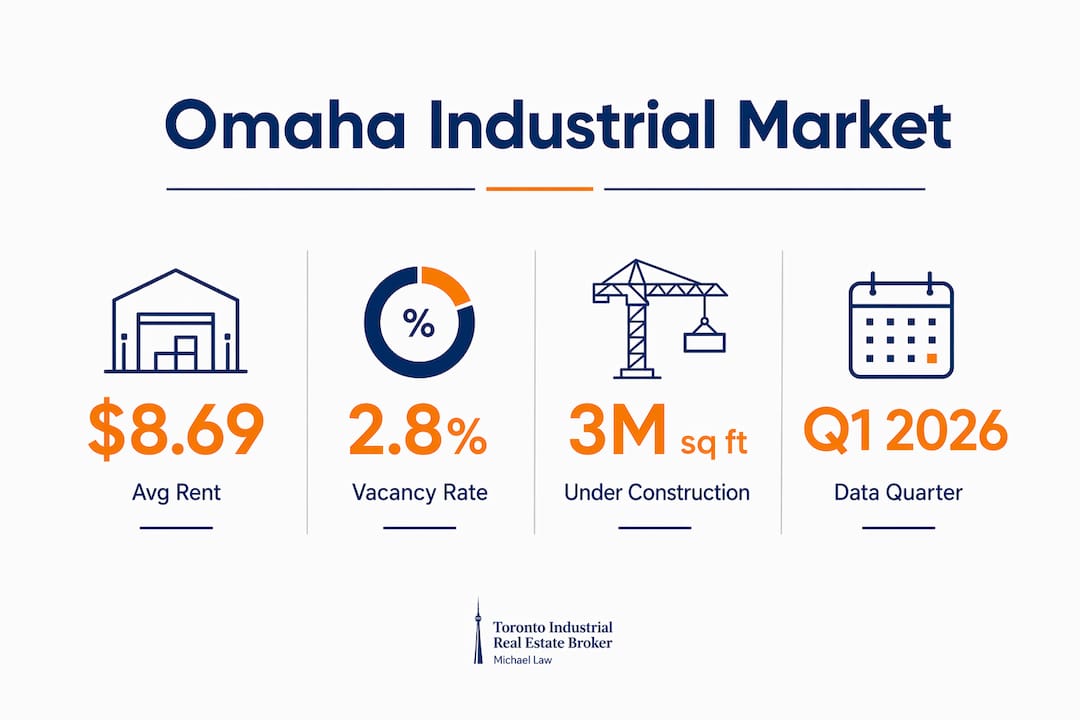
Average industrial rents reached $8.69 per sq ft in Q1 2026, up from the prior quarter. That incremental rise reflects a market where demand consistently outpaces available supply. Landlords hold meaningful negotiating power at this price point, and tenants who delay decisions face higher costs.

Industrial vacancy dropped to 2.8 percent as of Q1 2026. A vacancy rate below 3 percent is widely considered a landlord’s market. For investors, it signals strong occupancy income and limited downside risk on newly acquired assets.
New construction and development pipeline
Approximately 3 million sq ft of industrial space is currently under construction in Omaha. That volume of development activity is notable given how little vacancy exists. Developers are building speculatively because absorption has been strong enough to justify the risk.
High-profile commercial developments are also reshaping Omaha’s broader property market. The Buc-ee’s travel centre and the new Mutual of Omaha tower represent significant capital commitments that signal long-term confidence in the metro area. These projects attract ancillary industrial demand from logistics, distribution, and supply chain operators who need to be near growing commercial corridors.
| Metric | Q1 2026 Value |
|---|---|
| Average industrial rent | $8.69 per sq ft |
| Industrial vacancy rate | 2.8% |
| Industrial space under construction | ~3 million sq ft |
| Strongest CRE sector | Industrial |
Pro Tip: Track net absorption quarterly, not annually. A single quarter of negative absorption in a sub-3-percent vacancy market can signal a turning point before it shows up in annual reports.
How to evaluate leasing versus buying industrial properties in Omaha
The lease-or-buy decision in Omaha’s industrial market is not purely financial. It involves operational flexibility, capital allocation, and your read on where rents are heading over the next five to ten years.
Financial and operational comparison
Leasing preserves capital. A business that leases industrial space keeps its cash free for equipment, inventory, or expansion. Buying ties up capital in real property, but that capital builds equity and provides a hedge against rent escalation. With rents rising steadily and vacancy at 2.8 percent, buyers who lock in today avoid the compounding cost of future lease increases.
| Factor | Leasing | Buying |
|---|---|---|
| Upfront capital required | Low | High |
| Exposure to rent increases | High | None after purchase |
| Operational flexibility | High | Low |
| Long-term asset value | None | Builds equity |
| Balance sheet impact | Off-balance sheet | Asset recorded |
| Maintenance responsibility | Often landlord | Owner |
Leasing suits businesses with uncertain space requirements or those in growth phases where location needs may shift. Buying suits operators with stable footprints who want to control their occupancy costs long-term. Owner-user acquisitions are particularly compelling in Omaha right now because buying at today’s prices locks in cost certainty before rents climb further.
The role of broker expertise in the decision
A defensible commercial property valuation must account for income potential, tenant quality, and location upside, not just comparable sales. That level of analysis requires a broker who understands industrial assets specifically. Generalist brokers often miss the nuances of rent rolls, clear height requirements, and loading dock ratios that determine true industrial property value.
Broker advantages in commercial leasing extend well beyond finding available space. A specialist broker identifies whether a lease structure protects you during rent escalation cycles, whether tenant improvement allowances are negotiable, and whether the landlord has a history of honouring lease terms. Those details do not appear on any listing platform.
Pro Tip: Before signing any industrial lease in Omaha, request a full rent roll history for the building. Consistent tenancy signals a well-managed asset. High turnover signals problems that the listing will not mention.
What are strategic approaches to finding the best industrial deals in Omaha?
The most valuable industrial properties in Omaha rarely appear on public listing platforms. Many prime deals circulate exclusively through broker and investor networks before they reach any public catalogue. That reality defines the single most important strategic decision you will make: who you work with.
Why asset class specialists outperform generalists
Brokers specialising in industrial assets maintain exclusive access to listings, off-market opportunities, and landlord relationships that generalists simply do not have. A generalist broker lacks the deep understanding of local submarkets, pricing nuances, and rent roll analysis that industrial transactions demand. The gap in outcomes between a specialist and a generalist is not marginal. It is often the difference between securing a deal and missing it entirely.
Cascade Commercial’s approach to broker vetting makes this point clearly. Investors should ask any prospective broker how many industrial transactions they have completed in the past 12 months, in which submarkets, and at what price points. Vague answers are disqualifying.
Steps to identify and secure high-value opportunities
-
Define your criteria before approaching brokers. Specify clear height, loading configuration, power supply, and location requirements. Brokers share off-market deals with buyers who can move quickly and decisively.
-
Build relationships with two or three industrial specialists. Omaha’s industrial broker community is not large. Market reputation and trusted relationships are the primary currency for accessing early deal flow.
-
Establish credibility as a reliable counterparty. Brokers share exclusive opportunities with investors and tenants who close deals, not those who renegotiate at the last minute. Credibility directly affects deal access in tight markets.
-
Monitor the construction pipeline actively. With roughly 3 million sq ft under construction, pre-leasing opportunities exist before buildings are complete. Pre-leasing in a sub-3-percent vacancy market often secures better terms than waiting for a certificate of occupancy.
-
Review Omaha commercial real estate listings regularly. Public platforms like LoopNet and CoStar surface deals that did not move through private channels. They are not the primary source of top deals, but they provide market pricing benchmarks.
Pro Tip: Ask your broker which buildings in your target submarket have leases expiring in the next 12–18 months. Landlords with upcoming vacancies are often more motivated to negotiate, even in a tight market.
What negotiation tactics work in Omaha’s industrial lease market?
Negotiating an industrial lease in Omaha in 2026 requires a clear-eyed understanding of who holds leverage. With vacancy at 2.8 percent, landlords hold most of it. That does not mean tenants have no room to negotiate. It means tenants must negotiate on the right terms.
Key lease terms to understand and negotiate
Effective tenant representation integrates market analysis, site selection, and aggressive lease negotiation into a single process. Separating those elements weakens your position. The terms below are where the real money is made or lost in an industrial lease.
-
Rent escalation clauses. Most Omaha industrial leases include annual rent escalations of 2–4 percent. Negotiate a cap, or tie escalations to a published index rather than a fixed percentage. A rent escalation strategy over a five-year term can save tens of thousands of dollars in occupancy costs.
-
Tenant improvement allowances (TIAs). Landlords in tight markets offer smaller TIAs. Push for a higher allowance by committing to a longer term. A 7-year lease often unlocks TIA dollars that a 3-year lease will not.
-
Term length and renewal options. Longer terms protect tenants from rent spikes at renewal. Shorter terms preserve flexibility. In a rising rent environment, locking in a longer term at today’s rates is almost always the better financial decision.
-
Operating expense pass-throughs. Industrial leases are commonly triple-net, meaning tenants pay property taxes, insurance, and maintenance on top of base rent. Understand exactly what is included before signing. Uncapped operating expense pass-throughs can erode the economics of an otherwise attractive lease.
-
Early termination and assignment rights. Business conditions change. Negotiate the right to assign your lease or sublease the space if your operational needs shift. Landlords resist this, but it is a negotiable point in most transactions.
Tenant representation aligned with long-term brand goals improves expansion outcomes. Access Commercial’s brokerage approach demonstrates that site selection and lease negotiation are inseparable. Choosing the wrong location at a good rent is still a bad deal. Choosing the right location with a poorly structured lease is equally damaging.
Landlord representation and the other side of the table
Investors who own Omaha industrial real estate listings benefit from the same tight market conditions. Low vacancy gives landlords the ability to be selective about tenants, push rents at renewal, and limit concessions. Working with a landlord representative who understands industrial tenant profiles helps owners attract creditworthy, long-term occupants rather than filling space quickly with tenants who create problems later.
Key takeaways
Omaha’s industrial commercial real estate market is the strongest segment in the city, defined by a 2.8 percent vacancy rate, rising rents at $8.69 per sq ft, and nearly 3 million sq ft of new construction that reflects sustained investor confidence in 2026.
| Point | Details |
|---|---|
| Industrial vacancy is critically low | At 2.8%, Omaha’s industrial market strongly favours landlords and rewards early action by tenants. |
| Rents are rising steadily | Average industrial rents reached $8.69 per sq ft in Q1 2026, with further increases likely given supply constraints. |
| Off-market deals dominate | The best industrial properties circulate through broker networks before reaching public listings. |
| Specialist brokers outperform generalists | Industrial-focused brokers provide market access, pricing insight, and negotiation expertise that generalists cannot match. |
| Lease structure determines long-term cost | Escalation caps, TIAs, and operating expense terms matter as much as the base rent figure. |
What I have learned about Omaha’s industrial market after years in the sector
Omaha does not get the same attention as Chicago or Dallas in national industrial real estate conversations. That is exactly why it deserves more scrutiny from serious investors.
The fundamentals here are genuinely strong. A 2.8 percent vacancy rate is not a blip. It reflects years of consistent absorption driven by logistics growth, e-commerce distribution, and manufacturing activity in the region. When I look at markets with those characteristics, I pay attention.
The mistake I see most often from investors entering Omaha is treating it like a secondary market where they can afford to move slowly. That thinking is wrong. In a market this tight, hesitation costs money. Properties that are correctly priced and well-located move quickly, often before they are publicly listed. The investors who win here are the ones who have built relationships with the right brokers before they need a deal, not after.
I also want to be direct about broker selection. The difference between a specialist and a generalist in industrial real estate is not a matter of degree. It is a matter of access. A broker who primarily handles retail or office transactions does not have the landlord relationships, the submarket knowledge, or the lease structure expertise that industrial deals require. Ask hard questions before you commit to representation.
The 2026 construction pipeline is worth watching closely. Three million square feet of new supply sounds like a lot, but in a market with sub-3-percent vacancy, it is likely to be absorbed without meaningfully softening rents. If anything, the pre-leasing activity on new builds will confirm just how undersupplied this market remains.
My advice for investors and business owners right now is simple. Get into the market with the right representation, understand the lease terms before you sign anything, and do not wait for conditions to improve. They already are.
— Michael
Mlawrealestate: industrial real estate advisory for serious investors
Mlawrealestate delivers institutional-grade industrial real estate advisory backed by deep market data and a proven transaction record across leasing, acquisitions, and investment sales.

Whether you are evaluating Omaha commercial properties, structuring a lease renewal, or identifying acquisition targets in a tight industrial market, Mlawrealestate provides the analysis and representation that moves deals forward. Michael Law’s professional profile at Lennard Commercial Realty reflects a track record built on specialised industrial expertise, not generalist brokerage. For current listings and advisory services, visit Mlawrealestate commercial listings to review available industrial opportunities and connect with the team directly.
FAQ
What is the current industrial vacancy rate in Omaha?
Industrial vacancy in Omaha sits at 2.8 percent as of Q1 2026. That rate places the market firmly in landlord-favourable territory, with limited available space and upward pressure on rents.
What are average industrial rents in Omaha in 2026?
Average industrial rents reached $8.69 per sq ft in Q1 2026, according to NAI NP Dodge. Rents have trended upward from the prior quarter, reflecting tightening supply and sustained occupier demand.
How do I find off-market industrial properties in Omaha?
Off-market industrial deals circulate through broker and investor networks before reaching public platforms. Working with an industrial specialist and building a reputation as a reliable buyer or tenant is the most direct path to early deal access.
Should I lease or buy industrial space in Omaha right now?
Buying locks in cost certainty before rents rise further, making it attractive for operators with stable space requirements. Leasing suits businesses that need flexibility, though tenants should negotiate escalation caps and longer terms to manage future cost exposure.
What should I ask a commercial real estate agent in Omaha before hiring them?
Ask how many industrial transactions they have completed in the past 12 months, in which Omaha submarkets, and at what price points. Specialist broker expertise is the clearest predictor of market access and negotiation outcomes in industrial real estate.
Recommended

About Michael Law
Managing Partner and Industrial Real Estate Broker at Lennard Commercial Realty. Representing tenants and landlords across Toronto and the GTA for 15+ years. Michael specializes in GTA industrial real estate — connect with Toronto's leading industrial broker at mlawrealestate.com/industrial-broker-toronto.