
Limit Personal Guarantees to Six Months in GTA Commercial Leases
By Michael Law · Industrial Real Estate Broker, Lennard Commercial Realty
A personal guarantee in a commercial lease makes you personally liable if your corporate tenant defaults, and it can defeat the protection of your incorporation unless the wording narrows that exposure. Before you sign, do three things: read the exact clause to confirm what obligations it covers, ask the landlord for a cap or a burn-off period, and get a lawyer to review the document. Skipping any of those steps is how business owners end up owing far more than they expected.
TL;DR:
- Negotiating a personal guarantee should focus on capping the liability, typically to six or twelve months of rent, rather than accepting an unlimited obligation.
- Guarantee language that states the obligation survives bankruptcy or assignment can convert a guarantee into an indemnity, making you liable as a primary obligor.
- Alberta requires a lawyer’s certificate under the Guarantees Acknowledgment Act for enforceability, while Ontario defaults to enforcing the written agreement, emphasizing the importance of wording.
- Including a burn-off period or a good-guy guarantee can limit personal exposure, especially after a certain number of clean payment months or when vacating in good standing.
- Legal review during lease negotiations, preferably before signing, is critical to ensure the guarantee scope aligns with your risk appetite and to avoid surprises if the document has embedded indemnity clauses.
Table of Contents
- What a personal guarantee is in a Canadian commercial lease
- Guarantee versus indemnity: spotting the drafting that changes your liability
- What a personal guarantee typically covers
- Provincial rules and quirks that change enforceability
- How to limit your exposure: negotiation levers that work
- Checklist before you sign: questions to ask and red flags to spot
- Practitioner perspective: what GTA industrial tenants should know before signing
- Editorial take: why the standard advice undersells this risk
- How Michael Law | Lennard Commercial can help with your next lease
- Sources
- FAQ
What a personal guarantee is in a Canadian commercial lease
A personal guarantee is a contract in which you, as an individual, promise to cover your company’s lease obligations if the business can’t. Landlords ask for one because leasing to a numbered company with no operating history or thin assets is a real risk, and a signature from the principal behind that company gives them recourse beyond a shell corporation. Practical Law’s standard guidance notes that a guarantee can be drafted as unconditional, covering monetary obligations like rent and non-monetary ones like repair covenants.
Guarantees rarely show up as their own standalone page. They tend to hide inside:
- A schedule attached to the offer to lease or the lease agreement itself
- A landlord indemnity clause buried in the boilerplate near the end of the document
- Financing or estoppel certificates the landlord requires later in the tenancy
That last point matters because some practice notes flag guarantees as commonly embedded in main agreement text rather than presented as a clear, separate ask, which is exactly why so many tenants sign without realizing the full scope.
Guarantee versus indemnity: spotting the drafting that changes your liability
A true guarantee creates secondary liability. The landlord must generally pursue the tenant company first, and if that company goes bankrupt and disclaims the lease, a guarantor can sometimes argue the guaranteed obligation ended with it. An indemnity works differently: it makes you a primary obligor, meaning the landlord can come after you directly without exhausting remedies against the company first.
Pro Tip: Legal analysis from Ontario practitioners shows that indemnity language can survive a lease disclaimer in bankruptcy even when the underlying lease obligation is extinguished. That single drafting choice determines whether your personal exposure ends when the company folds.
Watch for phrases that quietly convert a guarantee into an indemnity:
- “Indemnifies and holds harmless” language layered on top of “guarantees”
- Wording that lets the landlord sue the guarantor “as if a primary obligor”
- Clauses stating the guarantee survives disclaimer, assignment, or bankruptcy of the tenant
If your document uses both guarantee and indemnity language in the same clause, treat it as an indemnity for planning purposes, because that’s how a court is likely to read it.
What a personal guarantee typically covers
Most guarantees extend well past base rent. Before you sign, map out exactly what dollar figure you could be on the hook for.
- Base rent for the balance of the term, which is the obvious piece most tenants expect.
- Additional rent, including your share of common area maintenance and property taxes (often called TMI in Ontario leases).
- Legal costs the landlord incurs enforcing the lease or the guarantee itself.
- Re-leasing costs, such as broker commissions and tenant improvement allowances paid to find a replacement tenant.
- Accelerated rent, where the landlord claims the full remaining term’s rent in one lump sum on default rather than waiting month to month.
Consider a simple case where base rent for the balance of term reaches hundreds of thousands of dollars; adding additional charges can significantly increase personal exposure under an unlimited guarantee. If two partners signed jointly and severally, the landlord can pursue either one for the full amount, not just half each.
Provincial rules and quirks that change enforceability
Guarantee law isn’t uniform across Canada, and the differences change whether a signature actually holds up.
- Alberta requires a lawyer’s certificate under the Guarantees Acknowledgment Act for many personal guarantees to be enforceable, meaning an unwitnessed signature can be worthless there.
- British Columbia allows implied acceptance under the Law and Equity Act in some circumstances, which raises the risk of informal or verbally modified guarantees being enforced.
- Manitoba’s repeal of parts of the Statute of Frauds doesn’t remove the wisdom of a written guarantee; it just removes a formal defence tenants used to rely on.
- Ontario operates on freedom of contract, so courts will generally enforce whatever the parties signed, which puts the entire burden on getting the wording right before you sign.
If your business operates in more than one province, don’t assume the Ontario version of a clause behaves the same way once it’s signed for a location in Alberta or BC.
How to limit your exposure: negotiation levers that work
You have more room to negotiate a guarantee than most tenants assume, particularly in a competitive leasing market where the landlord wants your tenancy locked in.
- Cap the dollar amount. Instead of an open-ended guarantee, propose a fixed ceiling, such as six or twelve months of base rent, rather than the full remaining term.
- Negotiate a burn-off. A time-limited guarantee that expires after 24 to 36 months of clean payment history is a common ask landlords will accept once a tenant has proven itself.
- Ask for a good-guy guarantee. This structure ends your personal liability the moment you vacate in good standing and hand back possession properly, protecting you from accelerated rent claims after you’ve left.
- Limit the guarantee to base rent only. Push to exclude additional rent, operating costs, and legal fees from the guaranteed amount where the landlord will agree.
- Require automatic release on assignment. If the landlord approves an assignment of your lease, the guarantee should terminate rather than following you after you’ve sold the business or the space.
Pro Tip: Structure your cap around the landlord’s actual out-of-pocket exposure rather than an arbitrary number. Add up the tenant improvement allowance they’d repay themselves, the broker commission they paid, and roughly three months of base rent. Landlords accept this structure more readily because it ties the guarantee to demonstrable loss instead of an open-ended figure they can’t justify to their own lender.
Checklist before you sign: questions to ask and red flags to spot
Run through this list with your lawyer, your broker, or your accountant before you put your name on any guarantee document.
- Does the clause say “guarantee,” “indemnify,” or both, and which obligations does each word attach to?
- Is there acceleration language that lets the landlord demand the entire remaining term’s rent at once?
- Does the guarantee terminate automatically on an approved assignment, or does it survive regardless?
- If you’re in Alberta, has a lawyer completed the Guarantees Acknowledgment Act certificate, and do you have a copy on file?
- Have you kept a signed original of the guarantee and any side letters that modify it?
Skipping the independent legal review step is the single most common mistake tenants make, usually because the guarantee arrives late in negotiations when everyone just wants the deal closed.
Practitioner perspective: what GTA industrial tenants should know before signing
In a tight GTA industrial market, tenants often assume the guarantee is non-negotiable because vacancy is low and landlords hold the leverage. That’s rarely the full picture. Tenant representation shifts that dynamic because a broker who knows what comparable industrial tenants are actually agreeing to can push back on scope, not just price. The most common wins we see involve capping the guarantee to a fixed number of months’ rent or securing a good-guy structure on a five-to-ten-year industrial term, rather than eliminating the guarantee entirely, which landlords will rarely agree to. Broker-led negotiation handles the commercial terms and comparables; a commercial lawyer should still review the final wording, particularly the indemnity language and any acceleration clause, before you sign anything.
Editorial take: why the standard advice undersells this risk
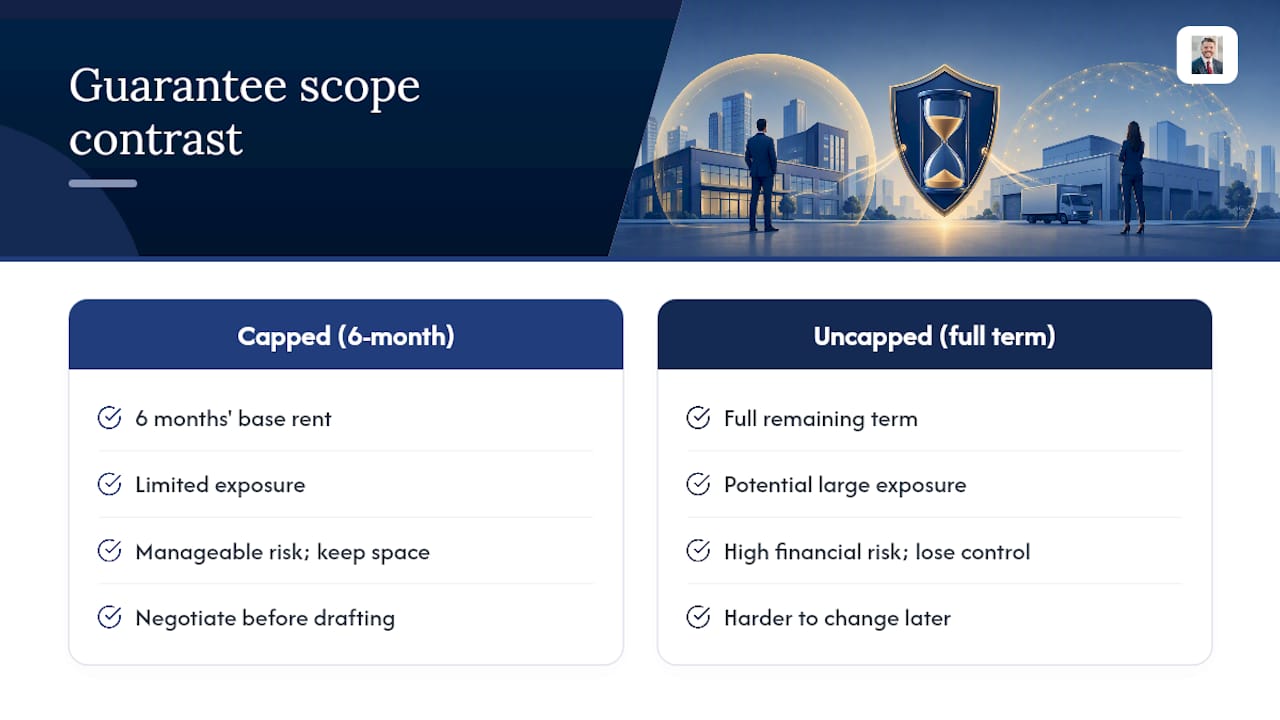
Most guides on personal guarantees treat them as a yes-or-no gate: sign or don’t sign. That framing misses the point. The real decision is about scope, not existence. A guarantee capped at six months’ base rent and a guarantee with no cap covering the full remaining term of a ten-year industrial lease are legally the same instrument with wildly different financial consequences. Tenants who focus their energy on refusing to sign anything often end up losing the space to a competitor, while tenants who focus on narrowing the wording end up with something manageable.
The conventional advice to “just get a lawyer to look at it” is necessary but incomplete. A lawyer can tell you what a clause means. Only someone negotiating the deal itself, ideally before the lease document is drafted, can get that clause changed. Sequence matters: negotiate the scope of the guarantee during lease negotiation, not after the document lands on your desk for signature.
— Michael Law
How Michael Law | Lennard Commercial can help with your next lease
Reviewing a guarantee clause after the landlord has already drafted it puts you on the back foot. An experienced industrial real estate broker works the negotiation from the other direction, building guarantee caps, burn-offs, and good-guy structures into the deal terms before the lease is drafted, so you’re not fighting over wording at the finish line.

As a tenant representation and industrial leasing specialist across Toronto and the GTA, Michael Law negotiates lease structure alongside rate and term, including the personal guarantee terms that determine your actual downside risk. If you’re evaluating industrial space in Ontario and want the guarantee negotiated before you sign anything, review tenant representation options and get a sense of what your specific deal should include.
This article is general information, not a substitute for advice from a qualified lawyer. Consult a qualified legal professional about your own circumstances before acting on anything here.
Sources
- Lease Guarantee — Practical Law (Thomson Reuters)
- Commercial lease negotiation: 10 key terms — Lamba Law
- Commercial lease guarantees in Ontario — Sauvé Law (Cabinet Sauvé)
- Guarantees and indemnities in commercial leases — Mondaq
FAQ
Do commercial loans require a personal guarantee?
Commercial lenders frequently require a personal guarantee from business owners, particularly for newer companies or loans secured against limited collateral, similar to how landlords request them on commercial leases.
Is personal guarantee insurance available in Canada?
Standard personal guarantee insurance products are not commonly available to Canadian small business owners; the more reliable protection is negotiating a capped or time-limited guarantee before you sign, rather than insuring an open-ended one after the fact.
How enforceable is a personal guarantee?
A properly drafted personal guarantee is generally enforceable under Ontario’s freedom of contract principles, though enforceability can depend on provincial formalities, such as Alberta’s requirement for a lawyer’s certificate under the Guarantees Acknowledgment Act.
Can you give me some examples of personal guarantees?
Common examples include an unlimited guarantee covering the full remaining lease term, a capped guarantee limited to a fixed dollar amount or a set number of months’ rent, and a good-guy guarantee that ends once the tenant vacates and returns possession properly.
What’s the difference between a personal guarantee and collateral?
A personal guarantee pledges your own assets and creditworthiness against the obligation, while collateral involves pledging a specific asset, such as equipment or a deposit; some financing guidance explains how lenders and landlords weigh these differently when assessing risk.
Recommended

About Michael Law
Managing Partner and Industrial Real Estate Broker at Lennard Commercial Realty. Representing tenants and landlords across Toronto and the GTA for 15+ years. Michael specializes in GTA industrial real estate — connect with Toronto's leading industrial broker at mlawrealestate.com/industrial-broker-toronto.