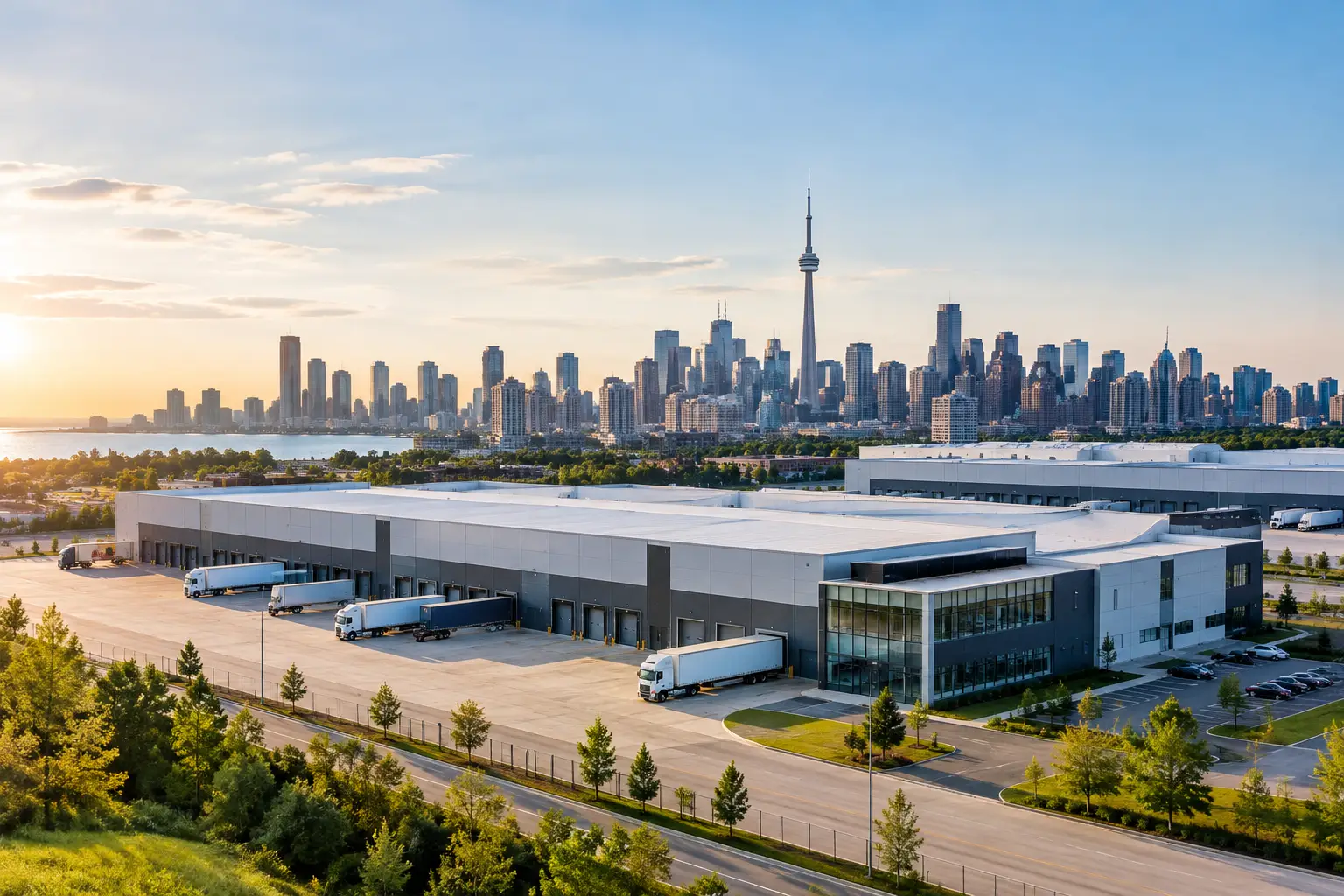
Industrial Market Trends Shaping GTA Real Estate
By Michael Law · Industrial Real Estate Broker, Lennard Commercial Realty
A 50,000-square-foot industrial building can look interchangeable on a listing sheet. In practice, a few details can determine whether it attracts serious users, commands competitive rent, or sits through a longer marketing period. Industrial market trends are increasingly separating functional properties from merely available ones across Toronto and the GTA.
For owners, investors, and occupiers, the central question is no longer simply whether industrial space is in demand. It is which space, in which location, with which operating characteristics, and at what total occupancy cost. The answer depends on the asset, the submarket, and the user profile.
Industrial Market Trends Are Becoming More Selective
The GTA remains a major industrial market because it combines a large consumer base, extensive transportation infrastructure, established employment centers, and limited land for new development. Those fundamentals continue to support industrial real estate over the long term. They do not, however, mean every building competes on equal terms.
After a period when tight availability pushed many tenants to take space wherever they could find it, occupiers have become more deliberate. They are reviewing loading configurations, clear height, trailer parking, office percentage, power capacity, yard depth, and access to major highways with greater scrutiny. A property that falls short in one of these areas may still lease or sell, but its pricing and marketing strategy need to reflect the limitation.
This shift is most visible in the difference between modern logistics facilities and older, smaller-bay inventory. Newer buildings with high clear heights, multiple truck doors, efficient circulation, and strong shipping access appeal to a broad pool of logistics, distribution, and light manufacturing users. Older facilities often remain highly relevant, particularly for contractors, service businesses, food-related users, and owner-occupiers. Their advantage may be location, lower total cost, or a layout suited to a specialized operation rather than large-scale distribution.
The takeaway is straightforward: broad market statistics are useful, but they are not a valuation opinion. An industrial property must be assessed against its true competitive set.
Location Still Matters, but Functionality Drives Decisions
Access to Highway 401, 400, 407, QEW, 410, and 427 corridors remains a meaningful factor in the GTA. For a distributor, minutes saved on a daily delivery route can outweigh a modest difference in base rent. For a contractor or showroom-oriented business, proximity to customers and labor may matter more than regional highway access.
That distinction affects site selection. A tenant serving downtown Toronto may place greater value on Scarborough or North York access. A business moving freight throughout Peel Region may focus on Mississauga, Brampton, or Vaughan. Companies seeking a lower-cost alternative, additional land, or access to a different labor base may look toward Hamilton, Oshawa, Whitby, Ajax, or Barrie.
There is no single “best” industrial location. The right location is the one that supports the operation without creating avoidable transportation, staffing, zoning, or occupancy-cost problems. Businesses that begin with a clear operating brief generally make better real estate decisions than those that begin with a map and an asking rent.
The Operational Checklist Has Expanded
Industrial users are increasingly evaluating features that were once treated as secondary. Electrical service is one example. Manufacturers, food processors, data-intensive operations, and businesses adding electric fleets may require more capacity than a conventional warehouse user. Upgrading power can be expensive, slow, or constrained by local infrastructure, so it should be investigated early rather than assumed.
Loading is another frequent source of disconnect. A building may have sufficient square footage but inadequate truck access, limited staging area, or a shared drive that complicates deliveries. Ceiling height, column spacing, sprinkler systems, environmental history, and permitted uses can create similar issues. These factors influence not only a tenant's efficiency but also an owner's future leasing depth and an investor's exit strategy.
Rent Growth Is Only Part of the Occupancy Cost
Asking rent gets attention because it is easy to compare. It is not the full cost of occupancy. Additional rent, property taxes, utilities, maintenance obligations, tenant improvements, moving costs, and downtime all affect the financial outcome of a lease decision.
For landlords, this means a quoted rate should be supported by a clear understanding of the property's condition and operating expenses. A higher asking rent may be justified by loading, parking, location, build quality, or a recently improved office component. It may be harder to defend if a prospective tenant must spend heavily to make the space functional.
For tenants, the lowest rate can become the most expensive option if the layout reduces productivity or the lease shifts unusual repair obligations to the occupier. Lease structure matters. Net leases, gross arrangements, renewal options, escalation clauses, restoration language, assignment rights, and exclusivity provisions can materially change risk over a five- or 10-year term.
This is where timing matters. Starting a search early creates leverage. When a tenant waits until its current lease is close to expiry, the available options may be limited and the ability to negotiate meaningful protections often declines.
Supply Constraints Have Changed, Not Disappeared
Land scarcity remains a defining issue in mature GTA industrial nodes. Conversion pressure, competing land uses, development costs, and municipal planning timelines all limit the ease with which new industrial supply can be delivered. That supports the long-term value of well-located industrial land and functional buildings.
At the same time, supply is not static. New projects, sublease space, business closures, relocations, and delayed expansion plans can create opportunities in specific pockets of the market. A tenant should not assume that all space is unavailable just because headline vacancy remains low. An owner should not assume that strong overall demand removes the need for disciplined positioning.
Sublease opportunities deserve particular attention. They can offer favorable economics or shorter-term flexibility, but the trade-off may be limited control, shorter remaining term, restoration requirements, or uncertainty around the head lease. For some businesses, that flexibility is valuable. For others, it introduces more risk than it solves.
What These Trends Mean for Industrial Owners
Owners should view leasing and disposition as a preparation exercise, not an event triggered by a vacancy or unsolicited offer. A property positioned before it reaches the market is easier to explain and more credible to qualified prospects.
Preparation starts with the basics: accurate building measurements, zoning confirmation, utility information, property tax records, environmental documentation, lease abstracts, and a realistic list of capital needs. If the building has limitations, such as low clear height or constrained loading, identify the users for whom those limits are less important. Trying to market a specialized building to every industrial tenant usually produces activity without conviction.
Capital improvements should also be evaluated through the lens of tenant demand. A new roof, upgraded lighting, repaired paving, cleaner office space, or improved shipping area can affect marketability. Not every improvement produces a dollar-for-dollar increase in value, but deferred maintenance often weakens negotiations and creates uncertainty during due diligence.
For an owner considering a sale, the buyer pool matters. An investor will focus on income durability, tenant quality, lease term, recoveries, and future rent potential. An owner-occupier may place greater emphasis on operational fit and the ability to occupy the building. The optimal sale strategy changes depending on which audience is most likely to assign the highest value.
A More Disciplined Approach for Buyers and Investors
Industrial investments are often described as straightforward because the buildings are practical and the tenant uses are familiar. The underwriting is rarely that simple. A property with stable income may have a near-term lease rollover, below-market rent, costly deferred maintenance, or a use that narrows the future tenant pool.
Buyers should test the asset against a realistic leasing scenario. If the existing tenant leaves, how long could it take to re-lease the space? What users can operate there under current zoning? What improvements would be necessary? Is the lease rate truly below market, or does the property have functional constraints that explain the discount?
For owner-occupiers, the question is different but equally important: does buying provide control and long-term operating stability that justify the capital commitment? Ownership can protect a business from rent volatility and relocation risk. It also concentrates capital in a single property and brings responsibility for repairs, financing, and future resale. The right choice depends on the business plan, balance sheet, and likely space needs over time.
Make the Property Decision Before the Deadline Decides It
The strongest industrial real estate decisions usually begin well before a lease expiry, acquisition deadline, or planned sale. Early planning gives owners time to improve and position an asset, tenants time to compare workable alternatives, and buyers time to complete proper diligence without forcing concessions later.
In a market where industrial properties are increasingly judged on operational detail, clear advice and careful execution matter. The goal is not to react to the latest headline. It is to understand what a specific property can do for a specific business or investment strategy, then negotiate from a position of preparation.

About Michael Law
Managing Partner and Industrial Real Estate Broker at Lennard Commercial Realty. Representing tenants and landlords across Toronto and the GTA for 15+ years. Michael specializes in GTA industrial real estate — connect with Toronto's leading industrial broker at mlawrealestate.com/industrial-broker-toronto.
Related Articles



More Toronto Industrial Real Estate Insights
Articles & Analysis
Common Questions
What is the difference between a base building and turnkey industrial lease?
In a base building industrial lease, the landlord delivers the premises in a shell or base condition and the tenant is responsible for completing improvements to make the space operational — often funded through a tenant improvement (TI) allowance from the landlord. In a turnkey lease, the landlord constructs or fits out the space to the tenant's specifications and delivers it ready to occupy, typically at a higher base rent.
Read →What is CAM (common area maintenance) in industrial real estate?
CAM, or common area maintenance, refers to the costs a tenant pays — on top of base rent — for the upkeep and operation of shared areas in a multi-tenant industrial building. In a typical GTA industrial net lease, CAM is one component of the operating cost recovery alongside property taxes and building insurance, and is charged on a per-square-foot basis proportional to the tenant's share of the building.
Read →What is a right of first refusal in an industrial lease?
A right of first refusal (ROFR) in an industrial lease gives the tenant the contractual right to match any third-party offer the landlord receives on an adjacent or specified space before the landlord can lease it to someone else. It is a space-control tool that lets an expanding tenant secure future growth space without committing to it upfront.
Read →