
Corporate brokers: your GTA industrial real estate guide
By Michael Law · Industrial Real Estate Broker, Lennard Commercial Realty
TL;DR:
- Corporate brokers manage industrial property transactions for corporations in Toronto and control marketing to protect confidentiality. They charge success-based commissions and must hold a TRESA license in Ontario, with licensing requirements varying by transaction type. Working with a specialized broker ensures controlled outreach, access to institutional buyers, and better valuation through market expertise.
Corporate brokers are licensed intermediaries who manage the sale, lease, or acquisition of industrial real estate and business assets on behalf of corporations. In the Greater Toronto Area, where industrial vacancy rates remain among the tightest in North America, the right corporate broker delivers far more than a transaction. These advisors control the marketing process, protect confidentiality, and build competitive tension among qualified buyers or tenants to extract maximum value. This guide explains how corporate brokers structure their fees, what licensing they must hold in Ontario, and how to choose the right type of advisor for your specific transaction.
What do corporate brokers charge for GTA transactions?
Business brokerage fees rely primarily on a success-based commission paid at deal closure. This structure aligns the broker’s incentive directly with the client’s outcome, which is the right model for high-stakes industrial transactions.
The fee structure typically works as follows:
- Success-based commission. The broker earns a percentage of the final transaction value only when the deal closes. No deal, no fee.
- Retainer or milestone payments. For complex transactions, brokers may charge an upfront retainer or milestone fees tied to specific deliverables, such as the preparation of a Confidential Information Memorandum (CIM). These fees are often credited against the final commission.
- Scaled commission rates. Commission percentages generally decrease as deal size increases. A $2 million industrial property sale carries a higher percentage rate than a $20 million portfolio transaction. This reflects the fixed workload involved in preparing marketing materials and managing buyer outreach, regardless of asset size.
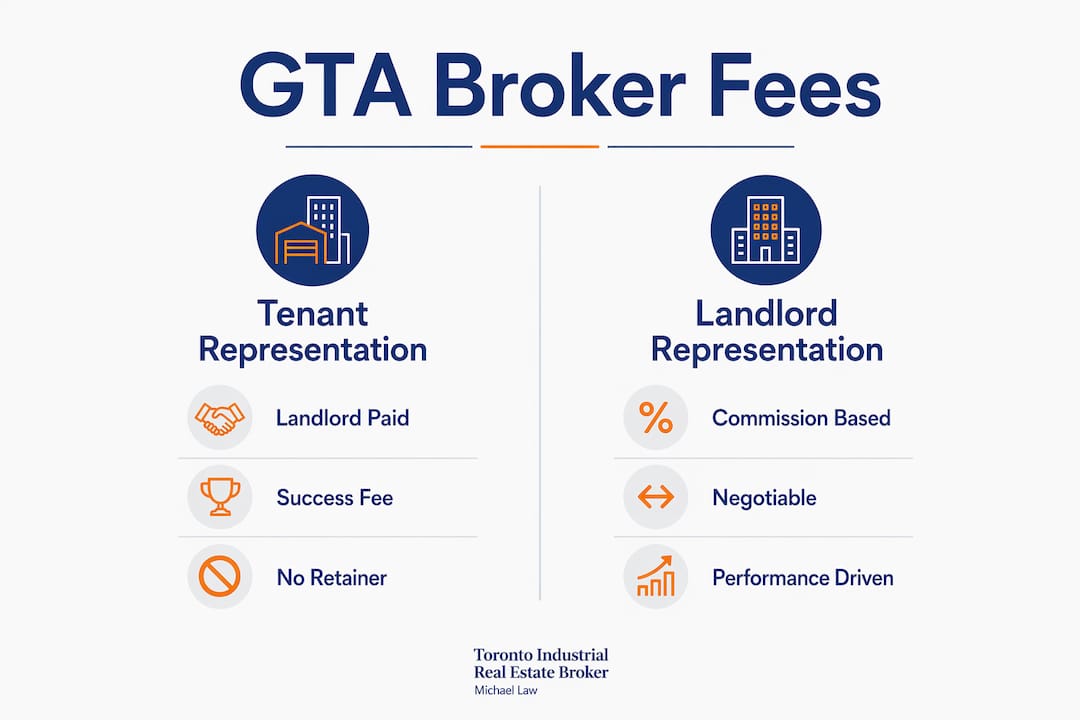
For GTA industrial leasing mandates, tenant representation brokers typically earn a commission from the landlord, paid as a percentage of total lease value. This means tenants often receive professional representation at no direct cost. The broker’s incentive, however, remains tied to deal completion, so clients should confirm the advisor’s process for managing competing offers.
Pro Tip: Ask any broker to show you their fee schedule in writing before signing an engagement letter. Understand whether retainer fees are credited against the final commission or charged separately.
Understanding fee structures matters because it tells you how your broker is motivated. A broker paid only on success will push hard to close. A broker paid a large upfront retainer regardless of outcome has less urgency. Match the fee model to the complexity and timeline of your transaction.
What licensing requirements apply to corporate brokers in Canada?
Licensing requirements for business brokers vary by province across Canada. Every province except Alberta requires a real estate licence for professionals conducting brokerage activities. This distinction matters for GTA corporate decision-makers because it affects who can legally represent you in an industrial property transaction.
In Ontario, brokers operating in industrial real estate must hold a licence issued under the Trust in Real Estate Services Act (TRESA), which replaced the Real Estate and Business Brokers Act (REBBA) in 2023. TRESA introduced stronger client representation rules and clearer disclosure obligations, which benefit corporate clients in complex leasing and investment transactions.
The table below summarises the key regulatory distinctions relevant to GTA corporate clients:
| Broker type | Licence required in Ontario | Primary transaction type |
|---|---|---|
| Real estate broker | Yes, under TRESA | Property leasing and sales |
| Business broker | Yes (real estate licence) | Business asset sales |
| M&A advisor | No licence required | Entity-level corporate transactions |
| Investment banking broker | Registered with CIRO | Securities and capital markets |
The distinction between a real estate broker and a business broker is especially relevant in industrial sectors. A real estate broker handles asset-level transactions, meaning the physical property changes hands. A business broker handles the sale of a going concern, where the business entity, its contracts, and its operations transfer to a buyer. Many GTA industrial transactions involve both elements simultaneously, particularly when a manufacturer sells its facility and its operating company together.
- Real estate brokers must hold an active TRESA licence in Ontario.
- Business brokers selling companies with real estate components also require a real estate licence in Ontario.
- M&A advisors structuring entity-level deals operate under securities law, not real estate law.
- Corporate finance brokers advising on capital structure fall under the Canadian Investment Regulatory Organization (CIRO).
Verifying your broker’s licence status through the Real Estate Council of Ontario (RECO) takes less than two minutes online. For any GTA industrial transaction involving both property and business assets, confirm that your advisor holds the appropriate credentials for both components.
What strategic advantages do corporate brokers provide for GTA industrial decisions?
The core advantage of working with a specialized industrial broker is controlled access to the market. Public listings attract unqualified parties, create price anchoring, and expose sensitive operational details to competitors. A professional broker avoids all three problems.

Successful brokers build a target list of 50 to 200 qualified buyers or tenants rather than posting openly. This controlled outreach produces better offers because each party knows others are evaluating the same opportunity. Competitive tension, not public exposure, drives valuation.
The strategic advantages for GTA industrial clients include:
- Confidentiality protection. Brokers use Confidential Information Memorandums and pre-vetted disclosure agreements to control who sees sensitive financial and operational data. Discretion during the brokerage process protects employee morale, customer relationships, and competitive positioning.
- Market positioning expertise. An experienced GTA industrial broker knows which Brampton logistics corridors are tightening, which Vaughan nodes have upcoming supply, and how to position your asset against current comparables. Generic advisors lack this depth.
- Institutional buyer networks. The GTA industrial market attracts REITs, pension funds, and private equity buyers alongside owner-operators. A broker with institutional relationships can access capital that never appears on public listing platforms.
- Valuation and deal structuring. Brokers with GTA transaction history can benchmark your asset against closed deals, not just asking prices. This distinction often means the difference between a well-priced deal and one that sits on the market.
- Negotiation management. Brokers manage the negotiation process at arm’s length, which removes emotion from the table and preserves the client relationship with the counterparty post-transaction.
Pro Tip: Request a broker’s list of closed GTA industrial transactions from the past 24 months before signing any engagement. Transaction history in your specific submarket, whether Mississauga Airport, Markham, or the Durham Region, matters more than total years in business.
Corporate finance advisory services now focus increasingly on risk and return management alongside capital efficiency, marking a clear shift from purely transactional roles. GTA industrial clients benefit from this evolution because it means brokers bring a consultative perspective to lease renewals, sale-leaseback structures, and portfolio repositioning, not just individual deal execution.
How do corporate brokers differ from business brokers and M&A advisors?
Terminology confusion is common in this space. Corporate brokers in capital markets act differently than business brokers selling privately held companies, and both differ from M&A advisors managing institutional transactions. Real estate managers must clarify their exact needs before engaging any advisor.
The clearest way to understand the differences is by transaction type and process model:
| Advisor type | Deal size focus | Process model | Typical GTA use case |
|---|---|---|---|
| Business broker | Under $2M earnings | Public or semi-public listing | Owner-operator selling a small industrial business |
| Corporate real estate broker | Any size | Controlled outreach to qualified parties | Industrial lease, investment sale, or owner-user acquisition |
| M&A advisor | Above $5M EBITDA | Competitive auction with coordinated bids | Corporate divestiture or platform acquisition |
| Investment banking broker | Institutional scale | Structured capital markets process | REIT portfolio transactions, debt financing |
The brokerage model suits owner-operated firms with earnings under $2 million. Higher-value transactions benefit from M&A advisors who run competitive auctions and coordinate multiple simultaneous bids. This is not a criticism of business brokers. It reflects the reality that institutional buyers expect a different process and level of documentation than individual owner-operators.
For GTA industrial real estate specifically, the corporate real estate broker sits at the centre of the spectrum. These advisors handle transactions of all sizes, from a 10,000-square-foot Scarborough warehouse lease to a $50 million Mississauga logistics facility sale. Their value comes from local market knowledge, controlled marketing, and the ability to access broker advantages in commercial leasing that generalist advisors cannot replicate.
Pro Tip: If your transaction involves selling a business that owns its own industrial real estate, you need an advisor who can handle both the asset-level and entity-level components simultaneously. Confirm this capability before signing.
Top-tier corporate finance advisory firms like KPMG and PricewaterhouseCoopers have each completed over 11,000 deals since 2001. That scale is relevant context. For most GTA industrial transactions, a specialized local broker with deep submarket knowledge will outperform a generalist firm with global reach but no GTA-specific expertise.
Best practices for maximising value when working with corporate brokers
Corporate clients who prepare thoroughly before engaging a broker consistently achieve better outcomes than those who rush to market. The preparation phase is where most value is created or lost.
Follow these steps to get the most from your corporate broker engagement:
- Scrub your financials before marketing. Preparation involves scrubbing financials and establishing positioning before any buyer or tenant sees your information. Unresolved accounting issues, deferred maintenance, or unclear lease terms create negotiating leverage for the other side.
- Define your confidentiality protocol. Decide in advance which employees, customers, and suppliers will be informed, and at what stage. Your broker should provide a standard Confidential Information Memorandum and a buyer qualification checklist before any outreach begins.
- Build competitive tension deliberately. Work with your broker to identify 50 to 200 qualified parties across institutional, private, and owner-operator buyer categories. Releasing information to multiple parties simultaneously creates urgency and improves offer quality.
- Align your legal and financial teams early. Engage your corporate counsel and accountant before the broker begins marketing. Late-stage legal or tax surprises kill deals. Early alignment prevents them.
- Communicate regularly with your broker. Set a weekly update cadence from day one. Brokers who go silent for weeks are not managing your process actively. Regular communication keeps the transaction on track and surfaces problems before they become deal-breakers.
Confidentiality requires specialized documents like Confidential Information Memorandums and pre-vetted buyer disclosure agreements to prevent disruption to daily operations. This is not a formality. A leak to a key employee or competitor before a deal closes can destroy months of work and reduce asset value materially.
For GTA industrial clients specifically, preparation also means understanding current submarket conditions. Vacancy rates, net rental benchmarks, and absorption trends in Brampton, Vaughan, or the Durham Region all affect how your broker positions your asset and what price or lease rate is achievable. Mlawrealestate publishes GTA industrial market intelligence that gives clients the data foundation needed to enter any transaction with confidence.
Key takeaways
Corporate brokers deliver the most value when clients prepare thoroughly, protect confidentiality, and choose an advisor whose process model matches the transaction type and size.
| Point | Details |
|---|---|
| Fee structure alignment | Success-based commissions align broker incentives with client outcomes; confirm retainer terms in writing. |
| Ontario licensing | All GTA real estate brokers must hold a TRESA licence; verify credentials through RECO before engaging. |
| Controlled outreach wins | Targeting 50–200 qualified parties creates competitive tension and improves offer quality over public listings. |
| Match advisor to deal type | Business brokers suit smaller owner-operator sales; M&A advisors handle institutional transactions above $5M EBITDA. |
| Prepare before marketing | Scrub financials and establish confidentiality protocols before any buyer or tenant sees your information. |
What I have learned from GTA industrial brokerage
The most common mistake I see corporate clients make is treating a broker engagement like a commodity purchase. They focus entirely on commission rate and ignore process quality. A broker who charges 50 basis points less but runs a passive listing strategy will almost always produce a worse outcome than one who charges full market rate and runs a controlled, competitive process.
The GTA industrial market has changed significantly over the past several years. Institutional capital has become far more active in the Mississauga Airport corridor, Brampton, and the North GTA nodes around Vaughan and Markham. That means the buyer pool for well-positioned industrial assets now includes REITs, pension fund advisors, and private equity platforms that simply did not participate in this market a decade ago. A broker without relationships in that institutional layer is leaving real money on the table for their clients.
The shift toward consultative advisory, which mirrors what corporate finance services now emphasise around risk management and capital efficiency, is the right direction. The best GTA industrial brokers I know are not just transaction managers. They advise clients on whether to sell or hold, whether to lease or buy, and how to structure a deal to minimise tax exposure and maximise operational flexibility. That is a fundamentally different service than posting a listing and waiting for calls.
The pitfall I see most often is clients who engage a generalist broker because of a personal relationship, then discover mid-process that the broker lacks the submarket data, institutional contacts, or process discipline to run a competitive transaction. By that point, the asset has been exposed to the market without generating competitive tension, and the opportunity to achieve a premium outcome has passed. Choose your advisor based on demonstrated GTA industrial transaction history, not familiarity.
— Michael
GTA industrial advisory with Mlawrealestate

Mlawrealestate provides corporate brokerage and advisory services across every major GTA industrial corridor, from Mississauga and Brampton in the west to Markham and the Durham Region in the east. Whether you are negotiating a lease renewal, acquiring an owner-user facility, or positioning an industrial asset for sale, the team brings transaction-tested market intelligence and institutional-grade process to every mandate. Michael Law’s advisory practice, affiliated with Lennard Commercial Realty, combines deep GTA submarket expertise with a controlled marketing process designed to produce competitive outcomes. Connect with the team at mlawrealestate.com to discuss your next industrial real estate transaction.
FAQ
What is a corporate broker in real estate?
A corporate broker is a licensed advisor who manages industrial property leasing, sales, and acquisitions on behalf of corporations. In Ontario, corporate real estate brokers must hold a TRESA licence issued by RECO.
How are corporate broker fees structured in Canada?
Business brokerage fees are primarily success-based commissions paid at deal closure, sometimes supplemented by retainer or milestone payments for complex transactions. Commission rates typically decrease as deal size increases.
Do corporate brokers in Ontario need a licence?
Yes. All provinces in Canada except Alberta require a real estate licence for brokerage professionals. In Ontario, brokers must hold a licence under the Trust in Real Estate Services Act (TRESA).
When should I use a corporate broker versus an M&A advisor?
Use a corporate real estate broker for asset-level transactions such as industrial leases and property sales. Engage an M&A advisor when the transaction involves selling a business entity, particularly where earnings exceed $2 million and a competitive auction process is warranted.
How does a corporate broker protect confidentiality during a GTA transaction?
Brokers use Confidential Information Memorandums and buyer vetting protocols to control who accesses sensitive financial and operational data. Buyers must pass financial qualification before the seller’s identity or detailed asset information is disclosed.
Recommended

About Michael Law
Managing Partner and Industrial Real Estate Broker at Lennard Commercial Realty. Representing tenants and landlords across Toronto and the GTA for 15+ years. Michael specializes in GTA industrial real estate — connect with Toronto's leading industrial broker at mlawrealestate.com/industrial-broker-toronto.
Related Articles



More Toronto Industrial Real Estate Insights
Articles & Analysis
Common Questions
What is the difference between a base building and turnkey industrial lease?
In a base building industrial lease, the landlord delivers the premises in a shell or base condition and the tenant is responsible for completing improvements to make the space operational — often funded through a tenant improvement (TI) allowance from the landlord. In a turnkey lease, the landlord constructs or fits out the space to the tenant's specifications and delivers it ready to occupy, typically at a higher base rent.
Read →What is CAM (common area maintenance) in industrial real estate?
CAM, or common area maintenance, refers to the costs a tenant pays — on top of base rent — for the upkeep and operation of shared areas in a multi-tenant industrial building. In a typical GTA industrial net lease, CAM is one component of the operating cost recovery alongside property taxes and building insurance, and is charged on a per-square-foot basis proportional to the tenant's share of the building.
Read →What is a right of first refusal in an industrial lease?
A right of first refusal (ROFR) in an industrial lease gives the tenant the contractual right to match any third-party offer the landlord receives on an adjacent or specified space before the landlord can lease it to someone else. It is a space-control tool that lets an expanding tenant secure future growth space without committing to it upfront.
Read →