
Industrial acquisition red flags: a GTA buyer checklist
By Michael Law · Industrial Real Estate Broker, Lennard Commercial Realty
The three red flags that kill GTA industrial deals are environmental contamination, zoning mismatches, and title encumbrances. The moment you go firm on a purchase, instruct a Qualified Person (QP) for a Phase I ESA under Ontario Regulation 153/04, confirm permitted uses against the City of Toronto’s EL/E/EH zoning categories, and order a current title search and survey.
Prioritise these three checks immediately:
- Environmental: A Phase I ESA identifies potentially contaminating activities (PCAs). Any PCA triggers a mandatory Phase II ESA with soil and groundwater sampling before a Record of Site Condition can be filed.
- Zoning: City of Toronto Zoning By-law 569-2013 divides employment lands into EL (light), E (industrial), and EH (heavy). Retail in the E zone is tightly restricted. Site-specific exceptions in Chapter 900 can silently override the base zone.
- Title: Easements, liens, tax arrears, and restrictive covenants can constrain use or block financing entirely.
Key takeaways
Environmental, zoning, and title checks must run before building inspections — in the GTA, these three categories account for the majority of deal failures and post-closing surprises.
| Point | Details |
|---|---|
| Phase I ESA is mandatory first | Any identified PCA under O. Reg. 153/04 triggers a Phase II ESA before an RSC can be filed. |
| Chapter 900 exceptions override base zoning | Always confirm site-specific exceptions; an incumbent tenant’s use does not prove yours is permitted. |
| Old surveys hide encumbrances | Surveys more than 30 years old miss registered easements, road widenings, and encroachments. |
| Remediation escrow beats a price cut | A holdback tied to actual remediation costs protects buyers better than a fixed pre-Phase II discount. |
| Michael Law | Lennard Commercial |
Table of Contents
- What title and market fraud signals look like in GTA industrial deals
- Does standard ESA coverage miss legacy contamination?
- Are there compliance risks under Toronto’s emissions and noise rules?
- How could upcoming zoning changes affect your purchase?
- Is the utility and infrastructure capacity actually sufficient?
- What structural issues are common in older GTA industrial buildings?
- The sequencing most buyers get wrong
- Work with Michael Law | Lennard Commercial on your next acquisition
- Sources
- FAQ
What title and market fraud signals look like in GTA industrial deals
Fraudulent or misrepresented industrial listings tend to share a pattern: ownership recently transferred at a price well below market, the title history shows gaps or multiple quick flips, and the seller resists producing an up-to-date survey. In the GTA’s tight market, pressure to waive conditions is real — and that pressure is itself a warning sign.
Order a full title search through Teranet and cross-reference the registered owner against the person executing the agreement. Outstanding work orders, property tax arrears, and unregistered easements rarely surface in a listing but show up immediately on title. A structured due diligence review catches these before you’re committed.
Does standard ESA coverage miss legacy contamination?
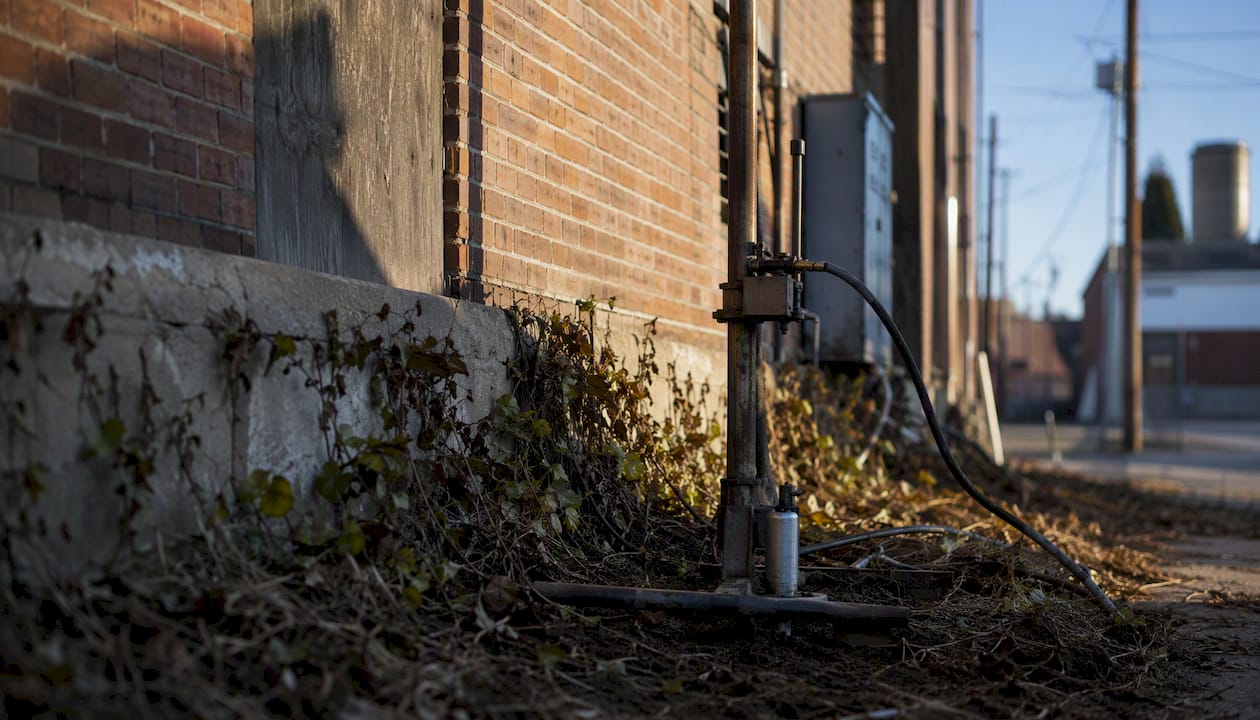
Often, yes. A Phase I ESA covers the subject property and a 250-metre study area for off-property PCAs, per the provincial Phase I guidance. What it does not catch: uses that predate available records, informal dumping, or contamination from a neighbouring property that migrated underground decades ago.
Older GTA industrial stock — buildings from the 1950s through 1980s in areas like North York, Etobicoke, and east Hamilton corridor — frequently has legacy solvents, heavy metals, or petroleum hydrocarbons that only a Phase II soil and groundwater program will find. Review historical aerial photographs, fire insurance plans (Goad’s Atlas), and municipal records going back at least 50 years before concluding a Phase I is sufficient.
Are there compliance risks under Toronto’s emissions and noise rules?
Yes, and they transfer with the property. The Ministry of Environment, Conservation and Parks enforces air emissions and environmental noise under the Environmental Protection Act. A property with an existing Environmental Compliance Approval (ECA) tied to a specific process or tenant operation does not automatically transfer that approval to a new owner or new use. Confirm whether any ECA is in place, what it covers, and whether your intended operation requires a new or amended approval before closing.
Noise-sensitive receptors nearby — residential, schools, or parks — can trigger noise impact assessments under MOE guidelines. Buyers planning to intensify operations should budget for this review during the conditional period.
How could upcoming zoning changes affect your purchase?
Toronto’s Official Plan Chapter 4 distinguishes Core, General, and Regeneration Employment Areas. Core Employment Areas carry the strongest protection against conversion to residential or mixed use. General and Regeneration designations are more vulnerable to policy shifts that could affect long-term industrial use.
Check whether the property sits within an area subject to a Secondary Plan, an Employment Land Conversion study, or a Major Transit Station Area overlay. The City’s interactive zoning map and planning portal show active applications and area studies. A zoning lawyer can flag whether any pending amendment could restrict your intended use or reduce the asset’s long-term industrial value.
Is the utility and infrastructure capacity actually sufficient?
Current service levels rarely equal future capacity. Confirm electrical service in amps and transformer capacity with Toronto Hydro or the relevant local distribution company — not just the landlord’s representation. A 400-amp service that runs a light manufacturing tenant may be wholly inadequate for a food processor or cold storage operator.
Check municipal water and sewer capacity with the City’s engineering department, particularly for properties in older industrial nodes where infrastructure is at or near capacity. Stormwater management is a growing constraint: many older sites lack adequate detention, and a change of use can trigger a stormwater management study under the Toronto Green Standard. For future scalability, confirm whether the local utility has capacity to upgrade service and what the lead time and cost would be.
What structural issues are common in older GTA industrial buildings?
Pre-1980 industrial buildings in the GTA carry specific structural risks that a standard home inspector will miss entirely. Engage a structural engineer, not just a building inspector.
Watch for differential foundation settlement, particularly on sites with fill, former creek beds, or proximity to the Don or Humber River valleys. Older spread footings can shift unevenly under heavy racking loads. Unreinforced masonry walls are common in 1960s and 1970s stock and perform poorly under seismic loading or lateral pressure from racking systems. Check roof structure for wood bow-string trusses, which have a known fire risk profile and can affect insurance premiums significantly. Floor flatness (Ff) and floor levelness (Fl) matter for modern racking and automated equipment — get a concrete floor survey if the building will carry high-bay storage.
The sequencing most buyers get wrong
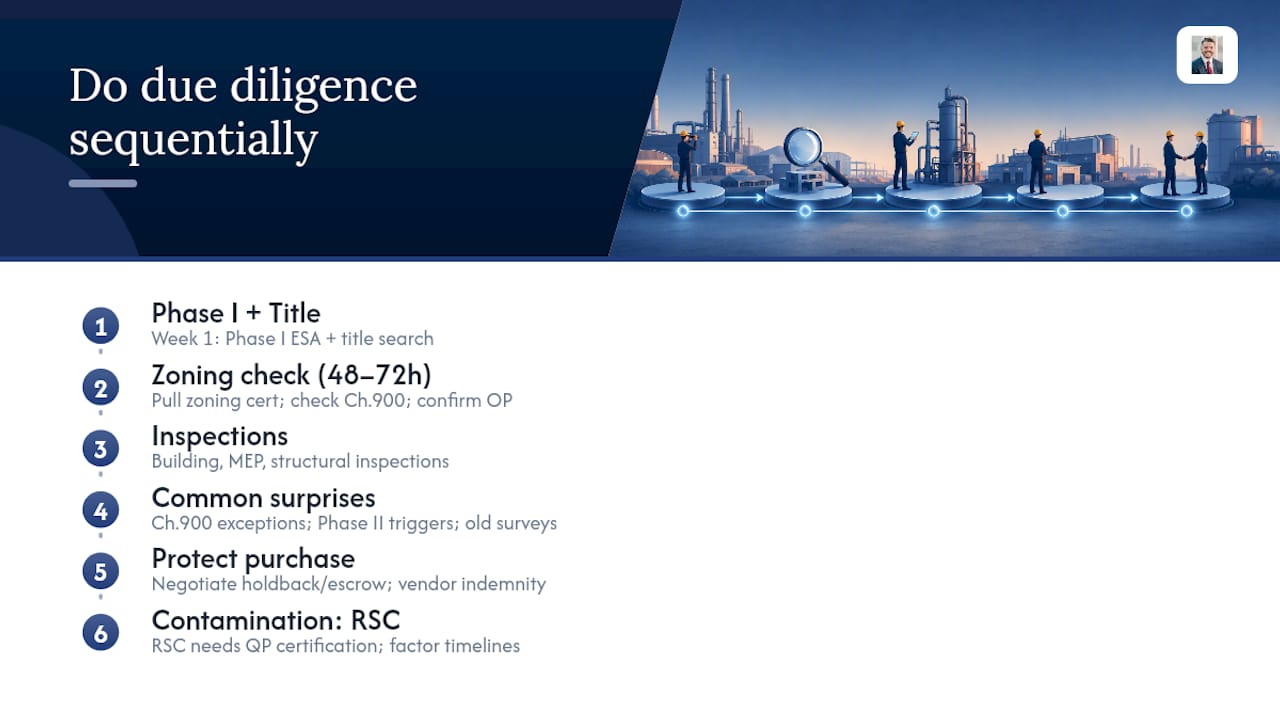
Most buyers treat due diligence as a parallel process. It should be sequential, at least for the first week.
Start with the Phase I ESA and title search simultaneously — these are the two items most likely to kill a deal or require a price adjustment. Zoning confirmation follows within 48–72 hours: pull the zoning certificate from the City, check Chapter 900 for site-specific exceptions, and confirm the Official Plan designation. Only after those three come back clean does it make sense to spend money on full building, MEP, and structural inspections.
Three things consistently surprise GTA buyers. First, Chapter 900 exceptions: a property zoned E may have a site-specific exception that prohibits the buyer’s exact intended use, and the incumbent tenant’s operation is not proof that yours is permitted. Second, Phase II triggers: a Phase I that identifies a dry cleaner, auto body shop, or gas station within the study area almost always leads to a Phase II — budget for it. Third, old surveys: a survey from 1987 will not show encroachments, easements registered in the last 30 years, or current lot lines after road widenings.
Pro Tip: *Negotiate a conditional holdback or remediation escrow into the purchase agreement rather than a simple price reduction. If contamination is found post-Phase II, a holdback tied to actual remediation costs protects you far better than a fixed discount agreed before the scope is known. Pair it with a vendor-side environmental indemnity covering pre-closing conditions.
When a Phase II confirms contamination, the brownfields RSC process under O. Reg. 153/04 provides a pathway to limit future liability — but it requires a QP to certify the site condition and takes time. Factor remediation timelines into your closing schedule, not just your price.
Work with Michael Law | Lennard Commercial on your next acquisition
Buying industrial property in the GTA without a broker who knows the regulatory terrain is the fastest way to inherit someone else’s problem. Michael Law | Lennard Commercial provides acquisition advisory that goes beyond finding the asset: coordinating Phase I/II ESAs with qualified environmental consultants, confirming zoning and Chapter 900 exceptions with municipal planning, and working alongside your real estate lawyer on title review and remediation escrow structuring.
The team covers warehouse, distribution, flex, and cold storage acquisitions across Toronto, Mississauga, Brampton, Vaughan, Markham, and the broader GTA. A first conversation costs nothing and typically surfaces the two or three risks a buyer hasn’t yet considered. Reach out through Mlawrealestate or connect directly with Michael Law at Lennard Commercial to get started.
Sources
The following resources belong in every GTA industrial buyer’s due-diligence file, shared with your QP, environmental consultant, zoning lawyer, and real estate counsel at the outset.
- Ontario Regulation 153/04 (Environmental Protection Act) – regulation text (Government of Ontario)
- City of Toronto Zoning By‑law 569‑2013, Chapter 60 Employment Industrial (City of Toronto)
FAQ
What triggers a Phase II ESA in Ontario?
Under O. Reg. 153/04, a Phase II ESA is required when a Phase I identifies a potentially contaminating activity on or within the study area of the subject property. Soil and groundwater sampling is then mandatory before a Record of Site Condition can be filed.
What are the EL, E, and EH zoning categories in Toronto?
Employment Light (EL), Employment Industrial (E), and Employment Heavy (EH) are the three industrial zoning categories under Zoning By-law 569-2013. Each permits different uses and imposes different restrictions; retail in the E zone is tightly limited, and Chapter 900 site-specific exceptions can further modify what is allowed on any individual parcel.
What is a Record of Site Condition and when do you need one?
An RSC is a formal filing on the Environmental Site Registry confirming a property meets provincial standards for its intended use. It is typically required when a property transitions from industrial to a more sensitive use, and a Qualified Person must certify the site condition before filing.
How long does industrial due diligence typically take in the GTA?
A Phase I ESA generally takes two to three weeks; a Phase II adds four to eight weeks depending on sampling scope. Title search and survey review can run concurrently. Budget the full conditional period — typically 30–60 days for an industrial acquisition — to complete all streams without rushing any one of them.
What is the biggest mistake GTA industrial buyers make?
Relying on an existing tenant’s operation to confirm permitted use. A tenant may be operating under a legal non-conforming status or a Chapter 900 exception that does not extend to a new owner’s intended use. Always obtain a zoning confirmation letter from the City before waiving conditions.
Recommended

About Michael Law
Managing Partner and Industrial Real Estate Broker at Lennard Commercial Realty. Representing tenants and landlords across Toronto and the GTA for 15+ years. Michael specializes in GTA industrial real estate — connect with Toronto's leading industrial broker at mlawrealestate.com/industrial-broker-toronto.
Related Articles

More Toronto Industrial Real Estate Insights
Articles & Analysis
Guide to Commercial Property Disposition
Read →How to Reduce Warehouse Vacancy in the GTA
Read →Markham Industrial Rents 2026: Tenant Rep Says Budget C$22 PSF
Tenant focused 2026 Markham industrial rent snapshot from a GTA tenant rep. Expect C$16–22 net and about C$22 gross; negotiation levers, cost checks, and...
Read →Brampton Warehouse Lease Negotiation Tactics
Read →Secure 30–90 Days on Your Fixturing Period Lease in the GTA
Negotiate fixturing period lease terms for GTA tenants: when to raise them, what clause language and tolling to demand, and how to secure 30–90 days.
Read →Common Questions
What is a sale-leaseback in industrial real estate?
A sale-leaseback is a transaction in which an industrial property owner sells their building to an investor and simultaneously signs a long-term lease to remain in the property as a tenant. The seller unlocks the capital tied up in their real estate while retaining full operational use of the facility. The buyer acquires a tenanted investment property with immediate cash flow from a known occupant.
Read →What is a dock-to-grade ratio in industrial real estate?
Dock-to-grade ratio in industrial real estate refers to the number of dock-level loading doors relative to the building's floor area, typically expressed as one dock door per X,000 square feet. It is a key specification for distribution and warehousing tenants because it determines how many trucks can load and unload simultaneously and therefore the building's throughput capacity.
Read →What is clear height in a warehouse or distribution centre?
Clear height in a warehouse or distribution centre refers to the usable vertical space from the finished floor to the lowest overhead obstruction — typically the bottom of the roof structure, sprinkler heads, or HVAC equipment. It is the single most important building specification for warehouse tenants because it determines how many racking levels can be installed and therefore how much product can be stored per square foot of floor space.
Read →