
OMERS: Letter of Credit Rights After Tenant Bankruptcy in GTA Leases
By Michael Law · Industrial Real Estate Broker, Lennard Commercial Realty
A properly drafted irrevocable standby letter of credit can be drawn for its full principal even after a tenant’s bankruptcy in Ontario. The Ontario Court of Appeal confirmed this in 7636156 Canada Inc. (Re), 2020 ONCA 681, applying the autonomy principle that treats a letter of credit as independent from the underlying lease. The outcome still turns on precise wording in both the lease and the letter of credit, and on the narrow fraud exception that can override even that independence.
TL;DR:
- The Ontario Court of Appeal confirmed that a letter of credit remains enforceable after a tenant’s bankruptcy if drafted with clear survivorship and independence language.
- Precise wording in the lease and LOC is crucial, especially regarding draw triggers and survivorship clauses, to maintain the landlord’s right to draw funds.
- The bank’s obligation under an LOC is independent and triggered by conforming documents, not the merits of any dispute between landlord and tenant.
- Tenants usually bear the costs of issuance, renewal fees, and collateral, with timelines ranging from one to six weeks depending on banking relationships.
- Weak or ambiguous drafting can expose landlords and tenants to litigation risks, emphasizing the importance of reviewing and coordinating lease and LOC language before signing.
Table of Contents
- Key takeaways for landlords and tenants
- What a letter of credit is in a lease and how it functions
- The OMERS decision and why the autonomy principle matters
- Drafting checklist: lease and LOC clauses that decide the outcome
- Who pays for a letter of credit and how long it takes
- The fraud exception and how to reduce your exposure
- Sample wording and red flags to avoid
- Alternatives to a letter of credit for lease security
- Michael Law’s practitioner notes for GTA industrial leases
- Balancing landlord security and tenant cost in the GTA market
- Work with Michael Law | Lennard Commercial on your next lease
- Sources
- FAQ
Key takeaways for landlords and tenants
The core rule from OMERS is simple to state and harder to rely on without careful drafting. Here is what matters right now if your lease includes a letter of credit lease provision.
- The autonomy principle was confirmed by the Ontario Court of Appeal: a letter of credit is treated as separate from the lease it secures.
- Drafting is decisive. Courts look at the exact wording in the lease and the LOC, not general fairness arguments.
- The fraud exception is narrow. Allegations of a contract dispute between landlord and tenant will not, on their own, stop a bank from paying.
- Tenants typically bear the issuance and renewal fees, plus any collateral requirements the bank demands, which may vary based on circumstances.
- Landlords should review LOC survivorship language and track renewal or expiry dates as a standing administrative task.
Pro Tip: Calendar every letter of credit’s expiry date at least 60 days out. A lapsed LOC that was never renewed is functionally worthless, no matter how well the underlying clause was drafted.
For landlords, the immediate actions are: confirm the LOC contains independence and survivorship language, and confirm your property manager has a tracking system for renewal notices. For tenants, the immediate actions are: negotiate a cap tied to a specific dollar figure or a percentage of annual rent, and confirm what documentary triggers actually let the landlord draw. Legal professionals advising either side should pull the primary sources directly. The Bankruptcy and Insolvency Act and the Ontario Commercial Tenancies Act both bear directly on how a draw interacts with an insolvency proceeding, and the useful sources section later in this article lists where to find the case law and firm commentary that unpacks it.
What a letter of credit is in a lease and how it functions
A standby irrevocable letter of credit is a bank’s written promise to pay a fixed sum to a beneficiary, usually the landlord, if the applicant, usually the tenant, fails to perform under a specified condition. It differs from a bank guarantee in that the LOC is triggered by presenting conforming documents rather than by proving default in a broader legal sense. It differs from a cash security deposit in that the money sits with the bank, not the landlord, until a draw actually happens.
Three things typically happen when a landlord wants to draw:
- The landlord presents a written demand, usually accompanied by a certificate stating a permitted draw event has occurred.
- The issuing bank checks the documents against the LOC’s own terms, a process called documentary compliance.
- If the documents conform on their face, the bank pays. It does not investigate whether the landlord’s underlying claim against the tenant is actually valid.
That third step is the crux of using a letter of credit for rental security. The bank’s obligation runs to the paper, not to the merits of the landlord-tenant dispute. This is why lease letter of credit requirements almost always specify exactly what a draw certificate must say, word for word, rather than leaving it to interpretation.
There is also a practical distinction worth understanding before signing anything: cash-collateralized LOCs versus unsecured bank LOCs. In most commercial leasing situations in the GTA, particularly for tenants without a long banking relationship or strong covenant strength, the issuing bank requires the tenant to post cash collateral equal to the LOC’s face amount. That collateral sits with the bank as security for its own exposure. Larger, well-capitalized tenants sometimes qualify for an unsecured LOC issued against their general credit facility, which frees up working capital but usually costs more in ongoing fees. Either structure satisfies the landlord’s need for a secure lease with letter of credit protection; the difference is entirely about how the tenant finances the obligation on its own balance sheet.
The OMERS decision and why the autonomy principle matters
7636156 Canada Inc. (Re), 2020 ONCA 681, is the case every Ontario commercial leasing file involving a letter of credit now gets measured against. The facts are straightforward: a tenant went bankrupt, its trustee disclaimed the lease, and the landlord moved to draw roughly $2.5 million under the LOC that had backed the tenancy. The tenant’s estate argued the disclaimer should have ended the landlord’s right to draw, or at least capped it.
The Court of Appeal disagreed. It held that because the lease and the LOC were drafted with express survivorship language, stating the LOC would not be released, discharged, or affected by bankruptcy or insolvency, the landlord’s right to draw survived the disclaimer intact, regardless of any numeric limit. The bank’s obligation under the LOC was legally distinct from whatever remained of the lease itself.
The autonomy principle treats a documentary letter of credit as its own contract, separate from the lease that gave rise to it. A bank pays against conforming documents. It does not adjudicate whether the landlord and tenant are actually right about their dispute, and a bankruptcy trustee’s disclaimer of the lease does not automatically reach into that separate contract.
That reasoning drew directly on how Blakes and McMillan LLP both characterized the ruling: a clear win for landlord certainty, provided the paperwork was built to survive exactly this scenario.
A few consequences follow from OMERS that every drafter should internalize:
- The LOC, the lease, and the bank’s own reimbursement agreement with the tenant are treated as three separate contracts, each governed by its own terms.
- Cash collateral backing the LOC does not, by itself, trigger the anti-deprivation rule under Canadian insolvency law when the arrangement is properly structured.
- The Bankruptcy and Insolvency Act s.136(1)(f) sets out how a landlord’s claim ranks in a distribution of a bankrupt’s estate, but that priority scheme governs unsecured claims against the estate. It does not reach an LOC draw against a bank, because the bank, not the estate, is the paying party.
- The Ontario Commercial Tenancies Act governs the landlord’s remedies against the tenant and the leased premises. It sits alongside the LOC mechanism rather than displacing it.
Litigation risk has not disappeared. Trustees and receivers still test the boundaries of OMERS in fact patterns where the drafting is weaker, particularly where survivorship language is vague or where the LOC and lease seem to have been drafted by different hands with inconsistent terms. Expect continued appellate attention wherever a lease predates the current best-practice wording, because that is precisely the gap future challengers will look for.
Drafting checklist: lease and LOC clauses that decide the outcome
Everything in OMERS turned on wording. That means the drafting stage is where landlords secure their position and where tenants have real, legitimate room to negotiate protection.
Landlord-side clauses to insist on:
- Irrevocable, on-demand language stating the bank will pay upon presentation of a compliant demand, with no reference to the tenant’s consent or the underlying dispute.
- An express independence clause confirming the LOC obligation is separate from, and unaffected by, any dispute, defence, or set-off arising under the lease.
- Survivorship wording stating explicitly that bankruptcy, receivership, insolvency, or disclaimer of the lease does not release, discharge, or reduce the LOC.
- A defined indemnity clause covering the landlord’s costs of drawing and any shortfall if the draw proceeds are insufficient.
- Precise bank-certificate wording specifying exactly what statement triggers payment, avoiding subjective or ambiguous trigger language.
- Clear renewal and expiry mechanics, including an automatic extension or “evergreen” clause so the LOC does not lapse mid-term without notice.
Tenant-side protections worth negotiating:
- A cap on the LOC amount, often tied to a fixed dollar figure or a set number of months’ rent rather than an open-ended sum.
- Defined and limited draw events, restricted to specific defaults like non-payment of rent past a cure period, rather than any breach whatsoever.
- A notice-and-cure period before the landlord can present a demand, giving the tenant a real chance to fix the issue first.
- A dispute resolution mechanism, such as arbitration or expedited court review, for disagreements about whether a draw event actually occurred, separate from the bank’s payment obligation.
- Consideration of an escrow account as an alternative in lower-risk deals, which can be cheaper for smaller tenants than bank fees.
Pro Tip: Have the same law firm review the lease and the LOC application together before either document is signed. Inconsistent wording between the two, drafted by different hands on different timelines, is the single most common gap trustees exploit after the fact.
Coordinating the LOC with the tenant’s reimbursement agreement with its own bank matters too. If the bank’s internal collateral terms conflict with what the lease promises the landlord, the tenant can end up facing double exposure, once to the landlord and once to the bank, on the same underlying default.
Who pays for a letter of credit and how long it takes
Tenants pay. In nearly every commercial deal in the GTA, the tenant covers issuance fees, annual renewal fees, and, where the bank requires it, the cost of posting cash collateral to secure its own exposure. Landlords occasionally negotiate a contribution toward setup costs on larger deals, but that remains the exception, not the norm.
Fee ranges vary with the tenant’s credit strength, the collateral structure, the term length, and the face amount of the LOC. A well-capitalized tenant with an existing banking relationship and unsecured facility room typically pays a lower annual fee than a newer business that must post 100% cash collateral. Larger LOC amounts and longer terms generally push fees higher in percentage terms as well, since the bank’s exposure and administrative burden both grow.
Timing depends heavily on the applicant’s existing relationship with the issuing bank:
- Established tenants with existing credit facilities can often get an LOC issued within one to two weeks once the lease terms and required wording are finalized.
- New applicants without a prior relationship, or those requiring full cash collateralization, should expect three to six weeks, since the bank needs to complete its own underwriting and collateral documentation.
- Renewals are generally faster if the LOC includes automatic extension language, though landlords should still confirm renewal notices arrive on schedule.
Landlords managing multiple tenancies should track LOC expiry dates the same way they track rent escalations. A missed renewal notice can leave a landlord unsecured for months without anyone noticing until a default actually occurs.
The fraud exception and how to reduce your exposure
Courts recognize one narrow exception to the autonomy principle: fraud. If a beneficiary presents a draw demand knowing the underlying statement is false, or with no honest belief in its truth, a court can restrain payment. That threshold is deliberately high, and Canadian courts rarely reach it. The bank’s own duty is limited to checking that presented documents conform on their face to the LOC’s terms; it has no general duty to investigate the landlord-tenant relationship or second-guess the substance of a certificate.
This is where McMillan LLP’s commentary on the autonomy principle is worth reading closely: banks focus on documentary compliance, not on which party is factually correct about the underlying dispute. That single fact drives most of the risk allocation in this area of practice.
Risk-reduction steps for landlords:
- Keep a clean audit trail documenting the specific default that triggers a draw, in case the tenant later challenges the demand.
- Use precise, pre-agreed certificate wording so there is no ambiguity about what statement the bank is relying on.
- Avoid drafting a draw certificate that overstates the claim; even a technically true but misleading certificate invites a fraud challenge.
Risk-reduction steps for tenants:
- Negotiate a cap on the LOC amount so a single dispute cannot expose the full face value unnecessarily.
- Where the relationship allows it, negotiate an escrow arrangement instead of, or alongside, the LOC for lower-stakes obligations.
- Keep parallel documentation of performance and payment history, useful if a dispute over a draw ever reaches court.
Sample wording and red flags to avoid
Model language matters more than most negotiating parties expect, because courts read the LOC and the lease as a single package when deciding whether autonomy was actually preserved. A few structural elements come up repeatedly in well-drafted Canadian commercial leases:
- On-demand draw certificate: a short statement the landlord signs and presents to the bank, certifying that a specified default under the lease has occurred and remains uncured, without reference to any other agreement.
- Survivorship clause: language stating the LOC “shall not be released, discharged, terminated, or otherwise affected by any bankruptcy, insolvency, receivership, or disclaimer of the lease by a trustee.”
- Permitted draw events: a defined list, typically non-payment of rent beyond a cure period, unremedied breach after notice, or the landlord’s exercise of a termination right.
- Expiry, renewal, and substitution: wording confirming the LOC automatically renews unless the bank gives the landlord written notice a set number of days before expiry, with a substitution mechanism if the issuing bank changes.
Public reference material, including sample letter of credit wording published by Indigenous Services Canada, offers a useful baseline for the government’s own drafting conventions, though commercial lease agreements typically go further on survivorship and independence language than that template does.
Practitioners after OMERS consistently flag the same lesson: express survivorship and independence language in both the lease and the LOC is the factor that decides whether the landlord’s draw right actually survives an insolvency.
Red flags that tend to narrow or quietly undo autonomy include: language making the LOC “subject to the terms of the lease” without further qualification, silence on what happens upon disclaimer, and draw certificates that require the bank to assess whether a breach “in fact” occurred rather than simply certifying that one has been declared. Any of these openings gives a trustee or receiver a wedge to argue the LOC was never truly independent.
Alternatives to a letter of credit for lease security
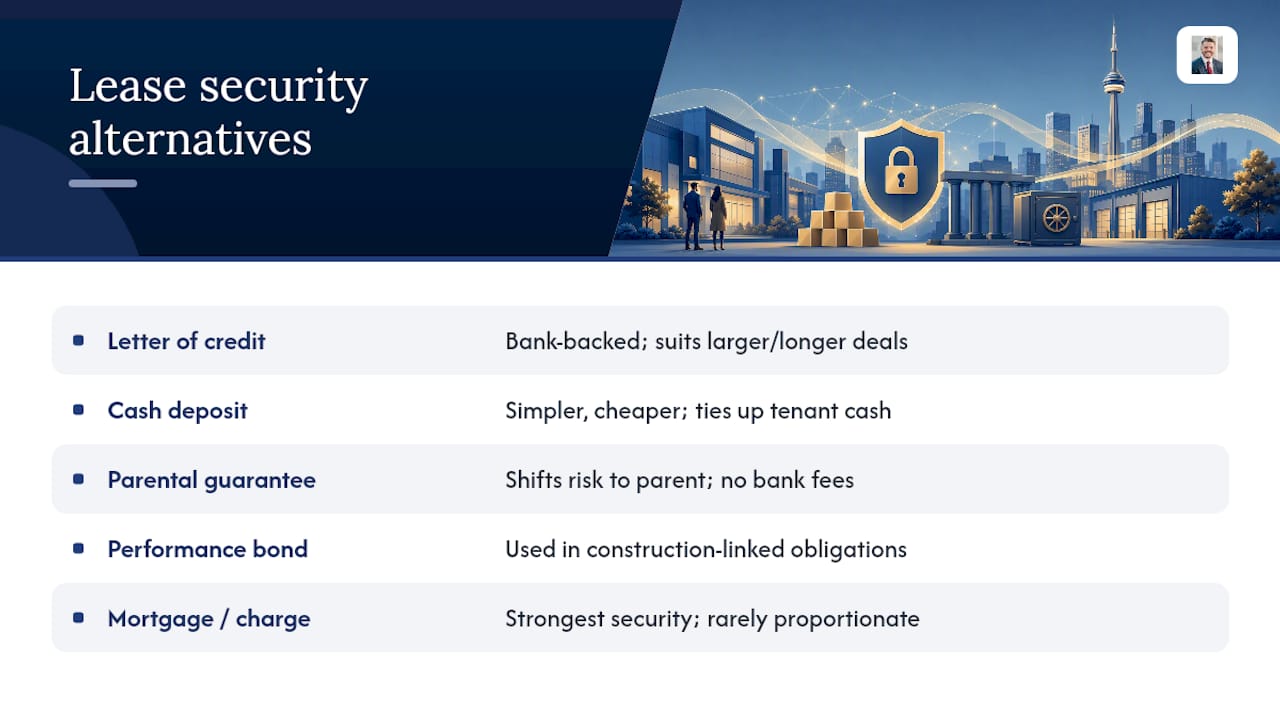
A letter of credit is not the only security option, and it is not always the right one. Cash security deposits are simpler and cheaper to arrange, but they tie up the tenant’s cash directly with the landlord and raise questions about how interest, if any, is handled and where the funds sit if the landlord itself becomes insolvent. Bank guarantees function similarly to an LOC in principle but are less standardized in Canadian commercial practice and can be slower to enforce.
Parental or corporate guarantees work well when the tenant is a subsidiary of a stronger covenant, shifting the credit risk to the parent company without requiring any bank involvement or fees. Performance bonds appear more often in construction-linked lease obligations than in straightforward rent security. Mortgages or charges against real property are the strongest form of security available but are rarely proportionate for a standard industrial lease.
For most GTA industrial deals, the choice comes down to deal size and tenant credit profile. An LOC earns its cost when the landlord needs bank-backed certainty on a larger space or a longer term; a cash deposit or parental guarantee often makes more sense for a smaller tenant where the fees of a bank instrument would eat disproportionately into the deal.
Michael Law’s practitioner notes for GTA industrial leases
Michael Law is Managing Partner at Lennard Commercial and a industrial real estate broker representing tenants and landlords across the Greater Toronto Area, including Mississauga, Brampton, Vaughan, and Barrie.
In practice, GTA industrial LOC amounts are often sized to cover tenant improvement costs plus roughly six to twelve months of operating exposure, a range that shifts with market tightness and tenant credit strength. Banks in this market generally move faster for tenants with an existing relationship than for first-time applicants, which matters when a lease closing date is fixed and the LOC has not yet been issued. Coordinating the LOC issuance timeline with the tenant improvement schedule and the occupancy date avoids a common bottleneck: landlords who wait until possession to confirm the LOC is actually in hand.
Balancing landlord security and tenant cost in the GTA market
Predictable LOC mechanics genuinely benefit the GTA industrial market. Landlords price risk more confidently, and financing on their end often gets easier when a lease is backed by bank-grade security rather than a promise. But an oversized LOC, sized well beyond genuine risk exposure, quietly taxes tenant affordability at a time when many occupiers are already stretched by rising operating costs across industrial properties in the GTA.
The proportionate approach is straightforward: size the LOC to actual exposure, write draw mechanics that are transparent enough that both sides know exactly what triggers a demand, and revisit the arrangement periodically rather than letting decade-old boilerplate carry forward unchanged. Clear drafting is cheaper than litigation, and OMERS makes clear that courts will enforce whatever the parties actually wrote, for better or worse.
— Michael Law
Work with Michael Law | Lennard Commercial on your next lease
Michael Law | Lennard Commercial gives GTA occupiers and landlords something a standard lease template cannot: direct, local negotiating experience with exactly how banks, landlords, and tenants behave once an LOC clause gets tested. Where a generic legal review might catch drafting risk after the fact, working with a broker during negotiation catches sizing, cost, and timing issues before they get locked into the lease.

If you are negotiating a new industrial lease or renewing one that includes an LOC provision, tenant representation from Michael Law | Lennard Commercial can help you assess whether the security amount, draw triggers, and renewal mechanics are proportionate to your deal. Landlords facing a lease renewal with outdated LOC wording can also benefit from a review before the clause is tested in a dispute. For coordinating tenant improvement costs against LOC sizing, resources like the tenant improvement renovation guide are a useful companion reference. Reach out through the Michael Law tenant representation page to book a lease review before your next renewal date arrives.
This article is general information, not a substitute for advice from a qualified lawyer. Consult a qualified legal professional about your own circumstances before acting on anything here.
FAQ
What is a letter of credit for a lease?
A letter of credit for a lease is a bank instrument, usually a standby irrevocable LOC, that guarantees payment to a landlord if the tenant defaults, replacing or supplementing a cash security deposit under the lease agreement.
What is a letter of credit in Canada legally?
In Canada, a letter of credit is treated as a contract independent from the underlying agreement it secures, under the autonomy principle confirmed by the Ontario Court of Appeal in OMERS; banks pay against conforming documents rather than adjudicating the underlying dispute.
Who pays for a letter of credit?
The tenant typically pays all issuance and renewal fees, and often must post cash collateral with the issuing bank, though contribution toward setup costs is occasionally negotiated on larger deals.
How long does it take to get a letter of credit?
Established tenants with an existing bank relationship can often secure an LOC within one to two weeks; new applicants or those requiring full cash collateral should expect three to six weeks.
Can a landlord always draw on a letter of credit after a tenant’s bankruptcy?
Not automatically. A landlord can draw the full principal only if the lease and the LOC contain express survivorship and independence language, as in OMERS; weaker or ambiguous wording leaves the outcome open to challenge.
Recommended

About Michael Law
Managing Partner and Industrial Real Estate Broker at Lennard Commercial Realty. Representing tenants and landlords across Toronto and the GTA for 15+ years. Michael specializes in GTA industrial real estate — connect with Toronto's leading industrial broker at mlawrealestate.com/industrial-broker-toronto.