
Why Toronto industrial lease terms differ: 2026 guide
By Michael Law · Industrial Real Estate Broker, Lennard Commercial Realty
Toronto industrial lease terms differ because no two deals share the same combination of lease structure, property type, location, market conditions, and tenant needs. The lease format alone, whether triple-net, modified gross, or gross, determines how costs are split between landlord and tenant. Layer on top of that the submarket, the building’s age, the tenant’s operational requirements, and the current state of the GTA industrial market, and you get a wide range of outcomes from one deal to the next.
Key reasons lease terms vary in Toronto:
- Lease type (NNN, gross, modified gross) dictates cost allocation
- Market conditions such as vacancy rates and new supply shift negotiating leverage
- Property specifics including age, location, and subtype drive different obligations
- Tenant operations require customised use clauses, power specs, and loading configurations
- Bargaining power between landlord and tenant produces different concessions
- Ontario’s legal framework shapes default remedies, restoration obligations, and insurance requirements
Why Toronto industrial lease types produce different cost structures
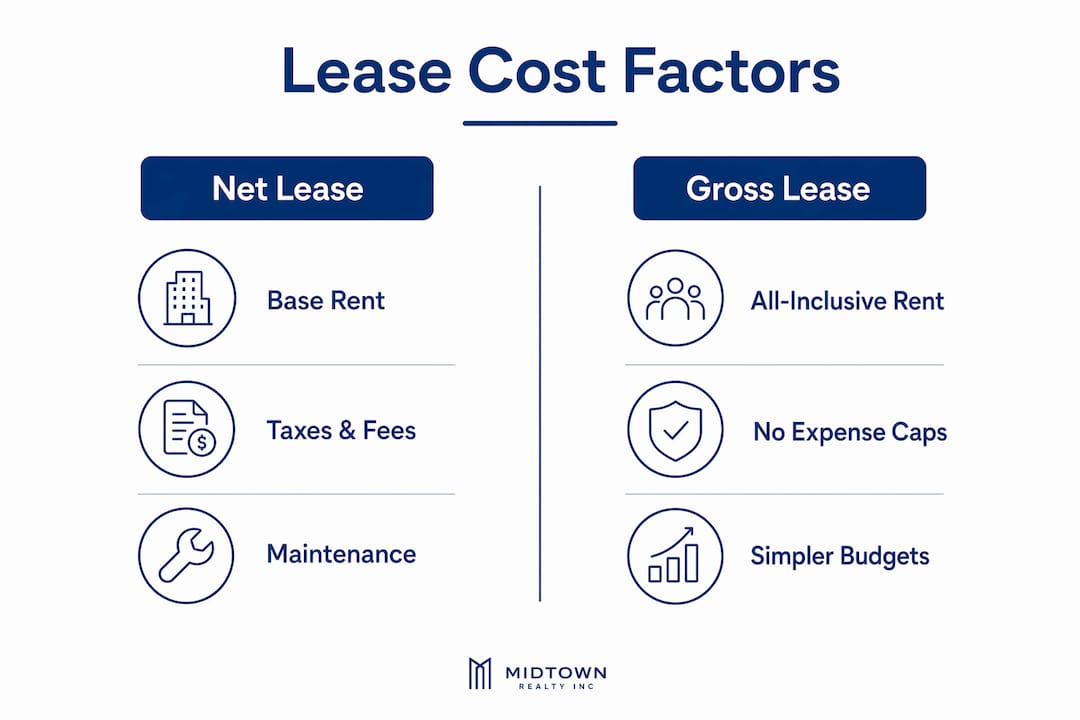
Most Ontario industrial leases are triple-net (NNN), meaning you pay a base rent plus additional rent covering taxes, maintenance, and insurance, commonly called TMI. The landlord collects base rent and passes operating costs through at cost. That structure is standard for warehouses and distribution centres across Mississauga, Brampton, and Vaughan.
Gross leases bundle everything into one payment, which transfers cost risk to the landlord who prices it back into the rent. Modified gross leases split certain expenses, often utilities or janitorial costs, between both parties. Single and double net leases exist but are rare in Toronto’s industrial sector. Percentage leases, where rent includes a share of gross sales, appear almost exclusively in retail-industrial hybrid spaces.
- Triple-net (NNN): Tenant pays base rent plus all TMI; landlord covers structural repairs only
- Gross lease: Single payment covers base rent and all incidentals; landlord absorbs cost risk
- Modified gross: Shared expenses negotiated case by case
- Single net (N): Base rent plus one incidental, typically property tax
- Double net (NN): Base rent plus two incidentals, usually tax and insurance
- Percentage lease: Base rent plus a share of gross revenue; uncommon in pure industrial
Over a 5–10 year term, a net lease with caps and audit rights on TMI almost always produces a lower total occupancy cost than a gross lease, where the landlord’s risk premium is baked into the rent from day one.
Key lease provisions that drive variability in industrial agreements
Term length runs 5–10 years for most GTA industrial deals, and the length you choose has a direct effect on every other provision. Longer terms unlock larger tenant improvement allowances (TIAs): on a 5–10 year deal, $10–$25 per square foot is achievable in 2026, with office build-out or food-grade work pushing allowances toward the top of that range. A five-year deal gives you more flexibility to relocate or right-size; a ten-year deal gives you better economics up front.
Rent escalation clauses are another major source of variability. Fixed annual increases of 2.5–3% are increasingly common as tenants push back against CPI-linked escalations, which can spike unpredictably. In a softening market, flat net rent in year one is also negotiable.
- Term length: 5-year deals offer flexibility; 7–10 year deals unlock larger TIAs and better rates
- Rent escalations: Fixed 2.5–3% annual bumps preferred over CPI-linked adjustments
- TIAs: Amortised into rent; landlord recoups cost over the lease term
- Use restrictions: Permitted operations, hazardous materials, and exclusivity rights vary by property and landlord
- Renewal options: Shorter terms provide optionality; longer terms offer better financial incentives
- Free rent: Several months free rent on 7–10 year deals is achievable in current market conditions
Pro Tip: Always compare total occupancy cost, meaning net rent plus TMI, not base rent alone. Two offers with identical base rents can diverge significantly once TMI and escalation schedules are factored in. Assess GTA industrial rent on a net effective basis to make a fair comparison.
Who pays for what: maintenance, repairs, and alterations
Capital repairs such as roof replacement or structural work typically remain the landlord’s responsibility, while day-to-day maintenance falls on the tenant in a NNN structure. The line between the two is where disputes most often arise, particularly in older buildings where HVAC systems and loading equipment are near end of life.
Tenant alteration rights vary considerably. Most landlords permit cosmetic changes with notice but require approval for structural modifications, additional dock doors, or mezzanine installations. The restoration clause is the provision tenants most often overlook: specialised improvements such as dock levellers or mezzanines commonly must be removed at the tenant’s cost at lease end unless the lease explicitly states otherwise.
- Landlord obligations: Structural repairs, roof, and base building systems
- Tenant obligations: HVAC maintenance, interior upkeep, and operational systems
- Alteration approvals: Written landlord consent required for structural changes
- Restoration clauses: Negotiate upfront which improvements stay and which must be removed
- Older buildings: More maintenance risk shifts to tenants; negotiate caps on HVAC repair costs
- Condition at signing: Document the building’s state thoroughly before taking possession
Insurance, liability, and default remedies in Toronto industrial leases
Tenants are typically required to carry commercial general liability insurance, property insurance covering their contents and improvements, and in some cases environmental liability coverage. The specific minimums vary by landlord, building type, and the nature of the tenant’s operations. A food-processing tenant faces different insurance requirements than a logistics operator.
Indemnity clauses determine who bears liability when something goes wrong on the premises. Landlords typically require tenants to indemnify them against claims arising from the tenant’s use of the space. Default remedies under Ontario law include the landlord’s right to terminate the lease, re-enter the premises, and pursue damages. Dispute resolution mechanisms, whether mediation, arbitration, or litigation, are usually specified in the lease and can affect how quickly and expensively a conflict gets resolved.
- Required insurance: Commercial general liability, property, and sometimes environmental coverage
- Indemnity: Tenants indemnify landlords against claims from tenant operations
- Default triggers: Non-payment, breach of use restrictions, and insolvency are common triggers
- Remedies: Lease termination, re-entry, and damages claims under Ontario commercial law
- Dispute resolution: Mediation or arbitration clauses can reduce litigation costs
- Risk allocation: More complex operations attract more detailed liability provisions
How to negotiate industrial lease terms effectively in Toronto
2026 is a genuinely good year to push hard on lease terms. Tenant leverage has increased as vacancy has risen and new supply has come to market, particularly in submarkets with visible speculative development. Free rent, caps on controllable operating costs, and TIAs are all on the table in a way they were not in 2022 or 2023.
Start by knowing your total occupancy cost, not just the headline rent, as explained in How to build an investment property from scratch in the GTA | TESA Insights. Push for base-year tax protection, audit rights on TMI, and caps on controllable operating expenses. On longer deals, ask for free rent periods and a meaningful TIA. Working with an experienced industrial tenant representative like Michael Law | Lennard Commercial gives you access to current market data and negotiation experience across the GTA.
Pro Tip: Negotiate the restoration clause before you sign, not when you are preparing to vacate. Specify in writing which improvements, such as dock levellers, mezzanines, or racking systems, can remain at lease end. This one clause can save tens of thousands of dollars.
How market conditions shape what landlords will offer
The GTA industrial market has shifted meaningfully since its peak in 2022. Cross-border trade uncertainty has made flexible lease terms more attractive to tenants, and construction cost pressure is slowing speculative development, which is expected to tighten supply again by 2027. Right now, tenants in submarkets with new supply have real room to negotiate concessions that were simply unavailable two years ago.
Economic factors such as interest rates, construction costs, and e-commerce demand all feed into what landlords can afford to offer. When financing costs are high, landlords are less willing to offer large TIAs upfront. When vacancy is elevated, they will accept longer free-rent periods to secure a creditworthy tenant on a long term.
How landlord and tenant bargaining power shifts lease outcomes
A national logistics company signing a 50,000-square-foot, ten-year lease has fundamentally different leverage than a small manufacturer looking for 8,000 square feet on a five-year term. Credit quality, lease length, and the tenant’s ability to occupy quickly all affect what a landlord will concede. In a tighter market, landlords hold the cards; in a market with rising vacancy, tenants can extract meaningful concessions.
Landlords with multiple vacant properties in the same submarket are more motivated to deal. A tenant who has done their homework on comparable rents and vacancy rates, and who arrives with a clear brief, is in a much stronger position than one who is reacting to whatever the landlord presents first.
How location within Toronto affects your lease terms
Location within the GTA is one of the strongest predictors of lease terms. Properties in established infill nodes like North York, Etobicoke, or the Port Lands command premium rents and offer little flexibility because supply is genuinely constrained. Outer submarkets like Milton, Caledon, or Barrie typically offer lower net rents, more landlord flexibility on TIAs, and newer buildings with better clear heights and power.
Proximity to Highway 400, 401, 410, or 427 corridors adds a rent premium because logistics operators pay for access. A distribution tenant who needs to be within 30 minutes of downtown Toronto will pay more and negotiate less than one who can operate from a Brampton or Ajax location. Understanding industrial zoning in your target submarket is a prerequisite before comparing lease offers.
How lease terms differ across industrial subtypes
Warehouse and distribution facilities, flex industrial units, manufacturing plants, and cold storage spaces each attract different lease structures. A modern distribution centre with 36-foot clear heights and multiple dock doors commands a premium net rent and typically comes with a NNN structure and minimal landlord flexibility on alterations. Flex industrial units, which mix office and light industrial space, sometimes carry modified gross structures and shorter minimum terms.
Manufacturing facilities with heavy power requirements, floor load specifications, or environmental permits involve more complex use clauses and often longer terms to justify the landlord’s investment in building modifications. Cold storage is a category of its own: the capital cost of refrigeration infrastructure means landlords almost always require longer terms and higher TIAs to recoup their investment.

Legal and regulatory factors that shape Toronto industrial leases
Ontario’s Commercial Tenancies Act governs the relationship between commercial landlords and tenants, covering default remedies, re-entry rights, and distress procedures. Unlike residential leases, commercial leases in Ontario are largely governed by contract, which means the negotiated terms of the lease document carry significant weight. There is no rent control equivalent for commercial properties.
Zoning by-laws administered by the City of Toronto and regional municipalities determine what operations are permitted in a given building. Environmental regulations under Ontario’s Environmental Protection Act affect use clauses, particularly for tenants handling chemicals, food products, or waste. A commercial real estate lawyer familiar with Ontario law should review any industrial lease before signing, particularly where use restrictions, restoration obligations, or environmental indemnities are involved.

Work with Michael Law | Lennard Commercial on your next GTA industrial lease. Michael Law is a CoStar Power Broker and Managing Partner at Lennard Commercial, with over a decade of experience representing tenants across Mississauga, Brampton, Vaughan, Markham, Ajax, and the broader GTA. Whether you are negotiating your first industrial lease or restructuring an existing one, his team brings current market data and real negotiating leverage to the table. Get in touch to discuss your requirements.
Key takeaways
Toronto industrial lease terms vary because lease type, location, property condition, market dynamics, and tenant bargaining power all combine differently in every deal.
| Point | Details |
|---|---|
| Lease type determines cost split | NNN leases pass TMI to tenants; gross leases bundle costs but carry a landlord risk premium. |
| Term length drives incentives | Longer terms of 7–10 years unlock TIAs of $10–$25 per square foot in 2026 GTA deals. |
| Total occupancy cost is the real benchmark | Compare net rent plus TMI, not base rent alone, when evaluating competing offers. |
| Restoration clauses carry hidden costs | Negotiate upfront which improvements stay; dock levellers and mezzanines often must be removed. |
| 2026 favours tenant negotiation | Rising vacancy and new supply have made free rent and TIA caps accessible across GTA submarkets. |
FAQ
What are the main types of industrial leases in Toronto?
The most common is the triple-net (NNN) lease, where tenants pay base rent plus taxes, maintenance, and insurance. Gross and modified gross leases exist but are less typical for industrial space in Ontario.
Can you break a commercial lease in Ontario?
Breaking a commercial lease in Ontario requires either a negotiated surrender agreement with the landlord or a contractual termination right built into the lease. Without one of those, the tenant remains liable for rent for the remainder of the term.
Is TMI negotiable in a Toronto industrial lease?
Yes. While the TMI amount itself reflects actual operating costs, tenants can negotiate caps on controllable expenses, base-year tax protection, and audit rights to verify what landlords are passing through.
How long is a typical industrial lease term in the GTA?
Most GTA industrial leases run 5–10 years. Five-year terms offer more flexibility, while longer terms of 7–10 years typically unlock larger tenant improvement allowances and better net rent rates.
What is a Toronto industrial rent benchmark?
The Toronto industrial rent benchmark refers to the net rent per square foot for a given submarket and building class, used to compare lease offers. Total occupancy cost, net rent plus TMI, is the more reliable figure for evaluating and comparing deals across the GTA.
Recommended

About Michael Law
Managing Partner and Industrial Real Estate Broker at Lennard Commercial Realty. Representing tenants and landlords across Toronto and the GTA for 15+ years. Michael specializes in GTA industrial real estate — connect with Toronto's leading industrial broker at mlawrealestate.com/industrial-broker-toronto.
Related Articles

More Toronto Industrial Real Estate Insights
Articles & Analysis
Guide to Commercial Property Disposition
Read →How to Reduce Warehouse Vacancy in the GTA
Read →Markham Industrial Rents 2026: Tenant Rep Says Budget C$22 PSF
Tenant focused 2026 Markham industrial rent snapshot from a GTA tenant rep. Expect C$16–22 net and about C$22 gross; negotiation levers, cost checks, and...
Read →Brampton Warehouse Lease Negotiation Tactics
Read →Secure 30–90 Days on Your Fixturing Period Lease in the GTA
Negotiate fixturing period lease terms for GTA tenants: when to raise them, what clause language and tolling to demand, and how to secure 30–90 days.
Read →Common Questions
What is a sale-leaseback in industrial real estate?
A sale-leaseback is a transaction in which an industrial property owner sells their building to an investor and simultaneously signs a long-term lease to remain in the property as a tenant. The seller unlocks the capital tied up in their real estate while retaining full operational use of the facility. The buyer acquires a tenanted investment property with immediate cash flow from a known occupant.
Read →What is a dock-to-grade ratio in industrial real estate?
Dock-to-grade ratio in industrial real estate refers to the number of dock-level loading doors relative to the building's floor area, typically expressed as one dock door per X,000 square feet. It is a key specification for distribution and warehousing tenants because it determines how many trucks can load and unload simultaneously and therefore the building's throughput capacity.
Read →What is clear height in a warehouse or distribution centre?
Clear height in a warehouse or distribution centre refers to the usable vertical space from the finished floor to the lowest overhead obstruction — typically the bottom of the roof structure, sprinkler heads, or HVAC equipment. It is the single most important building specification for warehouse tenants because it determines how many racking levels can be installed and therefore how much product can be stored per square foot of floor space.
Read →