
Avoid Commission Forfeiture: Dual Agency in Ontario for GTA Tenants
By Michael Law · Industrial Real Estate Broker, Lennard Commercial Realty
Dual agency, called multiple representation under Ontario law, is permitted, but only when the brokerage or agent provides written disclosure and gets written consent from every client before an offer is presented. Skip that step, and the arrangement is legally shaky, exposing agents to commission forfeiture and clients to weaker representation. If you’re unsure whether your situation qualifies, RECO’s consumer guidance and a real estate lawyer are your first calls.
TL;DR:
- Written disclosure and consent must be obtained before any offer is presented to avoid legal issues and forfeiture of commissions.
- Multiple representation often occurs unintentionally in small markets or due to brokerage models blending designated and brokerage-wide representation.
- Failing to secure proper disclosure and consent can lead to commission forfeiture and legal invalidation of the transaction.
- Clients have the right to refuse dual agency and should ask specific questions about confidentiality and conflict management before agreeing.
- Reporting suspected undisclosed multiple representation promptly and consulting a lawyer can help protect your interests and legal rights.
Table of Contents
- What does dual agency mean in Ontario real estate?
- Is multiple representation legal under Ontario’s real estate rules?
- How multiple representation actually happens in the field
- The disclosure and consent process, step by step
- What happens when disclosure fails: risks and legal consequences
- Your rights: questions to ask before you consent
- How to report a problem or seek a remedy
- Michael Law’s perspective for industrial clients in the GTA
- Conflict-free representation for GTA industrial occupiers
- Sources
- FAQ
What does dual agency mean in Ontario real estate?
The Real Estate Council of Ontario (RECO) defines multiple representation as a brokerage, or a single designated representative, acting for more than one client with competing interests in the same deal. That definition covers more scenarios than most people expect.
It shows up in a few common forms:
- A brokerage lists a home for a seller, and a different agent at that same brokerage represents the buyer.
- One agent acts as the designated representative for both the buyer and the seller in a single transaction.
- Two separate buyers, both represented by the same brokerage, are competing for the same listing.
You’ll often see this called “double-ending” in media coverage, but that’s slang, not regulatory language. Ontario’s rulebook uses “multiple representation” exclusively, and that’s the term you should use when asking your agent direct questions. For industrial tenants, the same principle applies during site selection: if the brokerage representing you also represents the landlord on the same building, you’re in multiple representation whether anyone calls it that or not.
Is multiple representation legal under Ontario’s real estate rules?
Yes. The Trust in Real Estate Services Act (TRESA) governs registrant conduct in Ontario, and it permits multiple representation, but attaches conditions that are not optional.
RECO enforces those conditions through two bulletins that every agent should know cold:
- RECO bulletin 2.2 explains the difference between brokerage representation and designated representation, and spells out the brokerage’s supervisory duties either way.
- RECO bulletin 3.2 sets the operating rules for multiple representation itself, including consent and disclosure.
Bulletin 3.2 is unambiguous on timing: disclosure and written consent must happen before any offer is presented, not after, and not as a formality tucked into closing paperwork.
RECO’s rules also require brokerages to make best efforts to obtain written acknowledgement from each client and to retain those records. Ontario’s O. Reg. 580/05 reinforces this by requiring registrants to disclose material relationships in writing at the earliest practicable opportunity, not whenever convenient.
How multiple representation actually happens in the field
Multiple representation rarely starts as a deliberate plan. It usually emerges from geography and market structure.
- Small or thin markets. In smaller GTA submarkets or niche industrial segments, only a handful of brokerages actively work certain building types, which raises the odds the same brokerage represents both sides.
- One-desk brokerages. Smaller shops with few agents naturally increase the chance that one representative, or one office, ends up on both sides of a deal.
- A dominant local agent. An agent who lists heavily in one submarket may later be approached by a buyer for the same property, creating multiple representation almost by default.
Brokerages handle this differently. Some run a firm-wide brokerage representation model, where any agent in the firm is considered to represent the client. Others use designated representation, where only the specific agent assigned owes duties to that client. Mixing the two models within one brokerage is where things get messy: as RECO bulletin 2.2 notes, blending models raises the risk of inadvertent multiple representation that nobody flagged in time.
That operational risk is exactly why many brokerages simply prohibit same-agent multiple representation outright, even though TRESA allows it. Litigation exposure, the administrative burden of tracking consent paperwork, and the reputational cost of a client feeling shortchanged all outweigh, for many firms, whatever convenience dual agency offers.
The disclosure and consent process, step by step
Ontario law doesn’t leave the disclosure process open to interpretation. Here’s what has to happen, and in what order.
- Disclosure comes first, in writing, the moment multiple representation becomes apparent. The brokerage or designated representative cannot wait until an offer is drafted.
- Written consent from every client is mandatory before the brokerage or agent can proceed. RECO bulletin 3.2 requires the brokerage to make best efforts to secure written acknowledgement from each side.
- Records must be retained. If a dispute ever surfaces, the brokerage needs to produce the signed disclosure and consent documents on demand.
- Other interested buyers may need notification in certain scenarios, particularly where multiple offers are in play and one buyer is represented by the listing brokerage.
Pro Tip: Ask your agent to show you the disclosure form itself, not just a verbal summary, before you sign anything or submit an offer. If they can’t produce it on the spot, that’s your answer about how seriously the brokerage is tracking this.
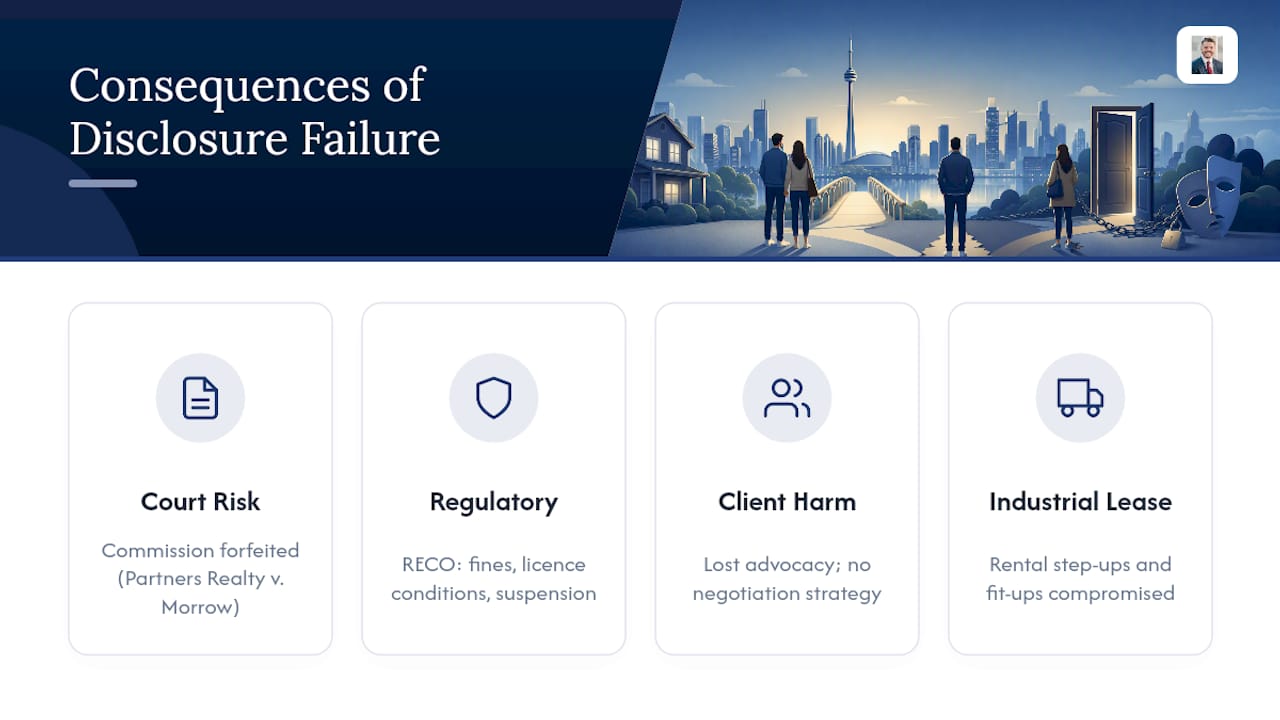
The consequences of skipping this process are not hypothetical. Ontario courts have shown a willingness to strip an agent’s commission entirely when disclosure and consent weren’t secured before an offer went forward, a point reinforced in Partners Realty Ltd. v. Morrow. Beyond commission risk, a client operating under an undisclosed or improperly disclosed arrangement may have grounds to argue the representation itself was invalid, which can complicate closing, financing conditions, or even the enforceability of the deal.
What happens when disclosure fails: risks and legal consequences
Ontario courts and regulators treat undisclosed multiple representation as a serious breach, not a technicality.
In Partners Realty Ltd. v. Morrow, the Ontario Superior Court found that an agent who failed to secure proper written disclosure and consent before presenting an offer forfeited entitlement to commission. The case stands as one of the clearest judicial signals that fiduciary disclosure duties in multiple representation are enforced, not just recommended.
Legal commentary from outlets like Law Times has flagged undisclosed dual agency as carrying both regulatory exposure through RECO complaints and civil exposure through the courts. RECO’s disciplinary process can result in fines, licence conditions, or suspension for registrants who fail to meet disclosure obligations.
For the client caught in the middle, the practical damage is often less dramatic but more costly: an agent under multiple representation cannot advocate as hard for either side, cannot share strategic advice about pricing or negotiating room, and must guard confidential information that would otherwise strengthen your position. In an industrial lease negotiation, where confidential terms like rental step-ups or fit-up allowances carry real financial weight, that lost advocacy is not a small thing.
Your rights: questions to ask before you consent
You are not obligated to accept multiple representation just because a brokerage proposes it. RECO explicitly confirms clients can refuse and request an alternative, such as a referral to a different brokerage or another designated representative within the same firm.
Before signing any consent form, ask:
- Exactly what information about my position, budget, or motivations will be shared with the other party?
- How will you manage a direct conflict if both clients want the same outcome on price or terms?
- Who physically holds my confidential documents, and how are they kept separate from the other client’s file?
| If the answer is unsatisfactory | Your alternative |
|---|---|
| Vague on information sharing | Request a different designated representative |
| No clear conflict process | Ask for referral to another brokerage |
| Documents not kept separate | Retain independent legal counsel before proceeding |
If the answers feel rehearsed or evasive, that’s your cue to walk. Independent representation, even from a different agent at the same brokerage, almost always serves your interests better than a shared arrangement.
How to report a problem or seek a remedy
If you suspect disclosure wasn’t handled properly, act quickly. Evidence has a way of going stale once a deal closes.
- Gather documentation first: your representation agreement, any disclosure or consent forms you received, and relevant emails or texts showing when multiple representation was raised.
- File a complaint with RECO if you believe a registrant failed its disclosure duties; RECO investigates and can impose disciplinary measures.
- Consult a real estate lawyer early, especially if you’re considering rescission, a damages claim, or a commission dispute, since remedies like those in Partners Realty Ltd. v. Morrow depend on timely, well-documented evidence.
Waiting weeks to raise concerns weakens your position. Preserve everything in writing the moment something feels off.
Michael Law’s perspective for industrial clients in the GTA
Multiple representation carries extra weight in industrial leasing, where rental rates, fit-up allowances, and step-in rights are commercially sensitive and rarely public. If your representative is also advising the landlord, you’re negotiating with one hand tied. I’ve seen tenant advocates lose real leverage this way, particularly during tenant representation agreements where confidentiality should have been non-negotiable. Occupiers should insist on exclusive representation clauses and early legal review before signing anything, not after a term sheet is on the table.
— Michael Law
Conflict-free representation for GTA industrial occupiers
Michael Law | Lennard Commercial positions itself as working exclusively on behalf of tenants and occupiers, avoiding representation of both sides of the same deal. This approach aims to allow for full disclosure of comparable rates, unfiltered advice on fit-up allowances, and negotiating room that isn’t softened to keep another client happy.
Whether you’re evaluating warehouse or distribution space across the GTA, weighing a relocation, or comparing site options for a manufacturing or logistics operation, exclusive tenant representation means someone is working only for your outcome. This approach is applied across various markets within the GTA industrial sector. If you want a confidential read on your current lease terms, or you’re heading into negotiations and want a second set of eyes before you sign anything, reach out through Michael Law’s industrial tenant representation services to start that conversation now.
Sources
- Understanding multiple representation | RECO
- RECO bulletin 3.2: multiple representation
- RECO bulletin 2.2: representation
- Partners Realty Ltd. v. Morrow (2014 ONSC 124) | CanLII
FAQ
Should I consent to dual agency in Ontario?
You’re never required to. RECO confirms clients can refuse multiple representation and request a different agent or brokerage instead. If the disclosure feels rushed or the answers about confidentiality are vague, refusing and seeking independent representation is almost always the safer path.
What is an example of dual agency in Ontario?
A common example is one brokerage listing a seller’s property while another agent at that same firm represents the buyer on the identical deal. It also happens when a single designated representative acts for both the buyer and seller directly, which requires written disclosure and consent from both before any offer is submitted.
What’s the difference between designated representation and dual agency?
Designated representation means only the specific agent assigned to you owes fiduciary duties, while brokerage representation extends that duty to the whole firm. Multiple representation can occur under either model when the same agent, or the same brokerage, ends up representing both sides of one transaction, as outlined in RECO bulletin 2.2.
What’s the lowest commission a realtor will take?
Commission rates in Ontario are negotiable and not set by law or RECO, so there’s no fixed floor. For industrial tenant representation specifically, current fee structures and service details are available directly through Michael Law | Lennard Commercial’s services page.
Recommended

About Michael Law
Managing Partner and Industrial Real Estate Broker at Lennard Commercial Realty. Representing tenants and landlords across Toronto and the GTA for 15+ years. Michael specializes in GTA industrial real estate — connect with Toronto's leading industrial broker at mlawrealestate.com/industrial-broker-toronto.
Related Articles



More Toronto Industrial Real Estate Insights
Articles & Analysis
2–3x Rent Gap: Secure a Compliant GTA Outside Storage Lease
GTA tenants: secure a compliant outside storage lease with zoning and environmental checks, clear site improvement priorities, and off market sourcing.
Read →GTA Finance: Operating Cost Reconciliation and GST/HST ITC Rules
A GTA playbook for operating cost reconciliation: step-by-step checks, a reconciliation checklist, sample journal entries, CRA GST/HST ITC guidance and...
Read →GTA Industrial Due Diligence Before You Buy
Read →Catch Hidden Additional Rent: GTA Industrial Lease Audit
Broker led lease audits help GTA industrial tenants spot hidden additional rent, make good liabilities, and negotiation levers at the offer stage before...
Read →GTA Investors: Rail Served Toronto, Rail Ready, Rules and Broker Tips
Investor briefing on rail served industrial Toronto: CN Certified Rail Ready sites, City rail proximity rules, Milton's new intermodal capacity and broker...
Read →Common Questions
What is a sale-leaseback in industrial real estate?
A sale-leaseback is a transaction in which an industrial property owner sells their building to an investor and simultaneously signs a long-term lease to remain in the property as a tenant. The seller unlocks the capital tied up in their real estate while retaining full operational use of the facility. The buyer acquires a tenanted investment property with immediate cash flow from a known occupant.
Read →What is a dock-to-grade ratio in industrial real estate?
Dock-to-grade ratio in industrial real estate refers to the number of dock-level loading doors relative to the building's floor area, typically expressed as one dock door per X,000 square feet. It is a key specification for distribution and warehousing tenants because it determines how many trucks can load and unload simultaneously and therefore the building's throughput capacity.
Read →What is clear height in a warehouse or distribution centre?
Clear height in a warehouse or distribution centre refers to the usable vertical space from the finished floor to the lowest overhead obstruction — typically the bottom of the roof structure, sprinkler heads, or HVAC equipment. It is the single most important building specification for warehouse tenants because it determines how many racking levels can be installed and therefore how much product can be stored per square foot of floor space.
Read →