C$22.2/sf Budget: Mississauga Industrial Rents and Sublease Leverage
By Michael Law · Industrial Real Estate Broker, Lennard Commercial Realty
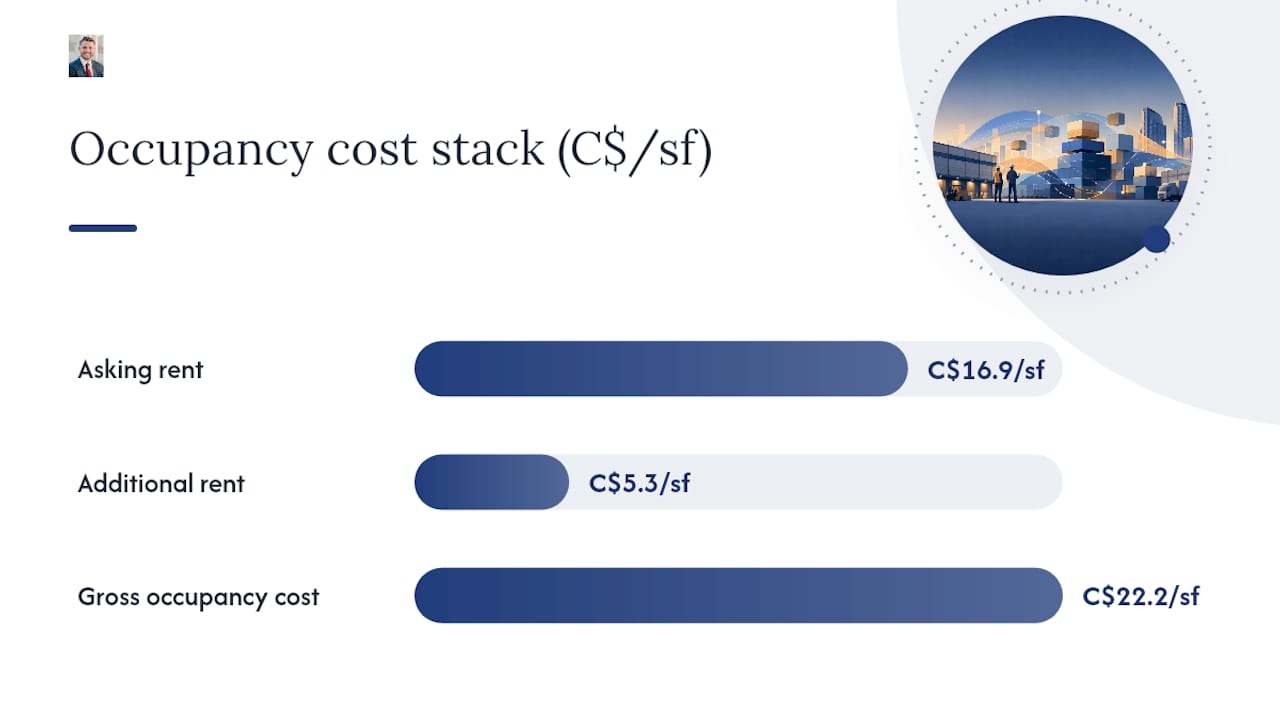
Mississauga industrial rents landed at an estimated asking rate near C$16.9 per square foot in the second quarter of 2026, with additional rents pushing gross occupancy costs toward roughly C$22.2/sf. Peel Region vacancy sits near 2.8%, tight by most standards, but rising sublease inventory is giving tenants more room to negotiate than headline numbers suggest. If you’re shortlisting space, start with a broker who can walk you through both listed and off-market inventory, since the best deals in this market rarely show up on a portal search.
TL;DR:
- Modern bulk buildings with 32 to 36 foot clear heights in Mississauga continue to command top-tier rents, while older second-generation spaces are experiencing softer demand and pricing.
- Sublease inventory is rising, offering tenants discounted options that are often 12 to 24 months long, but they should compare these against long-term lease opportunities.
- Finding space quickly depends heavily on brokerage networks and off-market listings, especially since asking rents and asking rent components vary widely by location and building class.
- Additional operating costs average around C$5.3 per square foot, bringing typical gross occupancy costs in Mississauga to approximately C$22.2 per square foot; tenants should review historical operating costs to avoid surprises.
- Negotiating lease terms effectively involves securing rent-free periods, tenant improvement allowances, and clear escalation caps, especially in buildings with high vacancy or sublease activity.
Table of Contents
- Mississauga industrial rents: market snapshot and recent trends
- Where to find Mississauga industrial space for lease
- Budgeting: what your gross occupancy cost actually looks like
- Negotiating your Mississauga industrial lease
- Get tenant representation for your Mississauga lease
- Broker perspective: reading the Mississauga sublease signal
- Key market reports and local pages
- Sources
- FAQ
Mississauga industrial rents: market snapshot and recent trends
Asking rents across the Toronto industrial market, including Mississauga, eased to about C$16.9 per sq. ft. in 2Q26, with additional rents (operating costs and property taxes) running around C$5.3/sf. Stack those together and a tenant landing a typical bulk unit is budgeting close to C$22.2/sf in gross occupancy cost before fit-out.
Peel Region, which covers Mississauga, Brampton, and Caledon, closed the first half of 2026 with vacancy near 2.8%, still low by historical standards. Availability, however, widened to roughly 5.3% as sublease inventory climbed, increasing availability. That gap between vacancy and availability matters: it tells you space is technically occupied but increasingly up for grabs as tenants trade space back to the market before their term ends.
The bigger story is bifurcation. Modern bulk buildings with 32 to 36 foot clear heights, particularly those near Airport Corporate Centre, Meadowvale, and Dixie-Eglinton, continue to command top-tier rents because occupiers competing on logistics speed need that clear height and column spacing. Older second-generation buildings, often built decades ago with lower ceilings and tighter loading, are softening in relative terms. That split is where negotiating leverage actually lives right now. A tenant chasing a brand-new distribution box will pay full freight. A tenant willing to take older stock, or a sublease with 12 to 24 months left on the term, can often land materially better economics.
Where to find Mississauga industrial space for lease
Finding the right building fast usually comes down to which channel you search first. Each has real trade offs:
- Brokerage listings and networks — the fastest route to both active and pre-market inventory, since brokers often hear about upcoming vacancies before they’re publicly listed.
- Commercial real estate portals — good for a broad first scan of asking rents and square footage, but listings lag actual availability and rarely show sublease terms clearly.
- Landlord and developer websites — useful for new construction and larger institutional owners, though coverage is limited to that owner’s portfolio.
- Sublease listings — often the best value in today’s market, especially in Mississauga where churn among logistics and 3PL tenants keeps supply moving.
Rent ranges shift sharply by node. Airport-adjacent submarkets near Pearson command a premium because carriers and 3PL operators pay for the last-mile advantage. Mid-bay product in the 20,000 to 60,000 square foot range remains the deepest segment of the market, while small-bay units under 15,000 square feet are scarcer and get snapped up quickly by local trades and light manufacturing tenants.
Before booking tours, filter for three things: clear height matching your racking plan, truck court depth for your trailer count, and whether the listing discloses additional rent separately from base rent. Skipping that last check is how tenants end up touring buildings that don’t fit their budget at all.
Budgeting: what your gross occupancy cost actually looks like
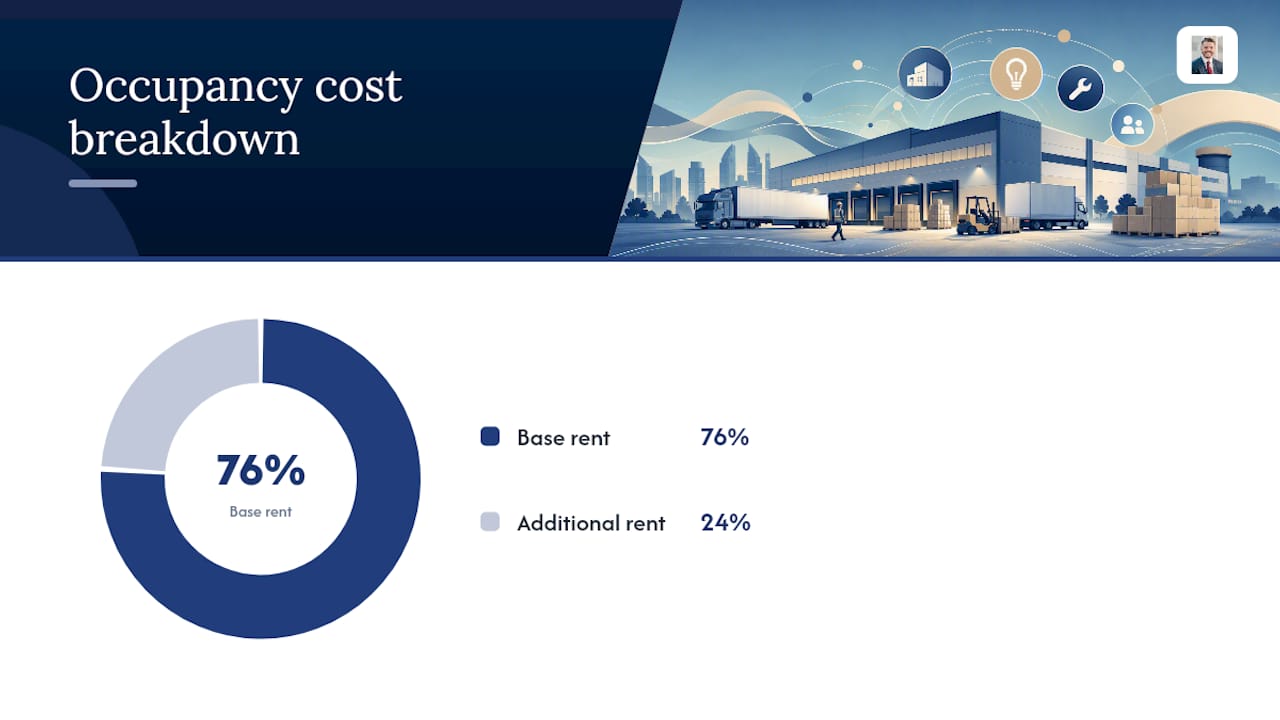
Base asking rent is only part of the bill. Additional rent, sometimes called common area maintenance or operating costs, covers property tax, insurance, and shared building expenses. Most Mississauga industrial leases run as net leases, meaning the tenant pays additional rent on top of base rent rather than a single all-in gross figure.
| Cost component | Estimated rate (2Q26) |
|---|---|
| Base asking rent | ~C$16.9/sf |
| Additional rent (operating costs, taxes) | ~C$5.3/sf |
| Estimated gross occupancy cost | ~C$22.2/sf |
Figures reflect 2Q26 market data for the Toronto industrial market, including Mississauga.
Product class moves these numbers meaningfully. A modern Class A bulk building will sit at or above the C$16.9/sf mark, while older Class B or C space can land well under it, sometimes with a landlord willing to negotiate on rent-free periods too. For a 5-year budget, model gross occupancy cost against a modest annual escalation and rebudget additional rent each year, since property tax reassessments and insurance costs rarely stay flat.
Pro Tip: Ask for a 3-year history of additional rent charges before signing anything. A building with volatile operating costs can quietly erode a rent advantage you thought you’d locked in.
Negotiating your Mississauga industrial lease
Once you’ve shortlisted a few buildings, the real work starts. Work through this before you sign anything:
- Confirm term length and whether a shorter term costs you a rent premium.
- Push for a tenant improvement allowance if the space needs fit-out work.
- Negotiate rent-free months, especially on longer terms or in buildings with longer vacancy history.
- Secure the right to sublease or assign the lease if your space needs change.
- Ask for a cap on annual operating-cost increases.
- Confirm expansion or early termination options if your growth plans are uncertain.
On tours, check loading configuration, clear height, column spacing, parking ratio, eave height, and electrical capacity, since retrofitting any of these later is expensive. Watch for red flags: unusually low asking rent with no explanation, vague additional rent figures, or a landlord unwilling to share the operating-cost history.
Pro Tip: A building advertised well under market rent is usually hiding a cost somewhere else, deferred maintenance, an outdated electrical panel, or a looming tax reassessment. Ask why before you get excited.
The practical sequence: shortlist three to five buildings, tour with your checklist in hand, get a letter of intent drafted on your top choice, then negotiate the lease terms before committing legal resources to a full document review.
Get tenant representation for your Mississauga lease
Tenant representation services can provide access to sublease and off-market inventory before it becomes publicly listed. That matters most right now, with sublease supply rising across Peel Region and genuine savings available for tenants willing to look past brand-new construction.
Professional brokers handle tenant representation, site selection, lease negotiation, and market data support, which can streamline the search for suitable industrial space. This approach can lead to a faster shortlist, improved commercial terms, and better insight into landlord flexibility versus posted rents.
If you’re planning a move or renewal in the next 6 to 12 months, start by pulling together your current lease, your space and headcount projections, and your target move-in date. Then reach out through the industrial tenant representation team in Toronto to walk through your options, or check office locations for the closest point of contact.
Broker perspective: reading the Mississauga sublease signal
Sublease volumes in Mississauga have been climbing, and that’s not a bad-news story for tenants willing to look at it clearly. It usually means occupiers are trading up to modern bulk space and leaving good older buildings behind at a discount. My practical suggestion: don’t dismiss a 12 to 24 month sublease offer just because the term feels short. Run the numbers against a fresh five-year deal first. More detail on submarket-specific pricing is in the Mississauga industrial areas guide, and you can review my background on the Lennard Commercial people page.
— Michael Law
Key market reports and local pages
Figures above draw from the 2Q26 Toronto, Ontario industrial market report and the GTA industrial market overview. For submarket detail, see the Mississauga industrial page.
Sources
FAQ
What is the average commercial rent per square foot in Mississauga?
Estimated asking rents for industrial space across the Toronto market, including Mississauga, were about C$16.9 per sq. ft. in 2Q26, with gross occupancy cost closer to C$22.2/sf once additional rent is included.
Where can I find industrial space for lease in Mississauga?
Brokerage listings and networks typically surface both public and off-market inventory fastest, followed by commercial real estate portals, landlord websites, and the sublease market, which has grown notably in Peel Region.
What is the most expensive area in Mississauga for industrial space?
Airport-adjacent nodes such as Airport Corporate Centre, Meadowvale, and Dixie-Eglinton command the highest rents, largely because of proximity to Pearson and highway access that logistics tenants pay a premium for.
Is there a standard commercial lease in Ontario?
There’s no single mandated standard lease for commercial or industrial space in Ontario. Terms vary by landlord, and most industrial leases in Mississauga follow a net lease structure, so reviewing each document carefully, or working with a tenant representative like Michael Law | Lennard Commercial, matters before signing.
Recommended

About Michael Law
Managing Partner and Industrial Real Estate Broker at Lennard Commercial Realty. Representing tenants and landlords across Toronto and the GTA for 15+ years. Michael specializes in GTA industrial real estate — connect with Toronto's leading industrial broker at mlawrealestate.com/industrial-broker-toronto.
Related Articles

More Mississauga Industrial Real Estate Insights
Articles & Analysis
Industrial Property Taxes Owners Need to Plan For
Read →Top industrial areas in Mississauga: 2026 guide
Discover the top industrial areas in Mississauga for logistics, manufacturing, and real estate investment in our detailed 2026 guide.
Read →Infill industrial development in Toronto: tenant & investor guide
Discover what is infill industrial development Toronto. Learn how to navigate opportunities in the tightening market for urban industrial space.
Read →Why Toronto suits urban logistics tenants in 2026
Discover why Toronto suits urban logistics tenants in 2026. With unmatched reach and a dense population, it’s the ultimate logistics hub.
Read →Brampton warehouse rents in 2026: what tenants need to budget
Explore the latest Brampton warehouse rents for 2026. Learn key pricing trends and budgeting tips to secure the best distribution space.
Read →Common Questions
What is clear height in a warehouse or distribution centre?
Clear height in a warehouse or distribution centre refers to the usable vertical space from the finished floor to the lowest overhead obstruction — typically the bottom of the roof structure, sprinkler heads, or HVAC equipment. It is the single most important building specification for warehouse tenants because it determines how many racking levels can be installed and therefore how much product can be stored per square foot of floor space.
Read →What is a letter of intent (LOI) in industrial real estate?
A letter of intent (LOI) in industrial real estate is a non-binding document that outlines the key business terms a tenant and landlord have agreed to in principle before a formal lease is drafted. It covers the essential deal points — rent, term, free rent, TI allowance, options — and signals mutual intent to proceed to a binding lease. While generally non-binding on the business terms, LOIs often include binding exclusivity or confidentiality provisions.
Read →What is CAM (common area maintenance) in industrial real estate?
CAM, or common area maintenance, refers to the costs a tenant pays — on top of base rent — for the upkeep and operation of shared areas in a multi-tenant industrial building. In a typical GTA industrial net lease, CAM is one component of the operating cost recovery alongside property taxes and building insurance, and is charged on a per-square-foot basis proportional to the tenant's share of the building.
Read →