
Infill industrial development in Toronto: tenant & investor guide
By Michael Law · Industrial Real Estate Broker, Lennard Commercial Realty
Infill industrial development in Toronto means building new or rehabilitating existing industrial facilities on vacant or underused urban land within the established built-up area, rather than pushing outward to raw greenfield sites. It is happening now because the GTA has almost no room left. Zoned and serviced industrial land has significantly decreased over the past decade, reflecting the shrinking availability of such land in the region, and the Ontario Greenbelt’s roughly 810,000 hectares of protected land makes outward expansion structurally impossible. City of Toronto chief planner Gregg Lintern has confirmed the pressure is acute. Michael Law, Managing Partner at Lennard Commercial, works directly with GTA tenants and investors navigating this tightening market every day.
Table of Contents
- How did Toronto’s industrial infill trend develop?
- What zoning rules govern infill industrial sites in Toronto?
- How does infill industrial development affect local jobs and the economy?
- Environmental considerations specific to Toronto infill sites
- Toronto infill industrial projects that show what works
- Working with Michael Law | Lennard Commercial on infill opportunities
- FAQ
How did Toronto’s industrial infill trend develop?
Toronto’s inner industrial belt, built out through the postwar decades, was largely left alone while suburban greenfield parks absorbed demand through the 1980s and 1990s. As those peripheral sites filled and the Greenbelt locked the boundary, developers turned back to older employment corridors in Scarborough, North York, Etobicoke, and the Port Lands. Brownfield remediation became a viable path once land values rose enough to justify the cost. By the early 2020s, infill development projects across the GTA were no longer niche plays; they were the primary supply pipeline for new industrial space inside the city.
What zoning rules govern infill industrial sites in Toronto?
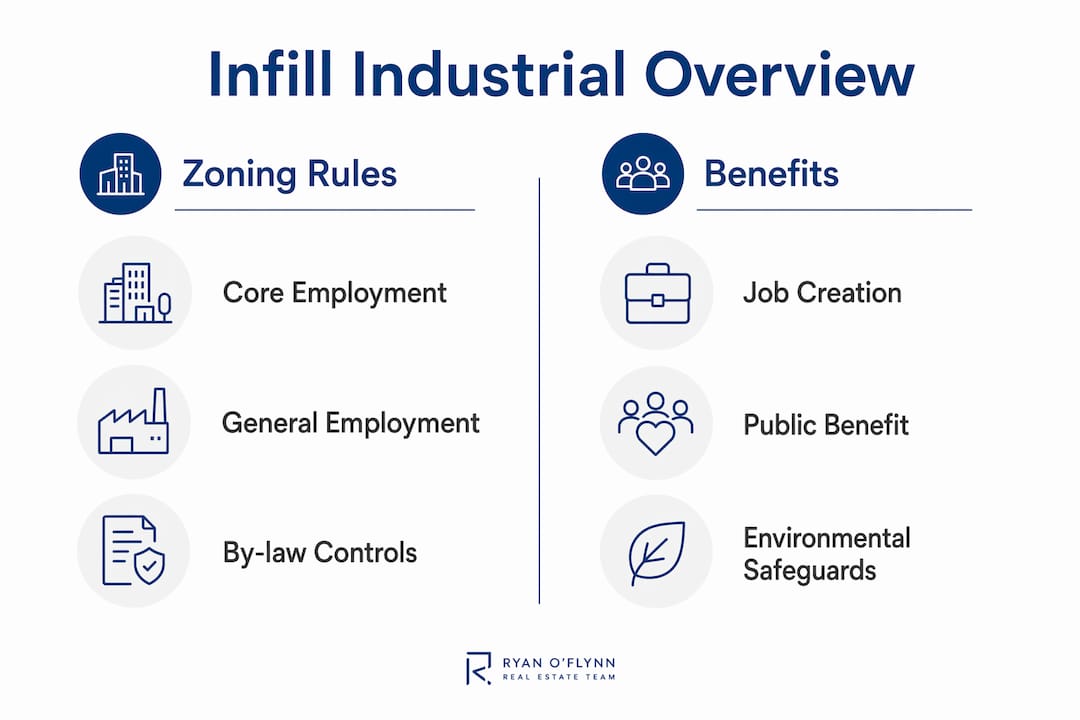
The City’s Official Plan designates industrial land as either Core Employment Areas or General Employment Areas. By-law 1108-2024, adopted October 10, 2024, tightened permitted uses in Core Employment Areas to manufacturing, warehousing and goods movement, associated offices, and research and development connected to manufacturing. Residential uses remain prohibited in Core Employment Areas. The Toronto Industry Network has flagged that proposed Official Plan Amendment 804 could strip industries in converted Regeneration Areas of third-party appeal rights, a material legal risk for any occupier signing a long-term lease on a site near a proposed conversion boundary. Checking industrial zoning status before committing is non-negotiable.
How does infill industrial development affect local jobs and the economy?
Toronto’s employment areas cover a notable portion of the city’s land and generate a significant share of its jobs, according to a City of Toronto staff report. Infill development that retains and intensifies those areas preserves that employment density rather than trading it for housing. Studies comparing brownfield and infill industrial development with greenfield alternatives find measurable net public benefit per hectare, largely from avoided peripheral infrastructure costs and more efficient use of existing roads and utilities.

Environmental considerations specific to Toronto infill sites
Many Toronto infill sites sit near the waterfront, the Don River corridor, or Greenbelt-adjacent ravine systems, which triggers additional environmental review. Brownfield remediation is often a prerequisite, and sites operating under Environmental Compliance Approvals from the Ministry of the Environment must demonstrate that air and noise emissions stay within regulated limits even as sensitive receptors move closer. The ESG implications of brownfield remediation, including soil and groundwater assessment costs, belong in every investor’s pro forma from day one.
Toronto infill industrial projects that show what works
The Port Lands concrete campus at 651 Commissioners Street illustrates both the promise and the tension. CBM Ready Mix operates there under provincial Environmental Compliance Approvals, supplying concrete across the city, yet residential conversion proposals nearby have forced the operator to defend its right to continue. In Scarborough, the New Forest Paper Mill near Scarborough Town Centre, a provider of stable unionized jobs, faces the same pressure after the City approved two condo towers on the adjacent parcel. These cases show that successful infill industrial occupancy depends as much on land-use stability and legal protection as on the building itself. Calvin Lantz of Stikeman Elliott has noted that early stakeholder engagement and formal mitigation planning are what separate operators who survive encroachment from those who are eventually forced to relocate.
Working with Michael Law | Lennard Commercial on infill opportunities
Infill industrial sites can offer genuine value in a market where GTA industrial vacancy sits well below the long-run average of 3.8%. The catch is that the due diligence is harder than on a standard suburban lease. Michael Law and the team at Lennard Commercial guide tenants and investors through exactly that complexity: zoning and land-use stability review, noise and traffic study requirements, EDGE Incentive Program eligibility, and lease terms that protect operational continuity if encroachment pressure grows.
| Factor | Infill / brownfield | Greenfield |
|---|---|---|
| Net public benefit per hectare | Higher (avoided infrastructure) | Lower |
| Travel-cost savings (De Sousa) | — | Baseline |
| Encroachment / conversion risk | Higher | Lower |
| EDGE incentive eligibility | Often eligible | Rarely eligible |
Pro Tip: Require a noise and vibration study, a traffic impact assessment, and a zoning stability review as conditions of any infill lease or acquisition. These studies surface operational constraints before you sign, not after.
For tenants seeking warehouse, distribution, or flex space across Mississauga, Brampton, Vaughan, Scarborough, Markham, Ajax, and beyond, tenant representation through Michael Law | Lennard Commercial means having a broker who knows which corridors carry the lowest conversion risk and which incentive programmes apply to your deal. Reach out directly at mlawrealestate.com to start a site search or due diligence review.
FAQ
What is infill industrial development in Toronto?
It is the construction or rehabilitation of industrial facilities on vacant, underused, or obsolete land within Toronto’s existing urban area, rather than on new greenfield sites outside the city.
Why is industrial infill growing in the GTA?
Zoned and serviced industrial land has dropped below 1,500 acres from over 4,000 acres a decade ago, and the Ontario Greenbelt prevents outward expansion, forcing developers to intensify existing employment lands.
What is the biggest risk for tenants in infill industrial locations?
Residential encroachment and land-use conversion pressure. Since 2020, the City of Toronto has reviewed over 150 requests to redesignate industrial land to residential or mixed-use, which can restrict or displace existing operators.
Does the City of Toronto offer incentives for industrial infill projects?
Yes. The EDGE Incentive Program provides tax-increment equivalent grants for new construction or major rehabilitation of employment space; eligibility depends on minimum gross floor area and investment thresholds.
How can Michael Law | Lennard Commercial help with infill site selection?
Michael Law | Lennard Commercial provides tenant representation, zoning and land-use stability review, and lease negotiation across the GTA, helping occupiers identify infill sites with low conversion risk and favourable lease terms.
Recommended

About Michael Law
Managing Partner and Industrial Real Estate Broker at Lennard Commercial Realty. Representing tenants and landlords across Toronto and the GTA for 15+ years. Michael specializes in GTA industrial real estate — connect with Toronto's leading industrial broker at mlawrealestate.com/industrial-broker-toronto.
Related Articles

More Toronto Industrial Real Estate Insights
Articles & Analysis
Guide to Commercial Property Disposition
Read →How to Reduce Warehouse Vacancy in the GTA
Read →Markham Industrial Rents 2026: Tenant Rep Says Budget C$22 PSF
Tenant focused 2026 Markham industrial rent snapshot from a GTA tenant rep. Expect C$16–22 net and about C$22 gross; negotiation levers, cost checks, and...
Read →Brampton Warehouse Lease Negotiation Tactics
Read →Secure 30–90 Days on Your Fixturing Period Lease in the GTA
Negotiate fixturing period lease terms for GTA tenants: when to raise them, what clause language and tolling to demand, and how to secure 30–90 days.
Read →Common Questions
What is a sale-leaseback in industrial real estate?
A sale-leaseback is a transaction in which an industrial property owner sells their building to an investor and simultaneously signs a long-term lease to remain in the property as a tenant. The seller unlocks the capital tied up in their real estate while retaining full operational use of the facility. The buyer acquires a tenanted investment property with immediate cash flow from a known occupant.
Read →What is a dock-to-grade ratio in industrial real estate?
Dock-to-grade ratio in industrial real estate refers to the number of dock-level loading doors relative to the building's floor area, typically expressed as one dock door per X,000 square feet. It is a key specification for distribution and warehousing tenants because it determines how many trucks can load and unload simultaneously and therefore the building's throughput capacity.
Read →What is clear height in a warehouse or distribution centre?
Clear height in a warehouse or distribution centre refers to the usable vertical space from the finished floor to the lowest overhead obstruction — typically the bottom of the roof structure, sprinkler heads, or HVAC equipment. It is the single most important building specification for warehouse tenants because it determines how many racking levels can be installed and therefore how much product can be stored per square foot of floor space.
Read →