Budget smarter in Milton: industrial rents $14 to $18, broker advice
By Michael Law · Industrial Real Estate Broker, Lennard Commercial Realty
Milton industrial rents currently run about $14 to $18 per square foot net, with vacancy tight enough at roughly 2% to 4% that good space doesn’t sit long. Modern Class A distribution buildings price at the top of that band; older stock and pre-lease deals on new construction can push past $18. Tenants should treat that snapshot as a starting point and confirm current availability before shortlisting.
TL;DR:
- Milton’s industrial rent ranges from $14 to $18 per square foot, with modern buildings and pre-lease deals asking closer to $16 to $18.
- Vacancy remains extremely tight at 2% to 4%, mainly due to large leases and rapid absorption along the 401 corridor.
- Building class and features such as clear height, dock door count, and yard space significantly influence rental prices within the market.
- Availability for large spaces over 100,000 square feet can fluctuate quickly with new deliveries or tenant moves, requiring real-time negotiation.
- Total occupancy cost analysis should include property taxes, CAM, utilities, and TI allowances, not just headline net rent.
Table of Contents
- What is the current Milton industrial rent range?
- What affects Milton industrial rent pricing?
- Where does availability sit by building size?
- How does Milton compare to Mississauga, Brampton, and Toronto?
- How do you evaluate and budget a Milton industrial lease?
- How long does it take to find and occupy space in Milton?
- Michael Law’s perspective: what tenants actually get wrong
- What makes up total occupancy cost beyond base rent?
- Michael Law’s take: the number that matters isn’t the one everyone quotes
- How Michael Law | Lennard Commercial helps Milton tenants lease smarter
- Sources
- FAQ
What is the current Milton industrial rent range?
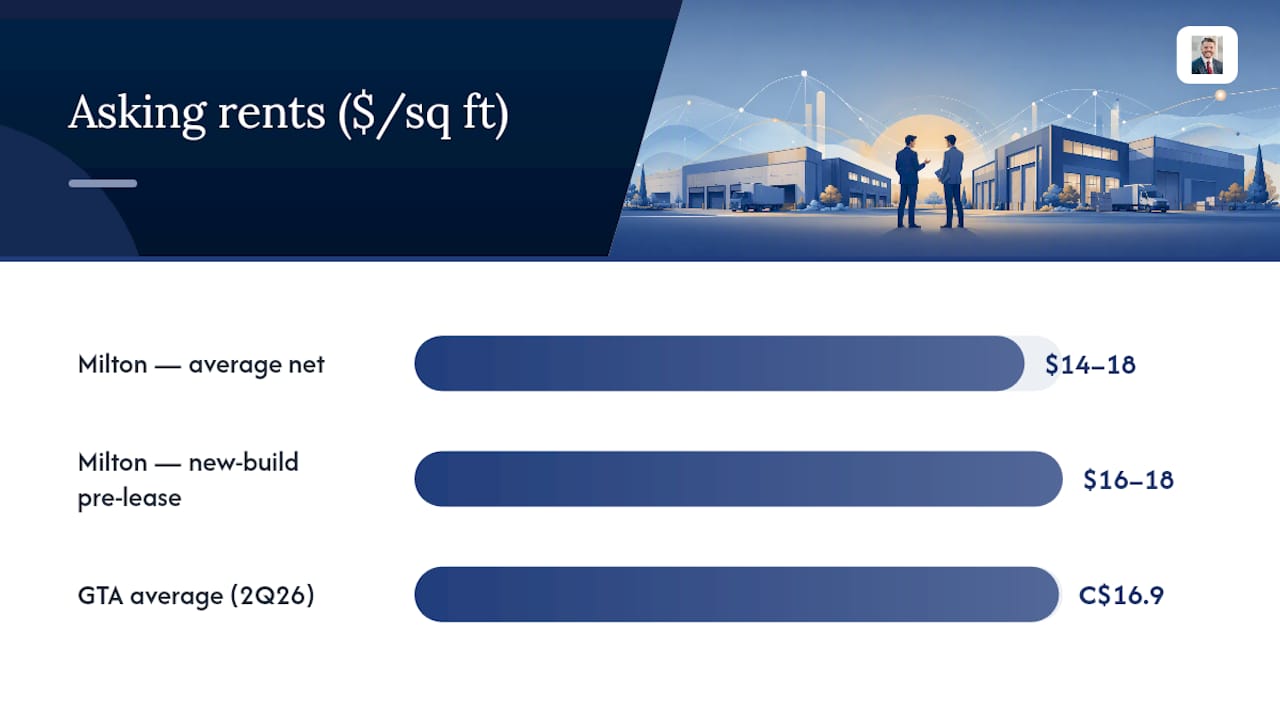
Milton’s industrial market is tighter than most of the GTA, and the numbers back that up. Vacancy sits between 2% and 4%, a range that has held despite a wave of new construction along the 401 corridor. Average net lease rates land at $14 to $18 per square foot, with modern buildings and new speculative product asking closer to $16 to $18 per square foot net once you factor in pre-lease campaigns for buildings still under construction.
Absorption has been unusually lumpy. Halton Region posted strong net absorption in the first half of 2026, driven largely by a single roughly 1.1 million square foot speculative lease in Milton. One deal that size can shift a submarket’s reported vacancy overnight, which is exactly why a single vacancy snapshot can mislead a tenant who is planning a search six months out.
Across the broader GTA, asking rents averaged about C$16.9 per square foot in the second quarter of 2026, putting Milton squarely in line with, and in some cases below, comparable submarkets. WarehouseIndex confirms Milton as one of the fastest-growing submarkets by new supply, concentrated near Highway 401 and Highway 407.
| Metric | Milton figure |
|---|---|
| Industrial vacancy rate | 2% to 4% |
| Average net asking rent | $14 to $18/sq ft |
| New-build pre-lease asking rent | $16 to $18/sq ft |
| GTA average asking rent (2Q26) | C$16.9/sq ft |
Key drivers behind the tightness:
- Concentrated new supply along the 401 and 400/Highway 9 corridors, absorbed faster than expected
- Population growth near 3% annually, feeding local labour and logistics demand
- A small number of very large leases that can distort headline vacancy figures for months at a time
What affects Milton industrial rent pricing?
Not every listing at “$16 a foot” is the same deal. Building class does most of the heavy lifting: legacy Class B and C product, often smaller bay depths and lower clear heights, tends to lease in the lower half of the range. Modern Class A distribution buildings, and new-build pre-lease space, sit at the top, and Lennard Commercial’s own market analysis points to a growing split between the two categories rather than a single blended market.
Specific building features move the number further:
- Clear height above 36 feet commands a premium over older 24 to 28 foot buildings
- Dock door ratio and trailer parking capacity matter more for logistics tenants than square footage alone
- ESFR sprinkler systems are increasingly a baseline expectation, not a bonus
- Wide column spacing and shallow bay depth suit e-commerce and cross-dock operations
- Secure, expansive yard space adds real value for container and trailer storage users
Pro Tip: Always ask whether the quoted rent is net or semi-gross. A $15/sq ft net quote and a $15/sq ft semi-gross quote can differ by several dollars once operating costs are added back in.
Where does availability sit by building size?
Availability varies sharply depending on the size of unit you need. Small bay space under 10,000 square feet is the scarcest category in Milton, since most new construction targets larger footprints and existing small-bay stock rarely turns over. Mid-size units in the 10,000 to 100,000 square foot range have moderate availability, particularly in flex and mid-bay product built in the last decade.
Large-format space above 100,000 square feet is where the market swings hardest. A single speculative building coming to completion, or a single large tenant vacating, can flip that segment from tight to soft within a quarter.
- Under 10,000 sq ft: tightest segment, limited turnover, long waitlists for good units
- 10,000 to 100,000 sq ft: moderate availability, best in mid-bay and flex product
- 100,000+ sq ft: availability swings with individual large leases and speculative deliveries
Tenants chasing large-bay space should ask their broker for a delivery and committed-occupancy schedule rather than relying on a static vacancy number, since one large lease can materially change what’s actually available within a single reporting period.
How does Milton compare to Mississauga, Brampton, and Toronto?
Milton generally undercuts the older, more built-out GTA submarkets on headline rent, though the gap has narrowed as new Milton supply gets absorbed. Mississauga and central Toronto industrial space typically commands a premium tied to proximity and land scarcity, while Brampton often runs close to Milton, sometimes slightly higher depending on product age, as covered in this Brampton warehouse rent analysis.
| Submarket | Typical net asking rent |
|---|---|
| Milton | $14 to $18/sq ft |
| Brampton | Comparable to slightly above Milton |
| Mississauga | Generally above Milton, tighter land supply |
| GTA average (2Q26) | C$16.9/sq ft |
Property taxes and development charges also shift the total picture. Milton’s newer building stock generally carries higher assessed values than older Mississauga or Toronto industrial parks, which can offset some of the headline rent savings once taxes are layered on. Milton tends to win on cost and access to large contiguous employment lands; Mississauga and Toronto still win on proximity to port and downtown-adjacent labour pools.
How do you evaluate and budget a Milton industrial lease?
Every offer needs to be checked against the same list before you compare it to another. Confirm each of these in the letter of intent:
- Whether base rent is quoted net, semi-gross, or gross, and what that includes
- Operating costs and common area maintenance, itemized rather than bundled
- Property tax allocation and whether it’s estimated or based on current assessment
- Utility metering, especially separate metering for gas and hydro
- Responsibility for structural repairs, roof, and HVAC replacement
- Tenant improvement allowance and how unused funds are treated
- Lease term length, renewal options, and rent escalation schedule
Negotiation room in Milton right now typically comes through tenant improvement dollars, short rent-free periods during fit-out, and phased occupancy for tenants moving from an existing facility. Landlord-funded upgrades to loading infrastructure are also on the table for larger, longer-term deals.
Pro Tip: Convert every TI allowance into an effective rent figure over the full lease term before comparing two offers side by side, as outlined in this leasing strategy guide. A generous TI package on a short term can cost more per year than a smaller one on a longer lease.
A quick worked example: a 50,000 square foot space quoted at $16/sq ft net, with additional rent (taxes, CAM, insurance) around $5.2 to $5.3/sq ft, lands total occupancy cost near $21.30/sq ft, or roughly $1,065,000 annually before utilities and insurance.
How long does it take to find and occupy space in Milton?
Finding the right building starts with the right channels. Brokerage listings and direct outreach to owners of Milton’s employment lands cover most available product; the sublease market is smaller but worth checking for shorter-term or below-market opportunities.
- Shortlist and site tours: two to four weeks once search criteria are set
- Letter of intent and negotiation: three to six weeks, longer for large-format deals
- Lease documentation and conditions: two to four weeks
- Fit-out and move-in: six weeks to several months, depending on scope
Tenants working without representation often lose weeks simply finding out which listed spaces are still genuinely available. Engaging a tenant representative early gives access to off-market and pre-lease opportunities and someone negotiating solely on the tenant’s side of the table.
Michael Law’s perspective: what tenants actually get wrong
The tenants doing best in Milton right now are logistics operators and mid-size manufacturers who move fast on shortlisted space rather than waiting for a “perfect” listing. Large-format distribution users benefit most from the new supply along the 401 corridor, but they’re also the ones most exposed when a single big lease tightens the market overnight.
The most common pitfall is treating headline rent as the whole story. I’ve seen deals that looked cheaper on paper cost more annually once taxes, CAM, and a thin TI package were factored in.
What makes up total occupancy cost beyond base rent?
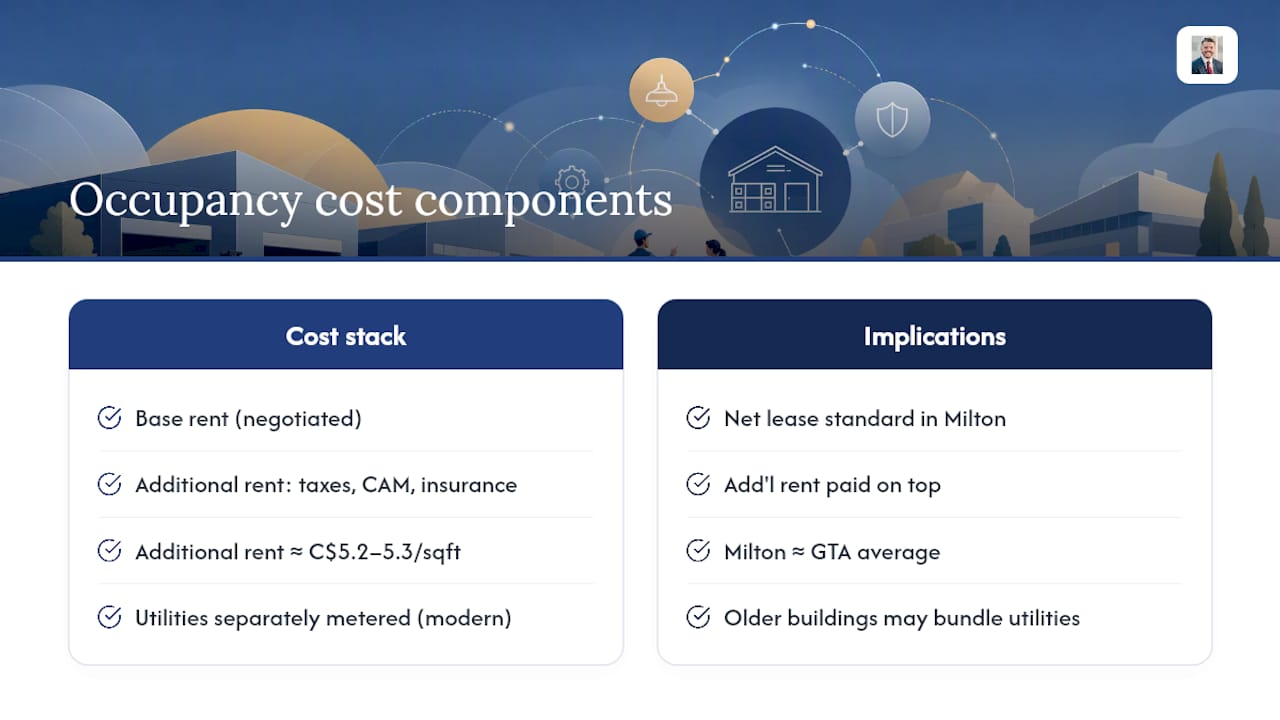
Base rent is only part of what a tenant actually pays each month. In a net lease, which is standard for Milton industrial space, the tenant also covers property taxes, common area maintenance, and building insurance as “additional rent” on top of the negotiated base figure. Across the GTA, additional rents averaged roughly C$5.2 to C$5.3 per square foot as of mid-2026, and Milton generally tracks close to that figure.
Utilities are typically separately metered in modern Milton buildings, which means the tenant pays actual consumption for gas and hydro rather than a landlord estimate. Older buildings sometimes bundle utilities into gross rent, which can hide real cost swings during winter months when heating a large warehouse gets expensive fast.
Common area maintenance covers snow removal, landscaping, parking lot repairs, and shared security, and it’s usually reconciled annually against a landlord estimate collected monthly. A 10 to 15 percent variance in gross occupancy cost between two seemingly similar buildings is common once these line items are compared properly, which is why the net rent figure alone should never be the deciding factor.
Tenants comparing multiple offers should ask for a full CAM and tax history for each building, not just a current-year estimate, since a newly assessed property or a building coming off a tax appeal can see costs jump the following year.
Michael Law’s take: the number that matters isn’t the one everyone quotes
Most tenants shopping Milton fixate on the net rent figure and stop there. That’s backwards. The rent range of $14 to $18 per square foot tells you almost nothing about what a lease will actually cost until you’ve priced the additional rent, confirmed the utility metering setup, and modelled the TI allowance as an effective rent over the term.
The conventional advice, “find the cheapest net rent,” falls apart the moment you compare an older building with bundled utilities against a modern one with separate metering and a stronger TI package. I’d rather see a tenant pay $17/sq ft net for a building with a clean tax history and a fair CAM structure than $15/sq ft for one with unpredictable annual reconciliations.
What tenants should prioritize first is a full occupancy cost comparison across every shortlisted building, done before any letter of intent goes out. Rent is negotiable. A messy CAM structure or an underpowered electrical service usually isn’t, at least not without real capital cost.
— Michael Law
How Michael Law | Lennard Commercial helps Milton tenants lease smarter
Finding the right Milton industrial space usually comes down to who sees the listing first and who negotiates it best, not just who searches the hardest. Tenant representation services work exclusively for tenants to advocate in negotiations, aiming to secure favorable terms for occupiers.
The process starts with a market review of current Milton availability, including off-market and pre-lease opportunities that never make it to a public listing site. From there, the team builds a shortlist matched to clear height, dock configuration, and yard requirements, then handles negotiation and lease documentation through to fit-out. For businesses already scoping Milton specifically, the Milton industrial real estate page has current local conditions; for a broader search across the GTA, the tenant representation team can start a confidential search today.
Sources
Figures in this guide draw on the Milton commercial appraisal data from Aion Appraisals, the Newmark Q2 2026 Toronto industrial market report, the WarehouseIndex GTA overview, and Statistics Canada business counts.
- Milton Commercial Appraisal | AACI Certified Ontario
- Industrial Market Overview (Newmark Q2 2026)
- The great decoupling: industrial real estate leasing (Lennard Commercial insights)
- GTA industrial market overview 2026 | WarehouseIndex
FAQ
Why is Milton, Ontario so expensive?
Milton’s costs reflect strong population growth, near 3% annually, combined with limited serviced employment land and heavy demand from logistics and distribution users along the 401 corridor.
Is Milton expensive to live and do business in?
Milton runs above average for the GTA on both housing and industrial rent, driven by the same growth pressure, though industrial rents at $14 to $18 per square foot net remain competitive against Mississauga and Toronto.
How much does it cost to rent a warehouse in Ontario?
Costs vary widely by submarket, but Milton industrial rents currently run $14 to $18 per square foot net, compared with roughly C$16.9 per square foot as a GTA average in 2026.
Is there a standard commercial lease in Ontario?
There’s no single mandatory lease form for industrial space in Ontario; most landlords use their own net lease templates, which is why reviewing base rent structure, CAM, and tax allocation line by line matters more than assuming standard terms apply.
When should I bring in a tenant representative for a Milton search?
Engaging representation early, ideally before touring space, gives access to off-market and pre-lease opportunities and ensures negotiation is handled solely in the tenant’s interest, which Michael Law | Lennard Commercial provides for GTA occupiers.
Recommended

About Michael Law
Managing Partner and Industrial Real Estate Broker at Lennard Commercial Realty. Representing tenants and landlords across Toronto and the GTA for 15+ years. Michael specializes in GTA industrial real estate — connect with Toronto's leading industrial broker at mlawrealestate.com/industrial-broker-toronto.
Related Articles

More Milton Industrial Real Estate Insights
Articles & Analysis
Industrial Property Taxes Owners Need to Plan For
Read →GTA industrial leasing process: a 2026 broker's guide
Discover what is GTA industrial leasing process in our 2026 broker's guide. Learn the steps to secure and occupy your ideal industrial space.
Read →Why Toronto suits urban logistics tenants in 2026
Discover why Toronto suits urban logistics tenants in 2026. With unmatched reach and a dense population, it’s the ultimate logistics hub.
Read →How to Find the Best Commercial Property for Sale
Read →Warehouse for Sale: How to Buy With Confidence
Read →Common Questions
What is clear height in a warehouse or distribution centre?
Clear height in a warehouse or distribution centre refers to the usable vertical space from the finished floor to the lowest overhead obstruction — typically the bottom of the roof structure, sprinkler heads, or HVAC equipment. It is the single most important building specification for warehouse tenants because it determines how many racking levels can be installed and therefore how much product can be stored per square foot of floor space.
Read →What is a build-to-suit industrial lease?
A build-to-suit industrial lease is a transaction where a developer or landlord constructs a new industrial building specifically to a tenant's requirements — custom specifications, layout, clear height, dock configuration, and site features — in exchange for a long-term lease commitment from the tenant, typically 10 to 15 years. The tenant gets a purpose-built facility without the capital cost of ownership; the developer recovers their construction investment through the lease.
Read →What does triple net (NNN) mean in a commercial lease?
A triple net (NNN) lease means the tenant pays base rent plus three additional cost layers: property taxes, building insurance, and maintenance/operating costs. In GTA industrial real estate, virtually all leases are structured as triple net — the landlord collects a fixed net rent and passes all operating expenses through to the tenant, either as direct charges or as a proportionate share of the building's total operating costs. Understanding what is and is not included in the operating cost pool is one of the most important aspects of industrial lease negotiation.
Read →